
All posts by A Scotsman in Suburbia

I am not a Grumpy Old Man I am a middle aged man who occasionally gets slightly hacked off with things. My politics are greenish and to the left of centre. I am married again, following being widowed. I own two bikes, one car, one campervan and half a cat. I love cycling (hence the bikes) and cycle sport especially road racing. During the winter I enjoy watching football (soccer if you are North American). I sometimes paint and enjoy cooking and eating.

If you get the X-Factor you will get AV

Johann Hari reckons that if you can get the voting system of the X-Factor you will get AV .This is absolutely correct. The X-Factor works on a form of AV. If your favourite was voted out this week, then you are perfectly free to vote for your next favourite singer next week. If you hate all of the remaining artists you are perfectly free not to vote. The only real difference being that you can buy as many votes as you want/can afford. (I’m sure that introducing this idea into national elections has occurred to at least some members of the Tory party)

Later on in the piece he makes this comment:

All this is a shame, because there is a real criticism of AV that has gone unheard. It’s that it doesn’t go nearly far enough. Nick Clegg once called it “a miserable little compromise”, and there’s some truth in that. Sauced with plenty of irony, AV wouldn’t be my first preference.

Let me explain. In Britain today, we have a centre-left majority who want this to be a country with European-level taxes, European-standard public services and European-level equality. We have had this for a very long time. Even at the height of Thatcherism, 56 per cent of people voted for parties committed to higher taxes and higher spending. But the centre-left vote is split between several parties – while the right-wing vote clusters around the Conservatives. So under FPTP they get to rule and dominate out of all proportion to their actual support, and drag most of us in a direction we don’t want to go. That’s why the Tories are united in supporting the current system, and throwing a fortune at preventing any change.

He is completely correct, AV doesn’t go nearly far enough.Johann would have us adopt AV+ whereas I would prefer STV. But we will save our differences on that until next time.

At the moment we are both agreed that the important thing is to win the referendum on May 5th, because defeat will consign any hope of voting reform to the dustbin for a generation.

Forget about the co-option of Labour dinosaurs like John Reid and Margaret Beckett, the No to AV campaign is a Tory campaign, funded by large amounts of Tory money. The are fighting AV because the know that there is no way that they can ever command a true majority of the vote, but want to be able to rule the country with 40% or less of the electorate supporting them
The No to AV campaing claims AV will cause spoilt Ballot Papers

The Evening Standard published a story on 7th April claiming that adopting the Alternative Vote (AV) will lead to more ballot papers being spoiled

Adopting the Alternative Vote (AV) for Westminster elections is likely to lead to more spoilt ballot papers and lower turnout, campaigners against reform claimed today.

No to AV published research highlighting the “damaging” effects of the relative complexity of AV compared with the existing first-past-the-post system.

It suggested that elections in which AV was used had higher rates of accidentally spoilt papers and fewer people taking part.

Completing the AV ballot paper is I must admit slightly more complex than completing a First Past The Post ballot paper. It does require that you can count up to, probably about twelve at a maximum  and recognise the numbers and write the appropriate numbers. Now most five-year old kids can manage to count and write the numbers up to ten, so hopefully by the time they get to voting age they will have added to their repertoire.

The fact that we have been electing the Mayor of London using AV for the past three Mayoral elections without too much drama does not appear to have occurred to the writer, but never mind don’t let the facts get in the way of a story.

The custom of putting an ‘X’ in the box alongside the name of our favoured  candidate is presumably two-fold, to ensure that the illiterate were not disenfranchised*, and  to reduce the possibility of the voter being identified**.  However working on the theory that complete illiteracy is less common than in the 1880’s I hope that the vast majority of the electorate can count up to twenty, even if the ‘No to AV campaign’ have to take their shoes and socks of to do it.

It should also be pointed out that there is no need to use your Alternative Vote, if you only want to acknowledge the Tory candidate put your 1 in his or her box and leave the others blank. In fact if only one candidate was being ranked , I’m fairly sure that the returning officer would accept an ‘X’ in that box as being a valid vote.


* How they knew who they were voting for I don’t know.

** If the powers that be want to know how you voted, believe me they can find out – those numbers on your ballot paper aren’t just to help them count how many have been used.

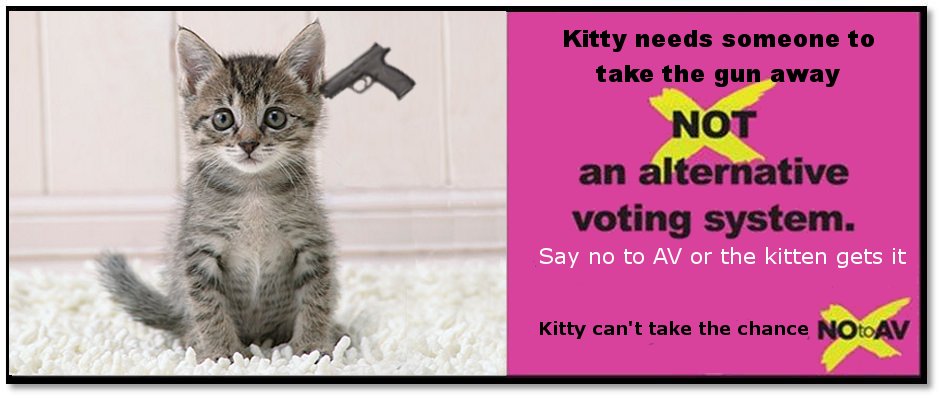
A new poster for the No to AV Campaign

I think this sums up most of the arguments of the No to AV mob.

Vote no or the kitten gets it

The Alternative Vote system is not perfect, but it does ensure that the winning candidate has the approval to a greater or lesser extent of at least 50% of the electorate. The current system allows a candidate to be elected with the approval of as little as 30% of their constituents.

Dark Skies

I grew up on a farm in the Scottish Borders. The nearest house to the one we lived in was about quarter of a mile away, the nearest town was about seven miles away and the nearest city about fifty miles away. When I went outside on a clear moonless night I have no idea how many stars I could see. Above me the of the universe was on display. Later in life I earned my living at sea. Sitting on the fo’c’sle on a warm tropical night looking up at the strange – to northern eyes – stars of the Southern Hemisphere is a memory I will always cherish. Now I live in the South London suburbs, I once counted the stars I could see on a clear moonless night. There were 42 visible. Where have all the stars I marvelled at in my youth gone. They are all still there. But our insistence that there be no difference between daylight and night drowns them out.
About two weeks ago we observed Earth Hour. We switched our lights off at 20:30, and discovered that with the light from the street lights at the front of the house, and our neighbour’s ‘security’ (as in blanket) light at the back, there was enough light, if not to read by, but to do most things.
Read On

Music to make you cry

This was the Guardians third leader today.

In praise of… music to make you cry .

There was also an article in the g2 section here. Various contributors suggest music that makes them cry with suggestions that go from Bach to ‘Bonny’ Prince Billy, via Kylie Minogue and Steve Earle.
One contribution, included because I like the song, even if it doesn’t make me cry:

Goodbye – Steve Earle
As a member of MP4 (a rock band made of MPs) I’ve often reduced people to tears, though not necessarily for the right reasons. Being half-Irish and half-Welsh, I’m a bit of a sucker for sentimental music. I’m a big fan of Earle, and especially Goodbye, which is a spare, pared-down song about a love affair in Earle’s lost years. Halley Came To Jackson by Mary Chapin Carpenter is another corny song that never fails to move me.
Kevin Brennan, Labour MP and MP4 guitarist

For what it is worth this is the song that always does it for me. There is something about Luke Kelly’s phrasing that brings out the poignancy of Patrick Kavanagh’s lyrics that always gets me.

Ronde Van Vlaanderen

The Ronde Van Vlaanderen  (Tour of Flanders if you don’t speak Flemish or Dutch) takes place tomorrow. It is one of my favourite races of the year. One of the reasons that I like it so much is that it very rarely throws up a lucky winner. The combination of cobbles and short very steep hills almost always seems to ensure that the strongest rider wins.

To give you a taste of what is to come here is Fabian Cancellara winning last years race. The commentary is in Flemish, which I think adds to the atmosphere.

It is easy to see how the (false) rumour that he had an electric motor hidden in his down tube started when you watch him attack on the Kapelmuur.  The rider in the Belgian Champions Jersey that he leaves for dead is Tom Boonen.

I got quite excited last year because for a little while I thought there was a possibility of the first British winner since Tom Simpson. David Millar made a strong attempt to get across to Boonen and Cancellara on the run to the Muur van Geraardsbergen and for a while it looked as if he might make it, but he didn’t quite have the legs. There are a couple of shots where the camera flicks back to the chasers. He is the rider being dropped.

As for this years race, if you have put your money on any one to win it has to be Cancellara. He was impressive last weekend winning the E3 Prijs Vlaanderen – Harelbeke, and it is difficult to see past him. Thor Hushovd is more focused on next weekend’s Paris-Roubaix which he has already stated that he would love to win while wearing the Rainbow Jersey. Phillipe Gilbert, while not without a chance, is probably building his form to peak for Liège-Bastogne-Liège where he has a better chance to win.

However, impressive as Cancellara was winning last weekend, Tom Boone was as impressive winning Gent-Wevelgem last Sunday. I’m not saying he will win, but he has form, and being Flemish, he will always be up for it.

So tomorrow it will all be played out on the 256 km road to Meerbeke. Unfortunately I can’t be where I would like to be, near the top of the Kapelmuur, so I will have to see if I can find a live feed on the internet instead.

I will be drinking Belgian Beer for the duration of the weekend to help with generating the proper ambience.

I am glad to see that The Guardian agrees with me

The Guardian has backed up what I wrote about porridge in a post last year.

Porridge is one of those dishes which, made well, can be ambrosial, as the French heroine of that wonderful film Babette’s Feast proved when she transformed the grim sludge that the Danes call øllebrød, a kind of rye porridge, into a delightful morning treat. Her porridge began the process of spiritual renewal through good food which transformed the life of the remote Danish village to which she had been exiled.

Couldn’t have said it better if I had tried.

Voting Reform – Party Lists

Party lists in theory should give almost perfect proportionality in the result of any election. The theory behind the system goes something like this:

  • Almost everyone votes for the party they support rather than the individual candidate
  • Instead of having individual constituencies why not just have a regional (or national) poll in which you cast your vote for your party of choice.
  • Add all the votes up and allocate the number of seats to each party based on the percentage of the vote obtained.
  • The parties then allocate the seats to MPs based on a list they have drawn up, normally with the party leader as the first person selected.

This is about as pure a form of proportional representation as you could wish for. If Labour get 30% of the vote they get 30% of the MPs. If the Green Party get 8% of the vote they get 8% of the MPs and so on. However there is one big snag with Party Lists – we don’t get to choose the people who represent us, the parties choose the people who represent us. The system can be made fairly transparent, but it still boils down to voting for a party and getting the representatives they choose in the order that they want them selected (presumably starting with the party leader).

The system is used in a modified form for the Scottish Assembly where it is known as the Additional Member System. There the majority of the members are elected by a First Past The Post system in individual constituencies. The electorate then has a second vote on a regional basis. The total number of seats in the Parliament are allocated to parties proportionally to the number of votes received in the second vote of the ballot using the d’Hondt method. For example, to determine who is awarded the first list seat, the number of list votes cast for each party is divided by one plus the number of seats the party won in the region (at this point just constituency seats). The party with the highest quotient is awarded the seat, which is then added to its constituency seats in allocating the second seat. This is repeated iteratively until all available list seats are allocated.

This is not as you may have gathered a method of electing our representatives that I like. The two main reasons for my dislike of the system are:

  • It breaks the link between the representative and the represented. We would no longer cast our vote either directly or indirectly for a person. Our vote goes to the party.
  • The MP’s loyalty needs to be toward his or her party, because it is the party that now decides whether they as individuals will be elected, not the voters. This is because the higher you are on your party’s list the greater you chances of being elected.

There is an argument for using this system as a top up to either FPP or AV (sometimes known as AV+) but I feel that this produces a two tier parliament, with some MPs directly elected and a rump beholden to their party bosses for their seats.

Earth Hour 2011

Earth Hour is on Saturday 26 March  from 20:30 to 21:30.  It is one of those things that can easily be dismissed as futile gesture politics. After all, what earthly difference is switching all your lights off for an hour going to make?

Well, hopefully the commitment you make by turning your lights (and televisions and computers) off for an hour will help to solidify in you the knowledge that you can make a difference to the world, and that the choices you make will have an effect on this world. Turning your lights off, or leaving every light in the house on, is your choice to make. Just as most other things in life are your choice to make. It is your choice as to whether you walk to the shops to buy a loaf of bread, or get the car out for a two-minute journey. You can make choices every day that will affect the future of the planet for good or ill.

Turning your lights off for an hour is an easy choice to make, but hopefully it will help you when the more difficult choices come along.

And if we all turn all our lights off, including the street lights, we might even get to see the stars.

Measure twice cut once..

Measure twice cut once is a good engineering principle which should have been applied (if slightly adapted) in this case.

I stole it from Nick Baine’s blog, but I’m sure you will agree that it is worth passing on.

Oh dear… « Nick Baines’s Blog.