All posts by A Scotsman in Suburbia

I am not a Grumpy Old Man I am a middle aged man who occasionally gets slightly hacked off with things. My politics are greenish and to the left of centre. I am married again, following being widowed. I own two bikes, one car, one campervan and half a cat. I love cycling (hence the bikes) and cycle sport especially road racing. During the winter I enjoy watching football (soccer if you are North American). I sometimes paint and enjoy cooking and eating.

I am glad to see that The Guardian agrees with me

The Guardian has backed up what I wrote about porridge in a post last year.

Porridge is one of those dishes which, made well, can be ambrosial, as the French heroine of that wonderful film Babette’s Feast proved when she transformed the grim sludge that the Danes call øllebrød, a kind of rye porridge, into a delightful morning treat. Her porridge began the process of spiritual renewal through good food which transformed the life of the remote Danish village to which she had been exiled.

Couldn’t have said it better if I had tried.

Voting Reform – Party Lists

Party lists in theory should give almost perfect proportionality in the result of any election. The theory behind the system goes something like this:

  • Almost everyone votes for the party they support rather than the individual candidate
  • Instead of having individual constituencies why not just have a regional (or national) poll in which you cast your vote for your party of choice.
  • Add all the votes up and allocate the number of seats to each party based on the percentage of the vote obtained.
  • The parties then allocate the seats to MPs based on a list they have drawn up, normally with the party leader as the first person selected.

This is about as pure a form of proportional representation as you could wish for. If Labour get 30% of the vote they get 30% of the MPs. If the Green Party get 8% of the vote they get 8% of the MPs and so on. However there is one big snag with Party Lists – we don’t get to choose the people who represent us, the parties choose the people who represent us. The system can be made fairly transparent, but it still boils down to voting for a party and getting the representatives they choose in the order that they want them selected (presumably starting with the party leader).

The system is used in a modified form for the Scottish Assembly where it is known as the Additional Member System. There the majority of the members are elected by a First Past The Post system in individual constituencies. The electorate then has a second vote on a regional basis. The total number of seats in the Parliament are allocated to parties proportionally to the number of votes received in the second vote of the ballot using the d’Hondt method. For example, to determine who is awarded the first list seat, the number of list votes cast for each party is divided by one plus the number of seats the party won in the region (at this point just constituency seats). The party with the highest quotient is awarded the seat, which is then added to its constituency seats in allocating the second seat. This is repeated iteratively until all available list seats are allocated.

This is not as you may have gathered a method of electing our representatives that I like. The two main reasons for my dislike of the system are:

  • It breaks the link between the representative and the represented. We would no longer cast our vote either directly or indirectly for a person. Our vote goes to the party.
  • The MP’s loyalty needs to be toward his or her party, because it is the party that now decides whether they as individuals will be elected, not the voters. This is because the higher you are on your party’s list the greater you chances of being elected.

There is an argument for using this system as a top up to either FPP or AV (sometimes known as AV+) but I feel that this produces a two tier parliament, with some MPs directly elected and a rump beholden to their party bosses for their seats.

Earth Hour 2011

Earth Hour is on Saturday 26 March  from 20:30 to 21:30.  It is one of those things that can easily be dismissed as futile gesture politics. After all, what earthly difference is switching all your lights off for an hour going to make?

Well, hopefully the commitment you make by turning your lights (and televisions and computers) off for an hour will help to solidify in you the knowledge that you can make a difference to the world, and that the choices you make will have an effect on this world. Turning your lights off, or leaving every light in the house on, is your choice to make. Just as most other things in life are your choice to make. It is your choice as to whether you walk to the shops to buy a loaf of bread, or get the car out for a two-minute journey. You can make choices every day that will affect the future of the planet for good or ill.

Turning your lights off for an hour is an easy choice to make, but hopefully it will help you when the more difficult choices come along.

And if we all turn all our lights off, including the street lights, we might even get to see the stars.

Measure twice cut once..

Measure twice cut once is a good engineering principle which should have been applied (if slightly adapted) in this case.

I stole it from Nick Baine’s blog, but I’m sure you will agree that it is worth passing on.

Oh dear… « Nick Baines’s Blog.

Voting Reform – First Past The Post

First Past The Post (FPP) is the system of electing our MPs, and, in England at least, most of our other elected officials. How it works is simple to understand. You are presented with a list of candidates and you put your “X” against the one you dislike the least. After the polls close the votes are counted and the person with the most votes wins. Dead simple, your dog could understand it, so why don’t I like it?

The first reason that I don’t like FPP is that it wastes my vote and thousands of other people’s votes. Where I live, in the area of South London that has Surrey as its postal address, if I vote the way I would naturally, for the Labour Party, my vote is wasted, it has no effect on the result of the election because it is completely outweighed by the Lib Dems and the Tories.

My guess is that roughly 25% of the population, in this area, would normally support the Labour party, about 35% would normally vote Tory and a slightly lesser percentage vote Lib Dem, with the remainder voting UKIP, Green and etc. So one in four of the local constituencies should have a Labour MP, err no…. Either Tory or Lib Dem. Strangely enough the current system probably means that the Lib Dems are over represented in this area due to a lot of Labour and Green supporters voting for them to try to keep the Tories out.

The second reason that I am against FPP is that it creates safe seats, where as the saying goes you could put a pig up as candidate and providing it was wearing the right colour rosette it would be elected. I know much has been written in the past day or two about the demise of the Liberal Democrats in the Barnsley by-election, but it does not disguise the fact that only Labour could win there, and that the winning candidate Dan Jarvis now has a job for life if he wants it. Unless of course he finds himself with  same accounting problems that his predecessor encountered. And again how many votes were wasted in this election? I would argue that every vote cast for a candidate other than the winner was wasted and about half the votes that were cast for him. The turn out for the by-election was 36.5% – roughly two-thirds of eligible voters stayed at home. Why? a wet and cold Thursday in early March probably did not help, but largely they stayed at home because the outcome was certain and they felt that it wasn’t worth the effort of going to the polling station.

If we want – and almost every politician of every hue say they want it – increased voter participation then we need an electoral system that makes every vote count for some thing.

The third reason that I am against FPP is that it encourages, even demands, tactical voting. In a two-way marginal seat, the supporters of the minority parties are almost obliged to vote against the candidate they like least, rather than voting for the candidate they like best. This depresses the vote of the minority parties and reduces their voice in the public square. For example at the last general election the green candidate for my constituency was a friend, and while my political leanings tip slightly more toward red than green, under any sensible voting system I would have voted for him, knowing that he would be unlikely to be elected in a single constituency vote, but knowing also that my vote is not wasted as my second and third preference votes, will still count if he is eliminated. This would give not only a fairer system of voting but also a clearer picture of the actual level of support for political parties. What happened in reality, I voted Liberal Democrat in the hope of keeping the Tories out. Which it did in this constituency, but for all the practical good it did the country, I would have been better voting Green.

The fourth reason I am against FPP is that it allows single party majority governments to be formed with considerably less than 50% of the votes cast, let alone the votes of 50% of the electorate at large. Even at its peak in 1997 Labour won 63% of the seats with only 43% of the votes cast. Admittedly the current coalition government took about 59% of the popular vote between the two parties, but this is genuinely the exception that proves the rule.

My conclusion about First Past The Post, it is better than no vote at all, but it is time that we ditched it in favour of a more democratic system that allows all voices to be heard and not just the biggest and loudest ones.

Chickpea and Cauliflower Curry

(from a Michelin Starred Chef)

I found this recipe by Angela Hartnett in last weeks Guardian. She has been publishing a series of quick and easy dishes that are described as Angela Hartnett’s midweek suppers. This is the first one I have tried, not so much because I didn’t like the look of the others, it is just that this was the first vegetarian dish in the series. I decided to make it for lunch today. My Veggie Wife thoroughly approves of it and so do I. It is dead simple to make. All the ingredients should be available at your local supermarket, if you don’t already have them in your cupboard.

I served it with naan bread (bought from Tesco’s) and a slightly chilled Hook Norton Bitter

I’ve included the ingredients and the method below.

Ingredients

(Serves four to six)

1 whole cauliflower
3 medium onions
4 cloves of garlic
½ tsp chopped fresh ginger
2 tsp ground coriander
2 star aniseed
½ tsp ground chilli
4 curry leaves
2 tsp garam masala
2 tsp ground cumin
1 tin of chopped tomatoes
1 tin of chickpeas*, drained
2 tbsp of chopped fresh coriander

Method
Remove the stalks from the cauliflower and cut into large florets. In a pan of boiling water, add the cauliflower and cook for five minutes. When ready, drain from the water and place back in the pan. Cover so it stays warm.

While the cauliflower is cooking, cut the onions into small pieces. Squash the garlic with the back of a knife to make it easier to peel. Chop until nice and fine.

In a pan, add a touch of butter, plus the onion, garlic and ginger, and sauté until golden brown.

In the same pan, add the dried spices and cook for a further five minutes.

Add the tin of tomatoes and  chickpeas and stir well. Then add the cooked cauliflower. Top up with 100ml of cold water and bring to a simmer for five to 10 minutes until the cauliflower is cooked.

Finish by adding the chopped  coriander. Serve on a warm plate.

*garbanzo beans if you are American.

Love Wins

Rob Bell’s new book ‘Love Wins’ seems to have stirred up an awful lot of controversy for a book that no one has read as yet (it’s not published until the end of March). It seems that some Calvinist/Reformed thinker/theologian in the United States saw the promotional video

and declared Rob Bell to be an Universalist. Some other deep thinker managed to sum everything up in a tweet; And a perfect storm arose in the blogo-twittersphere, or at least the Calvinist/Reformed micro-segment of it. Question, if you can sum a 300? page book up in a tweet, how come your sermons take so long?

Harvey Edser has been blogging on the theme of Universalism on and off for the past few weeks and covers it in greater depth than I could. Maggie Dawn and Fred Clarke – in two posts deal with the controversy and defend Rob Bell much more eloquently than I could so I will just point you in that direction.

All I want to say is watch the video I don’t think he says anything particularly evil, and if you are interested buy the book when it comes out. It will probably be, for a theological book  a good read, because it will have a narrative. If  nothing else, Rob Bell can tell a story and I think that makes all the Calvinist/Reformed thinkers and sitters in ivory theological seminaries jealous.

More Voting Reform – Single Transferable Vote (STV)

Anyone who has been reading my posts  on voting reform (if anyone has been reading them apart from possibly Grace) they will probably have noticed that I am trying to work out what I think  about it.

I am convinced that our current first past the post system is not good for democracy in the long, or even the short-term. I am not quite so sure what to put in its place, hence the series of posts.

“I am convinced that our current first past the post system is not good for democracy in the long, or even the short-term.”

This time I am going to look at the voting system known as the Single Transferable Vote (referred to from now on as STV to save typing). This is the system that has caught my imagination the most.

I’ll explain how I think it works, then look at the advantages and disadvantages of the system.

The STV is based on the idea of proportional representation and preferential voting. Initially your vote is cast for the your preferred candidate and then after candidates are either elected or eliminated, transferred to other candidates in line with the your stated preferences. The system minimises ‘wasted’ votes. You are also voting for individual candidates rather than party lists.

How it works

STV works by using multi-member constituencies. As with all alternative vote electoral methods, you rank the candidates in order of preference, 1 to however many candidates you care to vote for. You do not have to cast a preference for a candidate that you abhor. So you just number your preferences 1 to 11 and leave the twelfth candidate out. In the event of your preferred candidates being eliminated or elected your vote will not be transferred to them.

Candidates are generally elected using the following formula:

So in a constituency that elects 6 members, if there were, say 150,000 valid votes cast, each elected candidate would need to get 21,430 votes to be elected.

After you have cast your vote the system works like this:

All the First preference votes are counted, one candidate has 30,000 votes and is elected, but none of the others have enough first preference votes to get over the electoral thresh old. Candidate one has 8,570 surplus votes, so they are distributed among the remaining candidates according to the second preferences of the voters.

The votes are counted again and still no candidate reaches the magic figure, so the candidate with the lowest number of votes is eliminated and his or her second preference votes are redistributed among the other candidates. This process goes on until all the vacant seats are filled.

Ireland uses this system for its elections and if you want to see how this works in practice look at the results for the Dun Laoghaire Constituency in Ireland’s 2007 Elections.

The Electoral Reform Society has an example of a model STV Election here

Advantages

STV gives us as voters much more choice than any other system. We determine who is going to be elected. Under the current system part officials, especially in ‘safe’ seats, essentially decide who our MP will be long before we get a chance to vote. Under STV MP’s responsibilities will be more to the people who elected them than to their parties.

  • Fewer votes are ‘wasted’, either by being cast for a candidate with little or no chance of being elected, being cast as surplus votes for a winning candidate.  What this means is that most, if not all, voters will be able to identify representative that they helped to elect. This link in turn helps to increase the representatives accountability.
  • Post election STV gives voters a choice of representatives to approach with their concerns, rather than just the one, who may be indifferent or actively opposed to the concerns of the voter. Indeed in some cases the representative may be the cause of the concerns.
  • Competition, we are constantly told, is a good thing, and generally this is the case. Competition to provide a good service to constituents is no different.
  • Because there are no safe seats under STV,  candidates cannot be complacent and parties must campaign everywhere, and not just in marginal seats. This also means that candidates with in a party must find their own voice. It is extremely unlikely that if a party puts up a full slate of candidates (i.e. six candidates for a six member constituency) they will all be elected. So candidates with in a party will have to be able to sell themselves to the electorate as well as their party manifesto.
  • Because we rank candidates, the most disliked and/or extreme candidates cannot win, because they are no good at picking up second, third and lower-preference votes.
  • There is no longer any need for tactical voting. Vote for the candidates you want, not against the candidates that you don’t want.
    All my life for some reason or other I have managed to find myself living in Conservative/Liberal Democrat marginals. All my life this greenish, left leaning voter has been voting Lib Dem, in the hopes of keeping the Tories out. Under STV I will no longer have to do this.
  • Because there will be a more sophisticated link between a constituency and its representatives,  there will be an increased incentive to campaign and work on a more personal and local level, but also, the constituencies are likely to be more sensible reflections of where community feeling lies.

Disadvantages

To be honest I don’t think there are many. Most of the ‘disadvantages’  cites by supporters of ‘first past the post’ such as loss of connection between the representative and the constituents are red herrings. True STV is much more likely to give rise to coalition government, but current examples aside, is this necessarily a bad thing. However there are some potential problems.

  • If a representative dies in office, or resigns how do you replace them?
  • Counting of the votes will take longer than under the current system (or AV) so the results will not be declared on the night of the election.
  • In some parts of the country, notably the Scottish Highlands STV will result in massive constituencies.
  • Some voters find doing anything other than putting an ‘X’ in a box to complicated for them, therefore there will be an increase in spoiled votes.

To my mind none of these disadvantages come anywhere near to outweighing the advantages of  STV.

Summary

Give my choice STV is the electoral system I would choose. Unfortunately it is not the choice that we are being offered. The choice is between the current system (first past the post) and the Alternative Vote.

Boris Bikes

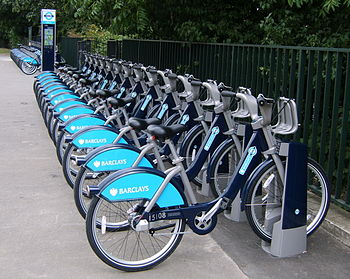
I had my first ride on a Boris Bike today.  Boris Bikes, (or to give them their proper name The Transport for London Cycle Hire Scheme) for those of you who may be unfamiliar with them, is a scheme set up about a year ago, that allows you to hire a bike for short periods at a nominal fee. It was inspired in the main by the Parisian Velib scheme. It costs £1 to register for a day and after that journeys of up to half an hour are free.

Boris Bikes
TfL Hire "Boris" Bikes

My first job of the day was at the top end of the Kings Road and my second one was at the other end. I suppose I could have walked or taken the bus, in fact I was going to walk, but as I was passing a bank of docked bikes inspiration struck. It takes about 60 seconds and a credit or debit card to obtain an unlocking code, and punch it in. Pull the bike out of the dock and you are off, London is your oyster. Actually if bike hire could be tied  into the Oyster Card scheme that would be brilliant.

I was quite impressed by the bike. The riding position is very upright but comfortable. They are heavy but you get the feeling that if you were in collision with a double-decker bus, it would be the bus that came off second best. (Disclaimer – I strongly  recommend not putting this theory to the test). There is something about them that encourages a relaxed, literally no sweat, style of riding. The three gears are more than adequate for any hills that you will find in Central London. I wouldn’t choose one for a full day ride in hilly countryside, but for short (up to half hour) trips in London they are brilliant. I was slightly disappointed that I couldn’t fit my rucksack into the luggage carrier, as I don’t like cycling with a pack on my back. But my rucksack is quite big, and for the ten minutes each way it wasn’t too bad.At the other end you just put the bike back in its docking station and leave it. When you want to use a bike again you just put your credit card into the reader, it checks that you have already paid and issues you with a new unlock code, and off you go again.

Riverside Vegetaria

Riverside Vegetaria* has long been one of our favourite restaurants and as we have eaten there three times since Christmas (four if you include Christmas Lunch), I have decided that it is about due for a review. We don’t normally eat there quite that regularly as Kingston is a good half to three-quarters of an hour journey from where we live. Recently however circumstances have led us to eating there  almost every Sunday, or at least that is how it seems.

Today, my brother-in-law and his wife had come to visit us. They are both carnivores, so our original plan was to take them to an Italian restaurant as we can usually find something that Mrs johnm55 (who is a veggie) can eat on an Italian menu. However when we arrived the queue was out the door and we were told it would be at least half an hour for a table. The brother-in-law didn’t fancy queueing so suggested that we try Riverside as Mrs johnm55 had been raving about it.

The first thing to note about Riverside is it’s setting. It is right on the river, and especially in summer the setting is, idyllic is probably going slightly over the top, but it is very attractive. The second thing is the service, which is always friendly and as efficient as it needs to be. The third thing is how do they manage to get as many tables into such a small space.

The fourth thing is the food. The menu is fairly eclectic, but does tend to have a bias towards food from the Indian Sub Continent. Also, and this is not a criticism, this is a traditional vegetarian’s vegetarian restaurant (vegans are also well catered for), as opposed to  a place like Terre a Terre in Brighton which has a more obvious appeal to omnivores, whilst still remaining vegetarian. So how did a couple of carnivores, or three if you count me, get on?

The women decided to skip the starters and stuck to the wholemeal garlic bread, which always arrives with the drinks. My b-i-l decided to have the Cream of Broccoli Soup and I had the Organic Spicy Vegetable Balls with Coriander Sauce. The Cream of Broccoli soup was pronounced as very enjoyable, but different to what he had expected. I pointed out that here a V beside a dish means Vegan not Vegetarian, so the unexpected taste might have been down the lack of cream, which he agreed was a possibility. My Spicy Vegetable Balls were excellent. They were two  balls of finely shredded carrot, onion and potato, well spiced, dipped in a light batter and deep-fried.  The Coriander Sauce that they were served with, tasted of fresh coriander, just enough chilli, cumin and ground coriander. I had never ordered them before, but will do so again.

The main courses arrived. My brother-in-law and I ordered the same thing, the Masala Dosai, my sister-in-law went for the Green Lentil and Vegetable Curry, and Mrs johnm55 decided that she was having the House Salad. Normally the House Salad has Cottage Cheese, but as she doesn’t like cottage cheese, they replaced it with a rather large quantity of avocado. I was an impressive plate of vegetables, fruits and nuts, accompanied by a jug of dressing. My sister -in-law was in the meantime tucking into her green lentils with obvious enjoyment.

My Dosai was as I expected it to be. The Dosai is a bit thicker than you would normally be served in a South Indian restaurant but nicely crisp on the outside and stuffed with a tasty, spicy, potato filling. Accompaniments  are a vegetable curry and a very good coconut sambar.

We debated having puddings, but decided that we were all full enough.

So how did the carnivores get on? I enjoyed my meal at Riverside as I always do, my brother and sister-in-law, thought it was excellent and said that they wished that they had something like it near where the live, so all in all a success.

The bill, including a bottle house red (which was perfectly drinkable, if nothing spectacular) came to £67.50, but as we have been eating there a lot recently we had a 20% discount card so only paid £54.00.

Because I am a bit of a coffee aficionado (or possibly snob) and sometimes have been disappointed by their coffee we walked along to Carluccio’s for coffee.

It was raining fairly heavily otherwise we would have gone for a walk along the river to help a very pleasant lunch go down

*If you click-through to the restaurant website I don’t think it has been updated recently and my feeling is the prices are slightly higher than those shown on their sample menu.