Tag Archives: Voting Reform

Voting Reform Revisited.

I haven’t said much about Voting Reform since we lost the referendum back in 2011. The results of our recent general election tell me at least that it is time to revisit it.
We need to get from this:

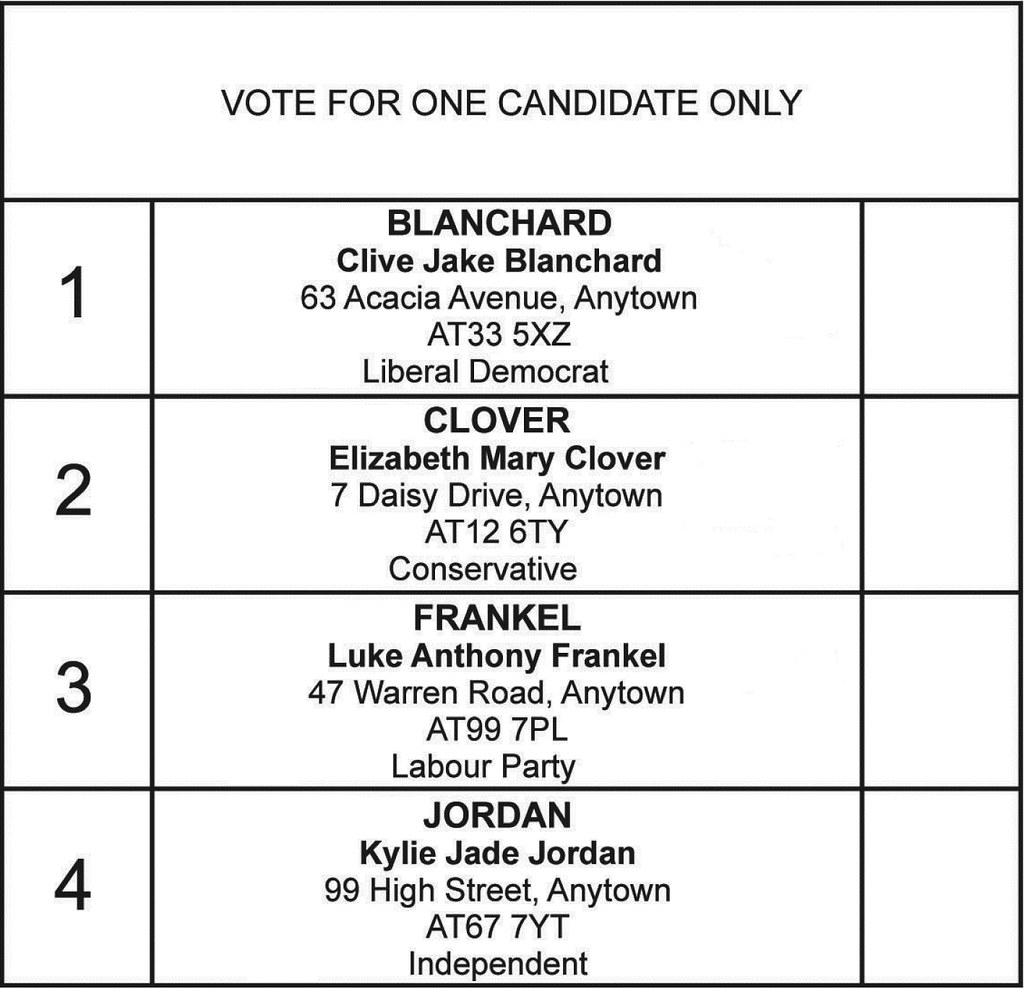
To something like this:

(This ballot paper is from New Zealand)

It looks as if we’ve lost.

I voted yes

I’m disappointed, but not surprised. The polls were indicating that this would be the result for quite some time now.

From the Guardian

7.40pm: It’s official. The no camp have won.

I’m not at the count, so I don’t know whether the anti-AV campaigners threw their hands in the air and shouted: “Yes.” I’d love to think they did.

• The no camp have now officially won the AV referendum campaign. They have passed the 50% threshold. They’ve now got more than 9.8m votes.

7.33pm: According to the BBC, the no camp need to get more than 9.8m votes to clinch victory. They’re almost there. Here are the latest figures, with results in from 342 out of the 440 areas.

Yes: 4,216,527 – 31.7%

No: 9,098,846 – 68.3%

I’m not quite sure where we go from here, if we can’t persuade the electorate to back what was a small first step on the way to electoral reform, I’m don’t know how we convince them to back proportional representation. Not that we are likely to get the opportunity for quite a while.

It also means that the original raison d’être for this blog has gone, although that would have been the case even if we had won. I am going to keep the blog going though, essentially because I enjoy writing it. Anyway the Giro d’Italia starts tomorrow, I’m still riding my bike, painting, cooking and eating, so there is plenty to blog about, and there will always be  other political subjects to get hot under the collar about.

I’m Voting Yes to AV

Why I am voting yes on the 5th of May

  1. The Alternative Vote is not perfect but it is more democratic than the system we currently use.
  2. It ensures that our elected representative has the approval (except under fairly unlikely circumstances) of at least 50% of the people who could be bothered to vote.
  3. If we don’t vote for this small improvement in out electoral system, any hope of the major change that is required will be lost for a generation.
  4. Voting for AV will seriously upset the Tories and John Reid – got to be a good thing.
  5. I don’t like kittens 😉

This is much important for our democracy than some people think. Resist the urge, those of you who support Labour to stick one to Nick Clegg, he’ll get his just desserts soon enough.

Just vote tomorrow, and vote ‘Yes’ .

AV is the Only Game in Town.

Jonathan Freedland in today’s Guardian tells us why we need to vote yes to the Alternative Vote on May the 5th. Most people in favour of a proportional system of electing our government will fully acknowledge that it is in Nick Clegg’s words a ‘Baby step on the way to Electoral Reform’. But it is a crucial step, it is the first step on the way to meaningful reform and if we do not take it, there will be no more steps for a long time.

We can argue the merits of Single Transferable Vote over the Additional Member System ’till we are blue, red, yellow or green in the face. We can agree that either would be infinitely superior to AV, but what we can’t do is refuse to vote for AV because it doesn’t give us everything we want.

Jonathan Freedland concludes with this lesson from Australia:

Of course AV is miles from perfect, even if it does allow voters to express more fully their true preferences; most reformers would prefer PR. But it’s naive to think that defeat next week would keep progressives’ powder dry, allowing for a future push for full-blooded electoral reform. That’s rarely how politics works. It’s success, not failure, that breeds success.

That lesson was taught in 1999, when Australia held a referendum on whether to remove the Queen as head of state. The alternative on offer was another “miserable little compromise” – with MPs, not the people, electing a new head of state – and some republicans preferred to let it fail and wait for something better. They’re still waiting – and Elizabeth II is still Queen of Australia.

Let’s not let the perfect be the enemy of the good

Voting Reform – Party Lists

Party lists in theory should give almost perfect proportionality in the result of any election. The theory behind the system goes something like this:

  • Almost everyone votes for the party they support rather than the individual candidate
  • Instead of having individual constituencies why not just have a regional (or national) poll in which you cast your vote for your party of choice.
  • Add all the votes up and allocate the number of seats to each party based on the percentage of the vote obtained.
  • The parties then allocate the seats to MPs based on a list they have drawn up, normally with the party leader as the first person selected.

This is about as pure a form of proportional representation as you could wish for. If Labour get 30% of the vote they get 30% of the MPs. If the Green Party get 8% of the vote they get 8% of the MPs and so on. However there is one big snag with Party Lists – we don’t get to choose the people who represent us, the parties choose the people who represent us. The system can be made fairly transparent, but it still boils down to voting for a party and getting the representatives they choose in the order that they want them selected (presumably starting with the party leader).

The system is used in a modified form for the Scottish Assembly where it is known as the Additional Member System. There the majority of the members are elected by a First Past The Post system in individual constituencies. The electorate then has a second vote on a regional basis. The total number of seats in the Parliament are allocated to parties proportionally to the number of votes received in the second vote of the ballot using the d’Hondt method. For example, to determine who is awarded the first list seat, the number of list votes cast for each party is divided by one plus the number of seats the party won in the region (at this point just constituency seats). The party with the highest quotient is awarded the seat, which is then added to its constituency seats in allocating the second seat. This is repeated iteratively until all available list seats are allocated.

This is not as you may have gathered a method of electing our representatives that I like. The two main reasons for my dislike of the system are:

  • It breaks the link between the representative and the represented. We would no longer cast our vote either directly or indirectly for a person. Our vote goes to the party.
  • The MP’s loyalty needs to be toward his or her party, because it is the party that now decides whether they as individuals will be elected, not the voters. This is because the higher you are on your party’s list the greater you chances of being elected.

There is an argument for using this system as a top up to either FPP or AV (sometimes known as AV+) but I feel that this produces a two tier parliament, with some MPs directly elected and a rump beholden to their party bosses for their seats.

Voting Reform – First Past The Post

First Past The Post (FPP) is the system of electing our MPs, and, in England at least, most of our other elected officials. How it works is simple to understand. You are presented with a list of candidates and you put your “X” against the one you dislike the least. After the polls close the votes are counted and the person with the most votes wins. Dead simple, your dog could understand it, so why don’t I like it?

The first reason that I don’t like FPP is that it wastes my vote and thousands of other people’s votes. Where I live, in the area of South London that has Surrey as its postal address, if I vote the way I would naturally, for the Labour Party, my vote is wasted, it has no effect on the result of the election because it is completely outweighed by the Lib Dems and the Tories.

My guess is that roughly 25% of the population, in this area, would normally support the Labour party, about 35% would normally vote Tory and a slightly lesser percentage vote Lib Dem, with the remainder voting UKIP, Green and etc. So one in four of the local constituencies should have a Labour MP, err no…. Either Tory or Lib Dem. Strangely enough the current system probably means that the Lib Dems are over represented in this area due to a lot of Labour and Green supporters voting for them to try to keep the Tories out.

The second reason that I am against FPP is that it creates safe seats, where as the saying goes you could put a pig up as candidate and providing it was wearing the right colour rosette it would be elected. I know much has been written in the past day or two about the demise of the Liberal Democrats in the Barnsley by-election, but it does not disguise the fact that only Labour could win there, and that the winning candidate Dan Jarvis now has a job for life if he wants it. Unless of course he finds himself with  same accounting problems that his predecessor encountered. And again how many votes were wasted in this election? I would argue that every vote cast for a candidate other than the winner was wasted and about half the votes that were cast for him. The turn out for the by-election was 36.5% – roughly two-thirds of eligible voters stayed at home. Why? a wet and cold Thursday in early March probably did not help, but largely they stayed at home because the outcome was certain and they felt that it wasn’t worth the effort of going to the polling station.

If we want – and almost every politician of every hue say they want it – increased voter participation then we need an electoral system that makes every vote count for some thing.

The third reason that I am against FPP is that it encourages, even demands, tactical voting. In a two-way marginal seat, the supporters of the minority parties are almost obliged to vote against the candidate they like least, rather than voting for the candidate they like best. This depresses the vote of the minority parties and reduces their voice in the public square. For example at the last general election the green candidate for my constituency was a friend, and while my political leanings tip slightly more toward red than green, under any sensible voting system I would have voted for him, knowing that he would be unlikely to be elected in a single constituency vote, but knowing also that my vote is not wasted as my second and third preference votes, will still count if he is eliminated. This would give not only a fairer system of voting but also a clearer picture of the actual level of support for political parties. What happened in reality, I voted Liberal Democrat in the hope of keeping the Tories out. Which it did in this constituency, but for all the practical good it did the country, I would have been better voting Green.

The fourth reason I am against FPP is that it allows single party majority governments to be formed with considerably less than 50% of the votes cast, let alone the votes of 50% of the electorate at large. Even at its peak in 1997 Labour won 63% of the seats with only 43% of the votes cast. Admittedly the current coalition government took about 59% of the popular vote between the two parties, but this is genuinely the exception that proves the rule.

My conclusion about First Past The Post, it is better than no vote at all, but it is time that we ditched it in favour of a more democratic system that allows all voices to be heard and not just the biggest and loudest ones.

More Voting Reform – Single Transferable Vote (STV)

Anyone who has been reading my posts  on voting reform (if anyone has been reading them apart from possibly Grace) they will probably have noticed that I am trying to work out what I think  about it.

I am convinced that our current first past the post system is not good for democracy in the long, or even the short-term. I am not quite so sure what to put in its place, hence the series of posts.

“I am convinced that our current first past the post system is not good for democracy in the long, or even the short-term.”

This time I am going to look at the voting system known as the Single Transferable Vote (referred to from now on as STV to save typing). This is the system that has caught my imagination the most.

I’ll explain how I think it works, then look at the advantages and disadvantages of the system.

The STV is based on the idea of proportional representation and preferential voting. Initially your vote is cast for the your preferred candidate and then after candidates are either elected or eliminated, transferred to other candidates in line with the your stated preferences. The system minimises ‘wasted’ votes. You are also voting for individual candidates rather than party lists.

How it works

STV works by using multi-member constituencies. As with all alternative vote electoral methods, you rank the candidates in order of preference, 1 to however many candidates you care to vote for. You do not have to cast a preference for a candidate that you abhor. So you just number your preferences 1 to 11 and leave the twelfth candidate out. In the event of your preferred candidates being eliminated or elected your vote will not be transferred to them.

Candidates are generally elected using the following formula:

So in a constituency that elects 6 members, if there were, say 150,000 valid votes cast, each elected candidate would need to get 21,430 votes to be elected.

After you have cast your vote the system works like this:

All the First preference votes are counted, one candidate has 30,000 votes and is elected, but none of the others have enough first preference votes to get over the electoral thresh old. Candidate one has 8,570 surplus votes, so they are distributed among the remaining candidates according to the second preferences of the voters.

The votes are counted again and still no candidate reaches the magic figure, so the candidate with the lowest number of votes is eliminated and his or her second preference votes are redistributed among the other candidates. This process goes on until all the vacant seats are filled.

Ireland uses this system for its elections and if you want to see how this works in practice look at the results for the Dun Laoghaire Constituency in Ireland’s 2007 Elections.

The Electoral Reform Society has an example of a model STV Election here

Advantages

STV gives us as voters much more choice than any other system. We determine who is going to be elected. Under the current system part officials, especially in ‘safe’ seats, essentially decide who our MP will be long before we get a chance to vote. Under STV MP’s responsibilities will be more to the people who elected them than to their parties.

  • Fewer votes are ‘wasted’, either by being cast for a candidate with little or no chance of being elected, being cast as surplus votes for a winning candidate.  What this means is that most, if not all, voters will be able to identify representative that they helped to elect. This link in turn helps to increase the representatives accountability.
  • Post election STV gives voters a choice of representatives to approach with their concerns, rather than just the one, who may be indifferent or actively opposed to the concerns of the voter. Indeed in some cases the representative may be the cause of the concerns.
  • Competition, we are constantly told, is a good thing, and generally this is the case. Competition to provide a good service to constituents is no different.
  • Because there are no safe seats under STV,  candidates cannot be complacent and parties must campaign everywhere, and not just in marginal seats. This also means that candidates with in a party must find their own voice. It is extremely unlikely that if a party puts up a full slate of candidates (i.e. six candidates for a six member constituency) they will all be elected. So candidates with in a party will have to be able to sell themselves to the electorate as well as their party manifesto.
  • Because we rank candidates, the most disliked and/or extreme candidates cannot win, because they are no good at picking up second, third and lower-preference votes.
  • There is no longer any need for tactical voting. Vote for the candidates you want, not against the candidates that you don’t want.
    All my life for some reason or other I have managed to find myself living in Conservative/Liberal Democrat marginals. All my life this greenish, left leaning voter has been voting Lib Dem, in the hopes of keeping the Tories out. Under STV I will no longer have to do this.
  • Because there will be a more sophisticated link between a constituency and its representatives,  there will be an increased incentive to campaign and work on a more personal and local level, but also, the constituencies are likely to be more sensible reflections of where community feeling lies.

Disadvantages

To be honest I don’t think there are many. Most of the ‘disadvantages’  cites by supporters of ‘first past the post’ such as loss of connection between the representative and the constituents are red herrings. True STV is much more likely to give rise to coalition government, but current examples aside, is this necessarily a bad thing. However there are some potential problems.

  • If a representative dies in office, or resigns how do you replace them?
  • Counting of the votes will take longer than under the current system (or AV) so the results will not be declared on the night of the election.
  • In some parts of the country, notably the Scottish Highlands STV will result in massive constituencies.
  • Some voters find doing anything other than putting an ‘X’ in a box to complicated for them, therefore there will be an increase in spoiled votes.

To my mind none of these disadvantages come anywhere near to outweighing the advantages of  STV.

Summary

Give my choice STV is the electoral system I would choose. Unfortunately it is not the choice that we are being offered. The choice is between the current system (first past the post) and the Alternative Vote.

Alternative Vote +

AV+

Alternative Vote Plus as the name suggests works in a similar manner to The Alternative Vote system with a top up of members chosen at a regional level from open Party Lists. The system was the one proposed by the Jenkins Commission, set up by the last Labour Government. Roy Jenkins took his brief seriously. Tony Blair’s purpose for the commission was  to kick voting reform into the long grass. He was very successful in doing this.

Basically for elections to the House of Commons the system would involve reducing the number of seats to about 500 with the members elected by the Alternative Vote method , i.e. you rank your candidates in order of preference and as the votes are counted the candidate with the least number of votes is eliminated and his or her second preference votes are allocated to the candidates indicated. This process carries on until one candidate has over 50% of the votes.

You would also have a second vote on a regional (possibly county) level where you can vote for a party or if you prefer a specified member of that party on the party list. This is the plus part of AV+.  About 120-140 additional members would be elected this way.

Like it’s parent, I can’t get ultra enthused about AV+. It is an improvement on first past the post (almost anything bar a suspension of elections would be) and should give a more proportional outcome to an election.

In its favour:

  • it keeps the tie of the M.P. to a geographical  constituency, albeit a slightly larger one than at the moment, unless of course we want to have more M.P.s.
  • it does produce a more proportional representation than straight AV
  • people other than me would argue that it should keep minority extremist parties out of parliament.

Against it:

  • it is not fully proportional.
  • the ballot paper is more complicated than at present.
  • it would still be likely to produce a single party government.

My objection to it is basically that it adds a lot of the complexity to the ballot paper and counting of the Single Transferable Vote or Additional Member System, without giving the proportionality that they do.

Voting Reform

Voting Reform has been in the news of late.

Various Labour and Conservative ‘Big Beasts’ have united to oppose any change in our current system of electing the House of Commons. I find it interesting to note that the Senior Politicians who have come out against electoral reform are all, well, senior in years, Margaret Beckett, Ken Clarke, David Blunkett, John Prescott to name some of the more prominent members of the group. They hardly represent the coming generation of politicians.

This has raised a few questions that I need to try to answer for myself

So these are my questions to answer.

  • Is the AV system worth fighting for?
  • Should we be looking at other – more radical systems
  • Are the Tory proposals to cut the number of MPs by 50 anti-democratic?
  • Shouldn’t we be doing something about the House of Lords as well?

I’ll make a series of posts trying to answer these questions.

Let us take them one at a time – AV first.

It is an improvement on the current system, in that it allows the voter the opportunity to cast their primary vote positively for their party of choice rather than negatively, voting against a particular party. As such it may help a few Green and UKIP candidates keep their deposits. It also means thy by the time an M.P. is actually elected, at least 50% of the people who actually cast their votes will have expressed some sort of preference for him or her. This compares with the current parliament where I believe only 3 M.P.s even managed 40% of the vote in their constituencies.

We can see from the Electoral Reform Society that had AV been in use at the last election it would have resulted in a few more LibDems a few less Tories and about the same number of Labour. Essentially It would have made no real difference.

Whilst can’t get all that enthusiastic about AV, it would for the first time allow me to cast my vote positively for the party I actually support rather than negatively, to prevent a Tory being elected. (I have somehow or other contrived to live my entire life in areas that are LibDem/Tory marginals.) It is also the only thing on offer so I will be voting for it come the referendum in May.

There are other and I think better systems that I think we should consider which I will get round to discussing in another post.

To list the ones that I think are worth considering :