As London grinds to a halt under the effects of a major 10cm snowfall, thoughts shift. People realize that corn flakes are not quite what is needed for breakfast. I should add that I appreciate other parts of the UK may have had more snow than us in London. However, what you don’t appreciate is the fact that if it hasn’t happened in London, then it hasn’t really happened.
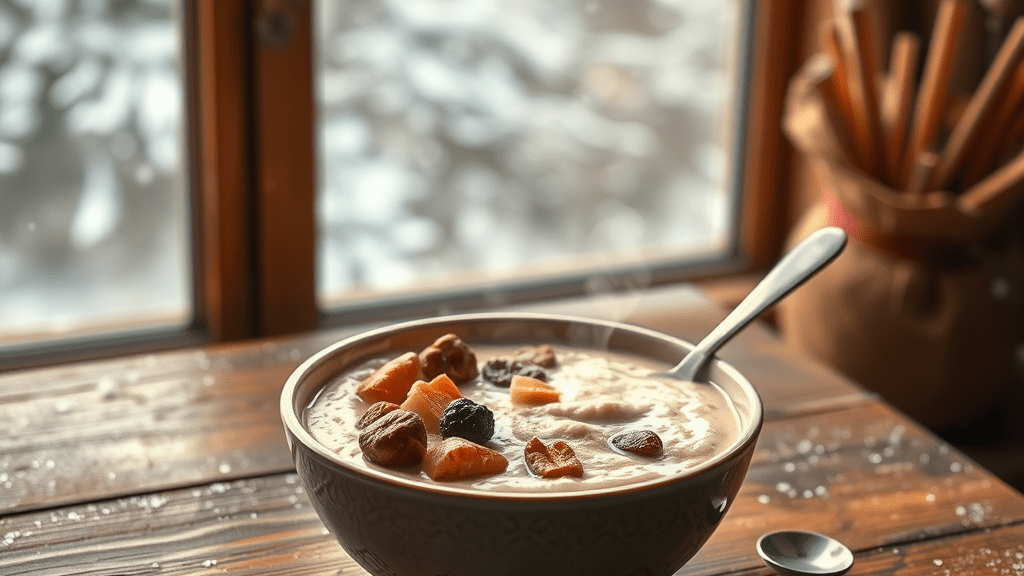
This is the season for porridge for breakfast. Besides all the well touted benefits of eating porridge for breakfast, making and eating a bowl of porridge is also satisfying. It does take slightly longer than pouring out a bowl of Rice Krispies. But believe me, you will be a better person, or at least feel like one, for making the effort.
The first piece of advice I will give you is do not make your porridge in the microwave.
Shortly after I was diagnosed as diabetic, I had a session with a Dietician. During our discussion about good food choices for blood glucose control, she mentioned that porridge was probably one of the best things I could eat for breakfast. She also mentioned that it could be made in the microwave. However, she forgot to tell me the most important thing about making porridge in a microwave. My immediate thought was ‘that will save washing up’. The next morning I proceeded to make my porridge in the microwave.
I measured out my usual recipe;
- For 1
- ½ a cup of rolled oats
- 1 ¼ cups of water
- a generous pinch of salt
I put it all into my porridge bowl. Then, I stuck it into the microwave and pushed start. After that, I went back to drinking my coffee and reading the newspaper. About five minutes later the microwave went ping. I wandered across the kitchen to retrieve my no effort, no washing up porridge. I discovered that the bowl was empty. The microwave was generously coated with porridge. I also discovered that removing porridge from the walls of a microwave is much harder. It is easier to remove it from a pan.
What my Dietician forgot to mention is that porridge made in a microwave foams up and boils over. Use a bowl that is at least five times the volume of the liquid. If you don’t consider this, do not make your porridge in the microwave. do not make your porridge in the microwave.
I now always make mine in a saucepan. It is just as quick and I think tastes better. Using the recipe above, put all the ingredients into a pan. Bring it to the boil. Then, turn it down to a low heat and allow it to ‘plop’ away happily for about five minutes. Give it a stir now and then. Traditionally, you should use a tapered stick called a spurtle. This stick usually has a thistle as a handle. We made them this way in woodwork class when I was at school. Stir it clockwise with this tool. I find that stirring it with a wooden spoon anti-clockwise also works. I put the salt in at the start. Some people like to cook the porridge then add salt to taste. All I will say is do not neglect the salt. It doesn’t need much, but porridge does need some salt.
For Saturday mornings, porridge made with oatmeal has a unique quality. If you are a traditionalist, it does have something that porridge made with rolled oats does not have.
The recipe is fairly similar but here are a couple of variations.
For 2
- 600ml/1pint water
- 100g 4 oz medium oatmeal
- Salt
- Bring the water to the boil, add the oatmeal slowly, stirring all the time.
- Reduce the heat and allow it to cook slowly. Just give the occasional ‘plop’.
- Let it cook for up to 30 minutes, depending on how solid you like your porridge.
- Give it a stir every now and again, add salt to taste and serve.
Again traditionally, you should eat your porridge by dipping a spoon of hot porridge into a bowl of cold milk. This is to keep your porridge hot, as adding cold milk to the bowl of porridge will cool it down. Nice though that is I think there are more interesting things to add to porridge.
Here are some of my favourites.
- Honey
- Thick natural plain yoghurt
- Fruit compote
- A tot of whisky and honey
- Cinnamon and chopped and toasted nuts
- Cream
Or of course any combination of them.
Should you make too much porridge, let it go cold and set solid. It is absolutely delicious sliced, fried in a little butter and served with runny honey.
As for washing up the pan, don’t, fill it with cold water and let it soak for a few hours. The porridge sticking to the pan will have come off as a sort of skin. This skin can be scooped up and discarded. This process leaves a clean and shiny pan behind.


 A Scotsman in Suburbia