
The final act of the tragedy that became the farce known as “Jan and Operacion Puerto” , concluded a few days ago. The drama began with Jan Ulrich being thrown off the 2006 Tour de France. It ended with the Court of Arbitration in Sport (CAS) giving him a meaningless (he retired in 2007) two-year ban running from August 2011. It also annulled all his results from May 2005 until his retirement. Cancelling his third place in the 2005 tour means that Francesco Mancebo is the rider who moves up a place. Richard Moore has a bit to say about this:
Whatever: it seems a bit rich of the UCI, cycling’s governing body, to have pursued Ullrich with such vengeance when they presided over — and, through their initial inaction, must take some responsibility for — an era so blighted by EPO. Why go after Ullrich and ignore others?
It is a farce that is confirmed by a study of the updated results of the 2005 Tour. With Ullrich’s third-place finish now airbrushed from history, Francisco Mancebo steps up to the podium. That’s the same Mancebo who, like Ullrich, was forced out of the 2006 Tour when his name was linked to Operacion Puerto. In fact, of the revised top ten, eight riders have either tested positive, served a ban or been under investigation for doping.
This leads to one conclusion. The problem was not Jan Ullrich.
The full article is here:Opinion: Richard Moore On The Career Of Jan Ullrich | Cyclingnews.com.
It is not clear how far Ullrich’s confessions as to the use of performance enhancing substances went but he has admitted to being involved with Dr Eufemiano Fuentes who ran the Madrid clinic associated with the Operacion Puerto blood doping investigation. He has described his actions as “being a mistake”. Every athlete caught doping describes their actions as being a “mistake”, usually they mean the mistake was in being caught, but he went on to apologise:
“I would like to sincerely apologise for this behaviour – I’m very sorry.”
“In retrospect I would act differently in some situations during my career.”
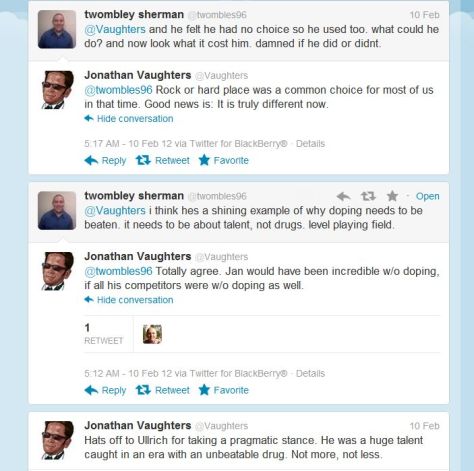
I have no idea if Jan Ullrich doped throughout his career. His introduction to cycling was through the old East German sports system, so it is quite possible. Having said that, he was not the only cyclist of that era to use performance enhancers. Jonathan Vaughters, now Garmin-Barracuda’s general manager, raced during the same period as Ullrich. He responded to the news with a series of tweets:
Ullrich was a classy rider and probably should have won more than he did, but he ran into Lance Armstrong, who might have been the better rider. Armstrong was certainly much more focused. If Armstrong had worn Adidas kit, as Ulrich did for much of his career, there would never have been any jokes about how far apart the stripes were in the early season races. Armstrong also probably had better support than Ullrich.
His only Tour de France Victory came in 1997, and it is from that tour that I take my abiding memory of Jan Ullrich the rider. His first day in the Yellow Jersey came on Stage 10 from Luchon to Andorra Arcalis. Bjarne Riis, the previous year’s winner, was the leader of the Telekom team, but was not going particularly well. Ullrich dropped back to the team car to ask if he could attack, permission was given, so he did, dropping every one, including climbers Richard Virenque and Marco Pantani. At one point (about 15:30) on the video you will see him looking around to admire the scenery, like a tourist out on a day ride. (He was probably looking across a bend to see how much distance he had put into Virenque and Pantani). That is my memory of him as a rider, just how easy he made it look that day.
I think I am correct in saying that the first eight riders to finish this stage have either been convicted of or admitted to doping. As Richard Moore said the problem was not Jan Ullrich.
Update 30/10/2012
As everyone now knows Armstrong was definitely ‘better prepared’ than Ulrich.
 A Scotsman in Suburbia