Tag Archives: cycling

Tour de France 2011 – Part 1

Tour de France Logo

Prologue

Well there isn’t a prologue this year. So you will have to make do with my musings on what is going to happen.

The GC (General Classification or Yellow Jersey) is I think it is a straight fight between Alberto Contador (Spa) Saxo Bank Sungard (last years winner) and Andy Schleck (Lux) Leopard Trek (last years runner-up). Schleck probably is a slightly better climber than Contador and has a stronger and more experienced team, (you don’t get stronger than Fabian Cancellara or more experienced than Stuart O’Grady and Jens Voigt), but Contador proved in 2009 that he can win without a team, or indeed with a team gave that appeared to be actively working against him. Contador is by far the best individual time trialist. The Team Time Trial is fairly short so no team (except possibly Euskatel) should lose too much time.

Who is going to win? I don’t know, but I will be very surprised, barring accidents or an early intervention by CAS, if Contador and Andy Schleck are not on the top two steps. The third step could be occupied by any one of about ten riders, Bradley Wiggins, Jurgen Van Den Broeck (Bel) Omega Pharma-Lotto and Cadel Evans (Aus) BMC Racing Team among the candidates.

The Points Competition (Green Jersey) has a new format this year with only one intermediate sprint per stage and not the two or three that there were in the past.. The other big difference is that the intermediate sprint is now worth 20 points to the winner with points going down to the first fifteen riders across the line. This means that anyone who wants to win the competition will have to go for the points at the intermediate sprint, unlike in earlier years when the overall contenders could rely on a breakaway mopping up the intermediate points and only have to worry about the final sprint. On paper the favourite to win the green jersey is Mark Cavendish, but he has a habit of sitting up in a sprint when he knows that he has been beaten, thus dropping points by finishing tenth when he could have been second or third. Thor Hushvod has stated that the Green Jersey is not his aim this year, so I think that it could well end up on the shoulders of his team-mate Tyler Farrar.

The King of the Mountains Competition (Polka Dot Jersey)has in recent years become a completion fought out by French riders who got themselves into early breaks and hoovered up the points available before the GC contenders started racing properly in the latter stages of the race. Like the Points competition the scoring has been altered this year, with fewer points available on the lesser climbs. This is possibly to discourage the opportunist French breakaway riders and encourage some of the bigger names to make it a goal if they lose time in the GC. Having said that I would like to see David Moncoutie (Fra) Cofidis win.

Stage 1

Saturday’s stage, unusually wasn’t a prologue time trial, but a road stage with a reasonably steep uphill finish. Philippe Gilbert was such a short-priced favourite for the stage that one Belgian punter was heard to remark that it would probably cost him money even if Gilbert won. Surprisingly enough Philippe Gilbert did win it and in style. His team controlled the race well into the finalé, including an amusing to watch, although probably not to do, 100m turn on the front, uphill, by André Griepel. Fabian Cancellara attacked with about 500m to go, forcing Gilbert to go probably a bit earlier than he had planned, but if Spartacus goes, you have to go with him if you want to win. Gilbert caught him and sat on for a few seconds to see what was going to do, then went himself. Cadel Evans tried to bridge across but didn’t manage and came second, with Thor Hushvod coming third and setting himself up nicely for an attempt at the yellow jersey in the following days team time trial.

The other incident that shaped the day, and could yet shape the tour was a mass pile up with about 10k to go. A spectator got too close to the action and caused an Astana rider to crash , bringing half the peleton with him. Alberto Contador although not actually involved, was caught behind the crash and lost about a minute and a half to his rivals.

Stage 2

The second stage of this years Tour de France was the Team Time Trial. Jonathon Vaughters the owner/manager of Team Garmin-Cervélo has tried to win a stage of the Tour de France for the past three years. In addition he has a bit of an obsession with the Team Time Trial. This is probably due the fact that one of the highlights of his career as a cyclist was winning the Team Time Trial stage in 2001 when he was a member of Roger Legay’s Credit Agricole team.

It all worked out perfectly for him and the team. They won the stage by 4 seconds and moved Thor Hushvod out of his world champions rainbow strips into the Maillot Jaune, though today he was rather incongruously wearing the polka dot jersey of the leader of the King of the Mountains competition. If you want to know why I suggest that you read the minutiae of the Rules & Regulations of the Tour de France (in French).
This is link is David Millar’s reaction to the win

Below is Johnathan Vaughter’s reaction.
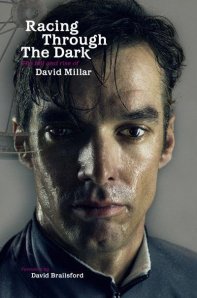
Book Review: Racing Through the Dark by David Millar

Racing Through the Dark by David Millar is an honest self-written account of his descent from an extremely talented young rider to a two-year ban for admitting to using various proscribed substances and through to something like redemption.

Racing Through the Dark cover

A confession; I have been a fan of David Millar more or less since the beginning of his career. Apart from his obvious talent, he always came across as being more interesting than the average cyclist. His answers to journalist’s questions were always a bit less bland.

I was there in 2001, wearing my “It’s Millar Time” t-shirt, in Dunkirk, when he crashed (and as the book tells started his burn) in the prologue. He may have heard my shouts of encouragement as he struggled up Cap Griz Nez, swathed in bandages, just about hanging on to the back of the peleton. I was as surprised and shocked as anyone when he admitted to doping in 2004. I was at the top of the hill at Southborough when he took the King of the Mountains points on the stage from London to Canterbury. So to the book.

The opening two short contrasting chapters set the tone for the book. The overture if it was an opera. The first chapter is his telling of his arrest and interrogation by the French Police that led to his confession of having used performance enhancing drugs.

The second chapter, set five years later, is his story of a magnificent, thrilling, but ultimately futile attempt to win the Tour de France stage from Girona (where he now lives) to Barcelona. Through his words you can capture the renewed joy that he has in the sport of cycling.

Tracing his path from an idealistic neo-pro to his eventual downfall is a fascinating psychological journey. While never excusing himself from responsibility, he shows clearly that unless you were a far more stable and emotionally mature person than he was then, the culture around you drew you into doping. The point at which he finally gives in and agrees to dope is strangely and chillingly banal and matter of fact.

His path back from the depths of 2004 in Biarritz, sitting on the steps to the beach with his sister Francis, wishing he had a fast forward button, to the closing paragraphs, the morning after celebrating his Gold Medal at the Commonwealth Games in Delhi, is neither smooth nor straightforward, but it is ultimately an uplifting story. He has problems with the French Justice system and the French Tax authority. His new team, Saunier Duval seemed to have similar problems to those he met at Cofidis, with riders notably Ricardo Ricco appearing to use EPO and other banned substances, and the management turning a blind eye to the goings on. Joining Jonathan Vaughters’ Slipstream team, with its anti-doping ethos, finally gave him something to believe in.

The book is about as far removed from the bland hack written “autobiographies” of sportsmen and women that we normally expect as can be. It is an open, honest and at times raw account of the pressures and strains that a top sportsman encounters. I think that it is a book that everyone should read, not just cycling fans. And if it does not win this years William Hill Sports Book of the Year award, then I will definitely read the book that beats it.

Racing Through the Dark by David Millar

I have managed to get hold of a copy of David Millar’s book Racing Through the Dark (Orion, 18.99 rrp) in time to read while I am on holiday. Richard Williams reviews it in today’s Guardian book reviews.

He says about the book:

David Millar provides one of the great first-person accounts of sporting experience

The definitive review will be on this blog after I get back from holiday.

The review also covers Richard Moore’s Slaying the Badger (Yellow Jersey, £12.99), which tells the story of the rivalry between Greg LeMond and Bernard Hinault and the 1986 Tour de France. I think that it will also be worth a read.

Persuading the UK to get on its Bike.

The Walking and Cycling group have released an interim report. It makes disappointing reading for those of us who see the bicycle as an essential part of a less energy intensive transport strategy. To sum the report up in a few words; The adult population of the UK just doesn’t get cycling, except as a leisure activity.

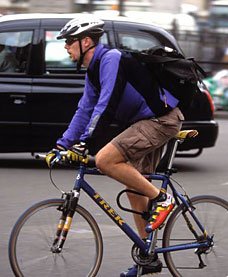
I’m trying to work out why? Does the image that we project as cyclists put people off? We are not all Lycra clad and super-fit, but if that is the image we project then it is understandable why the public think that they wont and don’t want to make the grade.

Typical British Cyclist ?

In the Netherlands, which in many ways is the European country that most resembles the United Kingdom, about 25% of all journeys are made by bicycle. In the United Kingdom it is about 2%. So what I want to explore is what makes the Dutch get on their bikes and the British get in their cars.

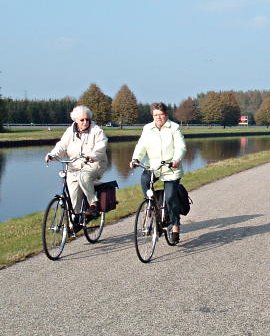
Typical Dutch Cyclists?

What are our reasons/excuses for using our cars and not our bikes?

The weather is often given as a reason, it rains a lot in Britain. It does if you live on the Northwest coast of Scotland or in Cumbria, but I refuse to believe that it rains more in the populated areas of Britain than it does in the Netherlands. Even if it does rain more, to quote some one, possibly Billy Connelly “there is no such thing as bad weather, just inappropriate clothing”

The Netherlands are much flatter than the United Kingdom claim the motorists. I will agree, that for the most part they are, but there are bits of the Netherlands that are far from flat, and large areas of the United Kingdom, such as London that are less than Alpine in their hilliness. Flatness of the countryside is a double-edged sword, as any one why has cycled across the Fens into a head wind will tell you.

In my opinion the biggest obstacle to getting the British on their bikes is a justified fear of the traffic in our cities and towns. I do think that the dangers of cycling in Britain are often overstated, but I cannot pretend that they are non-existent.

Mrs johnm55 loves cycling, put her on her bike out in the countryside, especially on a sunny day with the prospect of lunch at a country pub, and she is in heaven. But she hates cycling in London. She finds the conduct of a significant number of other road users intimidating. They rarely leave a safe distance between her and their vehicle, they overtake at inappropriate times and they are rude and impatient. As a result, when she does use her bike in London she tries to find routes that keep her away from traffic as much as possible. The problem with such routes are that they are usually rough surfaced, tend to take you away from populated areas, are often poorly lit after dark, and often have pedestrians wandering willy-nilly across them. Pedestrians who get upset, and as rude as any motorist, if you ring your bell to warn then that you are coming up behind them. (Possibly they would prefer it if you yelled “get out the #@*!#@!# way you moron.”, but Mrs johnm55 is a very polite woman and would never even think of saying things like that. johnm55 at times takes a different view.)

All this means is that compared to cycling on the road, cycling on traffic free routes, in London, often is a very slow way of getting from A to B.

Now, look at the photo of the Dutch cyclists above, what do you see under their wheels?  Correct, a well surfaced (motor) traffic free cycle route. The Netherlands has a has a comprehensive network of traffic free cycle routes which is one reason for the Dutch getting on their bikes. When the cyclist In the Netherlands has to share the road with cars, as they have to, even with a well designed system of cycle routes, The Netherlands has another advantage. In common with most other European countries the Netherlands has what is often known as a law of Strict Liability. The law assumes that unless proven otherwise, if a car collides with a more vulnerable road user (cyclist or pedestrian) then the car driver is at fault. The video gives explains how it works:

Any law similar to the Dutch law is of course anathema to our motoring organisations and Jeremy Clarkson, so there is not a lot of chance of a law like it being passed in this country any time in the near future. Of course a law of strict liability only goes so far. Hopefully it will make drivers slightly more careful around cyclists and pedestrians.  It is also comforting to know that your loved ones will be taken care of if you are crushed by a lorry, but it is probably fear of getting crushed by the lorry that stops you getting on your bike in the first place. So we are back to needing effective cycle routes.

London’s developing network of Cycle SuperHighways are a start, but the one I have used CS7 still allows cars to park on it, forcing you out into the main traffic. Car drivers also don’t seem to take all that much notice of the blue bit of the road surface that is for cyclists alone. Driver education might help. Getting more cyclists out on the road would definitely help to make life safer for all cyclists.

Possibly the choice of bikes on sale in the UK doesn’t help either. It is getting better, but if you go into the average bike shop in Britain you will be hard pushed to ride out on a bike that can be ridden wearing a suit. By that I mean a bike with full mud-guards, an effective chain guard, and an upright riding position. Strangely enough his type of bike is known in the UK as a Dutch roadster.

An additional problem is where people keep their bikes when they are not in use. I used to keep all my bikes safely locked up in the shed in my back garden. The five or six minutes it takes to get the bike out of the shed and on to the road, then make sure all the back doors and gates have been re-locked is not a big deal, if I am going out for an all day bike ride. However, if all I am doing is going along to the shops to get some bread and milk, it is easier to take the car. The car sits outside the front of the house, all I have to do is unlock it and jump in.
I overcame this problem by keeping my old bike locked to a strong point at the front of the house. This makes it at least as easy as using the car for short trips.

I was going to insert a mini rant about cycle helmets at this point, but he post is getting a bit long so I’ll save it for later.

To sum up; I feel we need to do the following to encourage more use of the bicycle for transport.

This study took place in Copenhagen, Denmark over 14.5 years. It found that cycling to work (an average of 3 hours cycling per week) decreased risk of mortality by about 40% compared to a sedentary control group. This study involved 30,000 people. The study took into account age, health status, and socio-economic factors such as education. It also found that older people gained even more from physical activity than younger people.

Next time for the sake of your health and the planet’s health, if you are going to the shops or the pub or to work, and the journey is five miles or less, think about walking or using your bike, it will probably be quicker anyway.

Boris Bikes

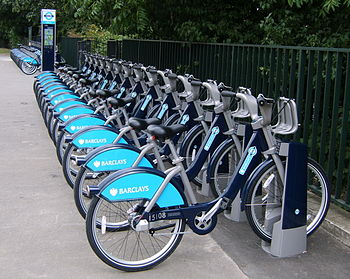
I had my first ride on a Boris Bike today.  Boris Bikes, (or to give them their proper name The Transport for London Cycle Hire Scheme) for those of you who may be unfamiliar with them, is a scheme set up about a year ago, that allows you to hire a bike for short periods at a nominal fee. It was inspired in the main by the Parisian Velib scheme. It costs £1 to register for a day and after that journeys of up to half an hour are free.

Boris Bikes
TfL Hire "Boris" Bikes

My first job of the day was at the top end of the Kings Road and my second one was at the other end. I suppose I could have walked or taken the bus, in fact I was going to walk, but as I was passing a bank of docked bikes inspiration struck. It takes about 60 seconds and a credit or debit card to obtain an unlocking code, and punch it in. Pull the bike out of the dock and you are off, London is your oyster. Actually if bike hire could be tied  into the Oyster Card scheme that would be brilliant.

I was quite impressed by the bike. The riding position is very upright but comfortable. They are heavy but you get the feeling that if you were in collision with a double-decker bus, it would be the bus that came off second best. (Disclaimer – I strongly  recommend not putting this theory to the test). There is something about them that encourages a relaxed, literally no sweat, style of riding. The three gears are more than adequate for any hills that you will find in Central London. I wouldn’t choose one for a full day ride in hilly countryside, but for short (up to half hour) trips in London they are brilliant. I was slightly disappointed that I couldn’t fit my rucksack into the luggage carrier, as I don’t like cycling with a pack on my back. But my rucksack is quite big, and for the ten minutes each way it wasn’t too bad.At the other end you just put the bike back in its docking station and leave it. When you want to use a bike again you just put your credit card into the reader, it checks that you have already paid and issues you with a new unlock code, and off you go again.

2012 Olympic Road Race Route

The route for the 2012 olympic road race has been announced and I am quite looking forward to it. Originally it was planned to be a boring tour of London’s tourist land marks, that could only have been made marginally exciting if the riders had been forced to complete the course on ‘Boris Bikes‘. But now they are going to send it out into the Surrey Hills and more specifically it is going to go up Box Hill. The Men’s race will do nine laps and the Women’s Race twice.

Now what I find exciting about this is first the fact that Box Hill will hopefully break the race up a bit. It is not a particularly long or even steep hill, at least compared with the mountain climbs in the Tour de France, but by the time they have climbed it nine times at race speeds, even the professionals will be beginning to feel it in their legs. My feeling though is that the long basically flat run in to the finish on the Mall will probably allow the race to come back together again for a spectacular sprint finish.

The second thing that I find exciting is that these are the roads that I ride my bike on. If I go out for a ride without any specific destination in mind I almost invariably end up going up Box Hill. The pros are going to be struggling up the same hills that I struggle up – only they will be struggling up at about three times my pace.

But what I really want to know is will they make it compulsory to stop for a cup of tea and a cake at Allison’s van in the Headley Heath car park? It is a compulsory stop for every other cyclist who rides round the Box Hill loop.

Hello world!

Well this is my first post on this blog.

There is a bit about who I am on my about page.

The blog will feature my random ramblings, but you will probably find that there are three main topics.

  1. Politics – you will find that my views are generally left of centre
  2. Cycling – I enjoy riding my bike, but I am also a fan of cycle sport in general and road racing in particular.
  3. Art – I paint, not very well, but I enjoy it, I also have views on other artists work.

There are other bloggers out there, as you probably already know, but this guy Fred Clark, who goes by the name Slacktivist is worth following.