Category Archives: Sport

Tour de France Part 5: Norway…… Cycling capital of the world!!

Tour de France Logo

Last Sunday after Darren Clarke had won the Open Golf Championship Rory McIlroy (@McIlroyRory) tweeted:

Northern Ireland…… Golf capital of the world!!

Today we have to say:
“Norway…… Cycling capital of the world!!”

Stage 17

Stage 17 went 179km from Gap to Pinerolo. The two biggest climbs of the day were the Cat.2 Col de Montgenèvre, which took the race into Italy and the Cat.1 climb up to Sestrières ( a stage finish in the past). A 40km descent to the foot of the final climb the Cat.2 Côte de Pramartino, followed. The peleton allowed a fourteen rider break-away to form and by the time they reached the intermediate sprint at 81.5 km they had a six-minute lead. The main contenders were content to bide their time on the first two climbs as any time gained would have easily been brought back on the long descent.

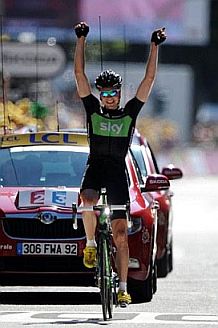
Edvald Boassen Hagen wins in Pinerolo

After losing out in the sprint yesterday Edvald Boasson Hagen decided that there was no way this was going to happen again. On the Côte de Pramartino he countered a Sylvain Chavanel attack, sat on his wheel for a few seconds then went himself. Chavanel couldn’t counter and Boasson Hagen rode away for a well deserved stage win.

Behind him in the Yellow Jersey group Alberto Contador was trying to attack the same way he did yesterday, but with less effect. He probably didn't want to go too deep today, bearing in mind tomorrow’s massive stage over three hors categorié climbs and finishing at the top of the Col du Galibier. I also think that Andy Schleck was a bit more with it today. That said Contador did manage to open a bit of a gap on the descent into Pinerolo, but the Schlecks and Cadel Evans closed it down in the last kilometre. Thomas Voeckler managed to lose a few seconds by overcooking a bend on the descent. Fortunately some one had left the gate to their driveway open so he got away with it, it could have been disastrous if they had left it closed.

The Tour organisers are probably hoping that tomorrows stage will define the Tour. My fear is that it is so hard that riders will ride very conservatively and only think about attacking in the final few kilometres. I would like to see someone take a chance and go on the Col d’Izoard and try to put 10 minutes into the race in the style of Coppi or Charly Gaul, but some how I don’t think that is going to happen. However in the meantime don’t forget;

“Norway…… Cycling capital of the world!!”

Tour de France Part 4: Gaps in Gap

Tour de France Logo

At last we had some racing from the GC contenders. Way up ahead we had Edvald Boasson Hagen as the meat in a Garmin sandwich (a few years ago we could have called it a Chipotle burrito). We might talk about that later, because it was the events five minutes back that interested me.

Stage 16

Stage 16 was a 151k uphill drag from Saint-Paul-Trois Châteaux to the top of the Cat.2 climb of the Col de Manse, followed by a wet, technical 10km descent into the finish in Gap.This is the descent that featured in Lance Armstrong’s famous off-road excursion in 2003.

On that final climb and descent we had the first real racing of this years tour. Alberto Contador had come out of the rest day feeling, well, rested and ready to race. He put in three real attacks. Not up the pace for five seconds and look round to make sure your brother is still there attacks, but put the hammer down for a minute then see who you have got rid of, keep the pace high to make sure the guys you’ve dropped don’t get back on, then go again to try to get rid of the rest, type attacks. By the time Contador had done this three times only Cadel Evans and Samuel Sánchez were still with him. Then over the top of the climb Evans, knowing that he is a better descender than Contador attacked him to try to put some more time into everyone. This is bike racing.

Thomas Voeckler still has the Maillot Jaune although his lead over Cadel Evans is now down to 1:45. Andy Schleck, lost over a minute, and did much whining about the descent. He is not a very good descender but there is more to bike racing than riding up mountains.

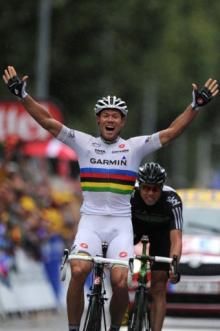
Thor Hushovd winning in Gap
Thor Hushovd, is a good descender and he can still sprint when required, even if he can’t match Cavendish and Farrar any longer. His kick for the line, ably assisted by Ryder Hesjedal was good enough to beat Boasson Hagen and he registered his third (including the Team Time Trial) stage win of the Tour. So with his week in the Maillot Jaune and his stage wins I think that he is reasonably satisfied with his tour so far.

The profile of tomorrows stage from Gap to Pinerolo looks much like today’s, so can we hope for some more racing. Contador seems up for it; Evans matched everything that Contador threw at him today, and the attacked on the descent; Thomas Voeckler will continue to fight to keep the Jersey. The only question marks are the Schlecks, who on today’s showing are not quite there either physically or more importantly mentally.

Tour de France Part 3: Second Rest Day

Tour de France Logo

Le Tour is now into its last week and as the riders take their second rest day I will take the chance to recap on the happenings since the last rest day and to update my predictions.

Stage 10

Stage ten took us from Aurillac to Carmaux was a typical transition stage through the Massif Central up and down all day with a scattering of third and fourth category climbs to keep riders who fancied wearing le maillot à pois for a day interested. The stage should have been one for a breakaway, but in the end it came down to a bunch sprint. The big surprise of the day was not that Thomas Voeckler kept the yellow, but that Mark Cavendish was beaten in a bunch sprint.

Philippe Gilbert found himself in a win/win situation. He attacked on the short but brutal final climb.He knew that if he got a gap he had a reasonable chance of winning the stage and even if HTC brought him back it would seriously mess up Cavendish’s lead out train. HTC did bring him back, but the result was Cavendish being left to his own devices in the last 500m. Cavendish said he made a mistake and didn’t go hard enough when went for the line. Possibly that was the case, but André Greipel (who left HTC to get out of Cavendish’s shadow) managed to pass him to record his first ever Tour de France stage win.

Stage 11

Stage 11 was from Blaye-les-Mines to Lavaur, another transition stage taking Le Tour to the foothills of the Pyrenees. There was a bit of climbing, a Cat.3 climb about 30 km from the start and a Cat.4 about 30 km from the finish. The parcours was a bit up and down but the last 30 kilometres were down hill or flat. I was probably the last stage before Paris that had bunch sprint written all over it and Mark Cavendish had a rare defeat to avenge. Actually to give “Cav” his due he was generous in his praise for the way Griepel took the stage. That wasn’t going to stop him trying to win this one though.

There were no late attacks to-day and his team gave him a textbook lead out and Cavendish finished it off in his normal style. Thomas Voeckler hep the Yellow for another day.

Stage 12

Col du Tourmalet
Stage 12 took us from Cugnaux to Luz-Ardiden and into le haute montange for the fist time. It was a bit of an anti-climax. Geraint Thomas and the inevitable and indomitable Jeremy Roy were the first two riders over the Col du Tourmalet. BY the foot of the Climb to Luz-Ardiden their escape was over. Samuel Sánchez and Jelle Vanendert got away from the group of the overall contenders and worked well to keep their gap. The Olympic Champion Sánchez manage to jump away in the last 500m to take the stage.

Further back down the mountain the group that Phil Ligget refers to as the “heads of state” – the GC contenders seemed content to try mini attacks which went nowhere and were easily covered. Frank Schleck eventually managed to get away, but only managed to put about 20 seconds into the rest of the group. Contador, who had not looked on the top of his game lost an extra 13 seconds. Thomas Voeckler who had done more than just hang on, kept le maillot jaune.

Stage 13

Stage 13 from Pau to Lourdes had the pundits talking inevitably about miracles. I suppose it was a minor miracle that one of the heaviest riders in the race, and sprinter to boot, (although he was always a lot more than just a sprinter) the World Champion Thor Hushovd won a stage that included the hors catégorie climb of the Col d’Aubisque. The summit was too far from the finish to make it worthwhile for the GC riders to waste energy trying to drop each-other. The stage looked like a stage for a breakaway specialist. Step up Jeremy Roy, who must have thought that he had finally cracked winning a stage, he had two-minute at the top of the Aubisque and about 40km downhill all the way to Lourdes. Disappointment, is probably far to mild a word to express what he felt when Hushovd came pst with 3km to go. He got the lead in the King of the Mountains competition as compensation, but I am certain he would have swapped it for the stage win.

Thor Hushovd thoroughly deserved the win. He rode a brilliant tactical race, covered his weakness in climbing, and played to strengths. He showed exactly why he is wearing the rainbow jersey this year. Thomas Voeckler kept yellow (obviously).

Stage 14

Stage 14 from Saint-Gaudens to Plateau de Beille was almost a carbon copy of Stage 12 to Luz-Ardiden. British rider in the early break, check. It was David Millar this time and not Geraint Thomas. Thomas Voeckler riding reasonably comfortably in the GC contenders group, check. Samuel Sánchez and Jelle Vanendert getting away from the GC group, check. Though this time it was Vanendert who took the stage. GC contenders making pretend attacks the giving up when some one tried to follow, check. A Schleck charging off in the last kilometre to gain a few seconds, check, though this time it was Andy and not Frank.

Stage 15

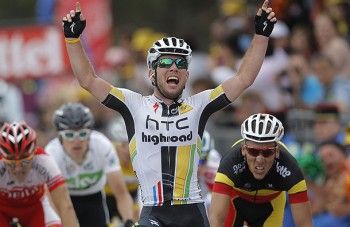
Stage 15 from Limoux to Montpellier was a flat transitional stage, taking the riders away from the Pyrenees towards the Alps. Obviously there was an early break, obviously HTC chased the break down and obviously “Cav”, despite some attempts by Sky, Garmin, Lampre and Liquigas to disrupt his lead out train, Mark Renshaw dropped him off at 200m to go. Obviously Mark Cavendish won the stage, taking his total stage victories to nineteen and setting a record of being the only rider to win four road (as opposed to prologue or time-trial) stages every year for four years. Even Eddy Merckx can’t match that.
He also extended his lead in the Points competition.

Rest day thoughts

The Green Jersey looks like it is Mark Cavendish’s to lose. Phillipe Gilbert could pick up points n the next two stages, but he is 70 points back, and won’t beat Cavendish on the Champs Elysees. His biggest danger elimination on time delays in the mountains, especially the stage that finishes at the top of the Col du Galibier.

The situation in the GC is not what I expected after the Pyrenees. I, along with the man himself, thought that Thomas Voekler’s time in yellow would finish at Luz-Ardiden. He has however ridden well and courageously and still has a lead of 1:49 over Frank Schleck and over two minutes to Cadel Evans, and Andy Schleck. Basso is just over 3 minutes back and Contador is 4 minutes off the pace.

I’m not sure if they are all at about the same level and can’t drop each other, or no one is yet willing to take the risk of losing the tour by making a major attack and blowing up, but what I do think is that if the racing in the Alps continues in the same vein as it did in the Pyrenees, the Thomas Voeckler on the top step of the podium next Sunday is a distinct possibility. If either of the Schlecks or Basso wants to win they need to have at least two minutes on Cadel Evans going into the time-trial. Contador would need to be at least level with him. Some one somewhere is going to have to attack and persist, the probably attack again if they want to win this race.

I am beginning to get the feeling that Andy and Frank Schleck don’t want to drop each other and when one attacks he seems to wait for the other, allowing everyone else back in. Liege-Bastoinge-Liege did show that they are not the sharpest knives in the block when it comes to tactics, though even a tactical genius of the calibre of Dimitri Konyshev could not have done anything against Philippe Gilbert that day.

Predictions? Cadel Evans for yellow in Paris, the other two steps I really don’t know. Contador is improving, but need to get four minutes, I think the Schlecks will find a way to lose the race between them. Basso and Samuel Sánchez are both looking good, but I don’t think quite good enough to win. And as I have already said don’t rule out Thomas Voeckler.

Tour de France 2011 – Part 2: Rest Day Reflections

Tour de France Logo

My original intention was to post my thoughts on the Tour daily, but life got in the way. So these are my thoughts on the first nine days

Stage 3

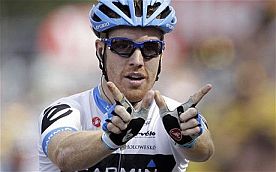
Stage three from Olonne-sur-Mer to Redon was the first of this years tour that offered an opportunity to the pure, as opposed to uphill sprinters. It followed a fairly predictable pattern, an early break by a few riders from French teams and/or Vaconsoliel, steadily reeled in by Garmin and HTC, with some help from other teams. I suppose that it was also fairly predictable, that being his first opportunity at a stage win, things didn’t go quite right for Mark Cavendish aka “The Fastest Man in the World”©. I’m not sure if Garmin successfully disrupted his lead-out train, or whether HTC just messed it up, but either way they failed to deliver him at the 200m to go sign the way they normally do. Garmin have clearly worked out who is going for what sprint and the Maillot Jaune Thor Hushvod, who no longer has the absolute top end speed of a flat-land sprinter, gave Tyler Farrar a perfect lead out to take his first ever individual stage win in the Tour de France.

Tyler Farrar wins Stage 3

About six weeks ago Tyler Farrar’s friend and training partner Wouter Weyland was killed in a horrific crash at the Giro d’Italia. Tyler dedicated the stage win to his memory.

“Cav” also ran into an almost inevitable conflict with the Race Referees. At the intermediate sprint, both he and Thor Hushvod were trying to get the same wheel, with the inevitable bit of pushing and shoving. Neither of the riders thought much about it, and it looked fairly innocuous to me, but the referees thought otherwise and disqualified them both from the sprint and fined them 200 SFr.

Stage 4

Stage 4 finished on the Mur de Bretange which is a beast of a hill in the middle of Brittany. It is about 2km long and ramps up at around 8 to 10%. So http://www.slipstreamsports.com/garmin-slipstream-pro-team/pro-men/thor-hushovd was widely tipped (including by himself) to lose the maillot jaune. It was a stage made for the type of rider who excels in the Ardennes classics. I other words Philippe Gilbert. It didn’t work out as expected though.

The peleton caught the inevitable breakaway a bit before the serious bit of the race. When it cane to the Mur a few riders had a dig including Gilbert and Contador but the guy who hung on to win by about a tyres width was Cadel Evans. Considering the length and the quality of his career I was slightly surprised to find that this was the first ever stage win in the Tour de France. Climbing out of his skin and into sixth place, in the same time as the winner was the MIghty Thor, holding on to his yellow jersey for another day.

Stage 5
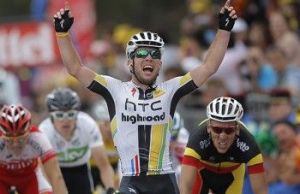
Stage 5 took us from Carhaix to Cap Fréhel we were still in Brittany, narrow winding roads cross winds and lots of opportunities to crash. The stage was sort of sprinters stage, but the finish was again uphill, not as long and steep as yesterday, but steep enough to make it difficult for the flat-earth sprinters. Mark Cavendish decided to prove the organisers wrong. I’m not sure where he popped up from, but in the midst of a bunch of uphill sprinters like Phillipe Gilbert and Edvald Boassen-Hagen “Cav” popped up to take the stage.

Stage 6

Stage 6 took us from Dinan (in Brittany) – Lisieux (in Normandy). It was another uphill finish. Mark Cavendish and Tyler Farrar must be wondering exactly what they have done to upset the organisers of the Tour de France.

The stage was notable because it was the first stage won by a British team for 43 years, not as long as the wait to win Wimbledon or the World Cup, but up their with them. A slight pity then that the winner was a Norwegian riding for Team Sky. Edvald Boassen-Hagen was perfectly set up for the stage by Geraint Thomas and took the win well. Oh the other Norwegian on the tour took third on the stage and kept the maillot jaune for another day.

Stage 7

Stage 7 ran from Le Mans to Châteauroux . Chateauroux was the scene of Mark Cavendish’s first ever stage win in the Tour de France, so would anyone like to guess what happened. Correct, HTC with all nine riders on the front gave Cavendish the perfect lead out, dropping him off with about 200m to go and he finished the job. It was probably made slightly easier because a crash delayed Tyler Farrar, the only other sprinter in the same league as “Cav”, wasn’t around to contest the sprint.

Thor Hushvod finished 7th and kept the lead for yet another day

Other news from a British perspective was  that Bradley Wiggins had to abandon, following a chute which left him with a broken collar-bone. This was a big disappointment as was in excellent form. I don’t think he would have won the race, but he would have challenged for a place on the final podium.

Stage 8

Stage 8 from Aigurande to Super-Besse Sancy was supposed to be the stage when the favourites showed their hand for the first time, and it was definitely the stage that would finally see Thor Hushvod relieved of the Maillot Jaune. The Moyen Montagne of the Massif Centrale was supposed to be too much for him, the first Category 2 climb of the tour and then the climb up to Super Besse should surely see him out the back.
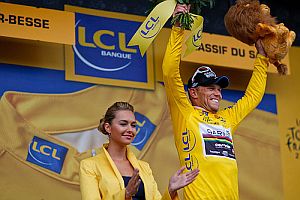
Thor Hushvod Yellow @Super Besse

Yet again this didn’t happen. The favourites were understandably a bit reluctant to blow their brains out for gains that would be insignificant when the real mountains arrive in the middle of the week. and Hushvod well supported by his team, finished comfortably with the leaders yet again.

Stage 9

A crash strewn Stage 9 from Issoire to Saint-Flour was the day that Garmin-Cérvelo and The Mighty Thor ran out of luck. A massive pile up on the descent from the Puy Mary saw Alexandre Vinokourov, Jurgen Van den Broeck, his team-mate Fredrik Willems and Garmin-Cervélo’s Dave Zabriskie all forced to abandon. Later on to wards the end of the stage a piece of what at best could be described as thoughtless driving by a French television car took out two of the riders, Juan-Antonio Flecha and Johnny Hoogerland, in the winning break. Flecha seemed to get away comparatively minor with cuts and bruises, but Hoogerland was pitched into a barbed wire fence.

Garmin’s original tactics had been to put David Millar into the break which everyone knew would include Thomas Voekler. This would have had two effects. First it would have put the onus on the other teams to chase and secondly as Millar was only 8 seconds off the lead himself, it would have discouraged Voekler as Millar would have inherited the Yellow Jersey if the break had made it to the finish. Unfortunately Millar had a minor fall and was still being patched up behind the peleton when Luis Leon Sánchez (who won the stage), Voeckler, Sandy Casar, Hoogerland, and Flecha took off.

The crash on the Puy Mary caused the peleton to declare a temporary truce to allow the riders caucht behind the crash to get back on, and by the time the truce was declared over the break’s lead had gone out from a manageable three minutes to round about ten. In addition Thor’s man for pulling back the breaks, Dave Zabriskie, was in an ambulance with a broken wrist. So after a full week on Thor’s shoulders the Maillot Jaune passed to Thomas Voeckler. The last time he held the jersey was in 2004 he kept it for ten days. His dogged determination to keep it turned him into the most popular rider in France. I doubt he will hold it for that long this time, but he should keep hold of it until The Pyrenees.

Rest Day

The first nine days have already shaped the Tour quite a bit. Two riders(Bradley Wiggins and Jurgen Van den Broeck) who had legitimate aspirations of standing on the podium in Paris are out. Alexandre Vinokourov a rider who does shake things up with his attacks is also out. Other contenders such as Andreas Kloeden, and Alberto Contador have been involved in crashes, Contador more than once. The problem with this is that even though the damage is limited to a bit of road rash, every time you come off it takes a little more out of you. The Schlecks and Cadel Evans have both escaped so far.

In my opinion the two main stories so far have been Thor Hushvod’s defence of the Maillot Jaune and Phillipe Gilbert’s attempts to win the Green Jersey and stages. The Green Jersey competition looks like a three-way fight between him, Mark Cavendish and Jose Joaquin Rojas. Cavendish is the best sprinter, Gilbert can pick up points on more hilly stages, but probably not in the high mountains, Rojas can do a bit of both, but isn’t as good as Gilbert in the hills and isn’t as fast as Cav in the sprints. Thor Hushvod shouldn’t be ruled out either. If you asked me to place a bet my money would be on Cavendish, but I would want decent odds.

As regards the General Classification, from what I have seen so far, my judgement is that Contador is not at 100%, Andy Shleck hasn’t tried anything so far but has covered any moves without apparently breaking sweat. Cadel Evans looks close to his best form, has been aggressive, without wasting too much energy, and generally looks up for it.

My men for the podium in Paris (barring accidents or illness) are those three, but I wouldn’t be too surprised if someone like Nicholas Roche or Tom Danielson sneaks onto the bottom step.

Tour de France 2011 – Part 1

Tour de France Logo

Prologue

Well there isn’t a prologue this year. So you will have to make do with my musings on what is going to happen.

The GC (General Classification or Yellow Jersey) is I think it is a straight fight between Alberto Contador (Spa) Saxo Bank Sungard (last years winner) and Andy Schleck (Lux) Leopard Trek (last years runner-up). Schleck probably is a slightly better climber than Contador and has a stronger and more experienced team, (you don’t get stronger than Fabian Cancellara or more experienced than Stuart O’Grady and Jens Voigt), but Contador proved in 2009 that he can win without a team, or indeed with a team gave that appeared to be actively working against him. Contador is by far the best individual time trialist. The Team Time Trial is fairly short so no team (except possibly Euskatel) should lose too much time.

Who is going to win? I don’t know, but I will be very surprised, barring accidents or an early intervention by CAS, if Contador and Andy Schleck are not on the top two steps. The third step could be occupied by any one of about ten riders, Bradley Wiggins, Jurgen Van Den Broeck (Bel) Omega Pharma-Lotto and Cadel Evans (Aus) BMC Racing Team among the candidates.

The Points Competition (Green Jersey) has a new format this year with only one intermediate sprint per stage and not the two or three that there were in the past.. The other big difference is that the intermediate sprint is now worth 20 points to the winner with points going down to the first fifteen riders across the line. This means that anyone who wants to win the competition will have to go for the points at the intermediate sprint, unlike in earlier years when the overall contenders could rely on a breakaway mopping up the intermediate points and only have to worry about the final sprint. On paper the favourite to win the green jersey is Mark Cavendish, but he has a habit of sitting up in a sprint when he knows that he has been beaten, thus dropping points by finishing tenth when he could have been second or third. Thor Hushvod has stated that the Green Jersey is not his aim this year, so I think that it could well end up on the shoulders of his team-mate Tyler Farrar.

The King of the Mountains Competition (Polka Dot Jersey)has in recent years become a completion fought out by French riders who got themselves into early breaks and hoovered up the points available before the GC contenders started racing properly in the latter stages of the race. Like the Points competition the scoring has been altered this year, with fewer points available on the lesser climbs. This is possibly to discourage the opportunist French breakaway riders and encourage some of the bigger names to make it a goal if they lose time in the GC. Having said that I would like to see David Moncoutie (Fra) Cofidis win.

Stage 1

Saturday’s stage, unusually wasn’t a prologue time trial, but a road stage with a reasonably steep uphill finish. Philippe Gilbert was such a short-priced favourite for the stage that one Belgian punter was heard to remark that it would probably cost him money even if Gilbert won. Surprisingly enough Philippe Gilbert did win it and in style. His team controlled the race well into the finalé, including an amusing to watch, although probably not to do, 100m turn on the front, uphill, by André Griepel. Fabian Cancellara attacked with about 500m to go, forcing Gilbert to go probably a bit earlier than he had planned, but if Spartacus goes, you have to go with him if you want to win. Gilbert caught him and sat on for a few seconds to see what was going to do, then went himself. Cadel Evans tried to bridge across but didn’t manage and came second, with Thor Hushvod coming third and setting himself up nicely for an attempt at the yellow jersey in the following days team time trial.

The other incident that shaped the day, and could yet shape the tour was a mass pile up with about 10k to go. A spectator got too close to the action and caused an Astana rider to crash , bringing half the peleton with him. Alberto Contador although not actually involved, was caught behind the crash and lost about a minute and a half to his rivals.

Stage 2

The second stage of this years Tour de France was the Team Time Trial. Jonathon Vaughters the owner/manager of Team Garmin-Cervélo has tried to win a stage of the Tour de France for the past three years. In addition he has a bit of an obsession with the Team Time Trial. This is probably due the fact that one of the highlights of his career as a cyclist was winning the Team Time Trial stage in 2001 when he was a member of Roger Legay’s Credit Agricole team.

It all worked out perfectly for him and the team. They won the stage by 4 seconds and moved Thor Hushvod out of his world champions rainbow strips into the Maillot Jaune, though today he was rather incongruously wearing the polka dot jersey of the leader of the King of the Mountains competition. If you want to know why I suggest that you read the minutiae of the Rules & Regulations of the Tour de France (in French).
This is link is David Millar’s reaction to the win

Below is Johnathan Vaughter’s reaction.

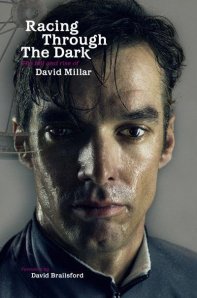
Book Review: Racing Through the Dark by David Millar

Racing Through the Dark by David Millar is an honest self-written account of his descent from an extremely talented young rider to a two-year ban for admitting to using various proscribed substances and through to something like redemption.

Racing Through the Dark cover

A confession; I have been a fan of David Millar more or less since the beginning of his career. Apart from his obvious talent, he always came across as being more interesting than the average cyclist. His answers to journalist’s questions were always a bit less bland.

I was there in 2001, wearing my “It’s Millar Time” t-shirt, in Dunkirk, when he crashed (and as the book tells started his burn) in the prologue. He may have heard my shouts of encouragement as he struggled up Cap Griz Nez, swathed in bandages, just about hanging on to the back of the peleton. I was as surprised and shocked as anyone when he admitted to doping in 2004. I was at the top of the hill at Southborough when he took the King of the Mountains points on the stage from London to Canterbury. So to the book.

The opening two short contrasting chapters set the tone for the book. The overture if it was an opera. The first chapter is his telling of his arrest and interrogation by the French Police that led to his confession of having used performance enhancing drugs.

The second chapter, set five years later, is his story of a magnificent, thrilling, but ultimately futile attempt to win the Tour de France stage from Girona (where he now lives) to Barcelona. Through his words you can capture the renewed joy that he has in the sport of cycling.

Tracing his path from an idealistic neo-pro to his eventual downfall is a fascinating psychological journey. While never excusing himself from responsibility, he shows clearly that unless you were a far more stable and emotionally mature person than he was then, the culture around you drew you into doping. The point at which he finally gives in and agrees to dope is strangely and chillingly banal and matter of fact.

His path back from the depths of 2004 in Biarritz, sitting on the steps to the beach with his sister Francis, wishing he had a fast forward button, to the closing paragraphs, the morning after celebrating his Gold Medal at the Commonwealth Games in Delhi, is neither smooth nor straightforward, but it is ultimately an uplifting story. He has problems with the French Justice system and the French Tax authority. His new team, Saunier Duval seemed to have similar problems to those he met at Cofidis, with riders notably Ricardo Ricco appearing to use EPO and other banned substances, and the management turning a blind eye to the goings on. Joining Jonathan Vaughters’ Slipstream team, with its anti-doping ethos, finally gave him something to believe in.

The book is about as far removed from the bland hack written “autobiographies” of sportsmen and women that we normally expect as can be. It is an open, honest and at times raw account of the pressures and strains that a top sportsman encounters. I think that it is a book that everyone should read, not just cycling fans. And if it does not win this years William Hill Sports Book of the Year award, then I will definitely read the book that beats it.

Racing Through the Dark by David Millar

I have managed to get hold of a copy of David Millar’s book Racing Through the Dark (Orion, 18.99 rrp) in time to read while I am on holiday. Richard Williams reviews it in today’s Guardian book reviews.

He says about the book:

David Millar provides one of the great first-person accounts of sporting experience

The definitive review will be on this blog after I get back from holiday.

The review also covers Richard Moore’s Slaying the Badger (Yellow Jersey, £12.99), which tells the story of the rivalry between Greg LeMond and Bernard Hinault and the 1986 Tour de France. I think that it will also be worth a read.

Persuading the UK to get on its Bike.

The Walking and Cycling group have released an interim report. It makes disappointing reading for those of us who see the bicycle as an essential part of a less energy intensive transport strategy. To sum the report up in a few words; The adult population of the UK just doesn’t get cycling, except as a leisure activity.

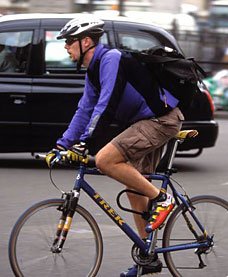
I’m trying to work out why? Does the image that we project as cyclists put people off? We are not all Lycra clad and super-fit, but if that is the image we project then it is understandable why the public think that they wont and don’t want to make the grade.

Typical British Cyclist ?

In the Netherlands, which in many ways is the European country that most resembles the United Kingdom, about 25% of all journeys are made by bicycle. In the United Kingdom it is about 2%. So what I want to explore is what makes the Dutch get on their bikes and the British get in their cars.

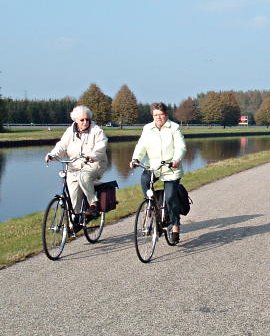
Typical Dutch Cyclists?

What are our reasons/excuses for using our cars and not our bikes?

The weather is often given as a reason, it rains a lot in Britain. It does if you live on the Northwest coast of Scotland or in Cumbria, but I refuse to believe that it rains more in the populated areas of Britain than it does in the Netherlands. Even if it does rain more, to quote some one, possibly Billy Connelly “there is no such thing as bad weather, just inappropriate clothing”

The Netherlands are much flatter than the United Kingdom claim the motorists. I will agree, that for the most part they are, but there are bits of the Netherlands that are far from flat, and large areas of the United Kingdom, such as London that are less than Alpine in their hilliness. Flatness of the countryside is a double-edged sword, as any one why has cycled across the Fens into a head wind will tell you.

In my opinion the biggest obstacle to getting the British on their bikes is a justified fear of the traffic in our cities and towns. I do think that the dangers of cycling in Britain are often overstated, but I cannot pretend that they are non-existent.

Mrs johnm55 loves cycling, put her on her bike out in the countryside, especially on a sunny day with the prospect of lunch at a country pub, and she is in heaven. But she hates cycling in London. She finds the conduct of a significant number of other road users intimidating. They rarely leave a safe distance between her and their vehicle, they overtake at inappropriate times and they are rude and impatient. As a result, when she does use her bike in London she tries to find routes that keep her away from traffic as much as possible. The problem with such routes are that they are usually rough surfaced, tend to take you away from populated areas, are often poorly lit after dark, and often have pedestrians wandering willy-nilly across them. Pedestrians who get upset, and as rude as any motorist, if you ring your bell to warn then that you are coming up behind them. (Possibly they would prefer it if you yelled “get out the #@*!#@!# way you moron.”, but Mrs johnm55 is a very polite woman and would never even think of saying things like that. johnm55 at times takes a different view.)

All this means is that compared to cycling on the road, cycling on traffic free routes, in London, often is a very slow way of getting from A to B.

Now, look at the photo of the Dutch cyclists above, what do you see under their wheels?  Correct, a well surfaced (motor) traffic free cycle route. The Netherlands has a has a comprehensive network of traffic free cycle routes which is one reason for the Dutch getting on their bikes. When the cyclist In the Netherlands has to share the road with cars, as they have to, even with a well designed system of cycle routes, The Netherlands has another advantage. In common with most other European countries the Netherlands has what is often known as a law of Strict Liability. The law assumes that unless proven otherwise, if a car collides with a more vulnerable road user (cyclist or pedestrian) then the car driver is at fault. The video gives explains how it works:

Any law similar to the Dutch law is of course anathema to our motoring organisations and Jeremy Clarkson, so there is not a lot of chance of a law like it being passed in this country any time in the near future. Of course a law of strict liability only goes so far. Hopefully it will make drivers slightly more careful around cyclists and pedestrians.  It is also comforting to know that your loved ones will be taken care of if you are crushed by a lorry, but it is probably fear of getting crushed by the lorry that stops you getting on your bike in the first place. So we are back to needing effective cycle routes.

London’s developing network of Cycle SuperHighways are a start, but the one I have used CS7 still allows cars to park on it, forcing you out into the main traffic. Car drivers also don’t seem to take all that much notice of the blue bit of the road surface that is for cyclists alone. Driver education might help. Getting more cyclists out on the road would definitely help to make life safer for all cyclists.

Possibly the choice of bikes on sale in the UK doesn’t help either. It is getting better, but if you go into the average bike shop in Britain you will be hard pushed to ride out on a bike that can be ridden wearing a suit. By that I mean a bike with full mud-guards, an effective chain guard, and an upright riding position. Strangely enough his type of bike is known in the UK as a Dutch roadster.

An additional problem is where people keep their bikes when they are not in use. I used to keep all my bikes safely locked up in the shed in my back garden. The five or six minutes it takes to get the bike out of the shed and on to the road, then make sure all the back doors and gates have been re-locked is not a big deal, if I am going out for an all day bike ride. However, if all I am doing is going along to the shops to get some bread and milk, it is easier to take the car. The car sits outside the front of the house, all I have to do is unlock it and jump in.
I overcame this problem by keeping my old bike locked to a strong point at the front of the house. This makes it at least as easy as using the car for short trips.

I was going to insert a mini rant about cycle helmets at this point, but he post is getting a bit long so I’ll save it for later.

To sum up; I feel we need to do the following to encourage more use of the bicycle for transport.

This study took place in Copenhagen, Denmark over 14.5 years. It found that cycling to work (an average of 3 hours cycling per week) decreased risk of mortality by about 40% compared to a sedentary control group. This study involved 30,000 people. The study took into account age, health status, and socio-economic factors such as education. It also found that older people gained even more from physical activity than younger people.

Next time for the sake of your health and the planet’s health, if you are going to the shops or the pub or to work, and the journey is five miles or less, think about walking or using your bike, it will probably be quicker anyway.

A good weekend for British Cycling

It has been a fairly impressive weekend for British Cycling.

Bradley Wiggins
Bradley Wiggins
Bradley Wiggins (Team Sky) won in the time-trial at the Bayern-Rundfahrt on Saturday (beating World Champion Fabian Cancellara by 30 seconds in the process) .
Geraint Thomas

Geraint Thomas (also Team Sky) also produced a strong ride to take him into the leaders jersey. He and his team successfully defended the lead on the final stage yesterday to give him his first major stage race on his palmares.

On top of that on the other side of the Alps in Milan, David Millar (Team Garmin-Cervelo) won the final stage of the Giro d’Italia

David Millar

Every one should have a bike like this

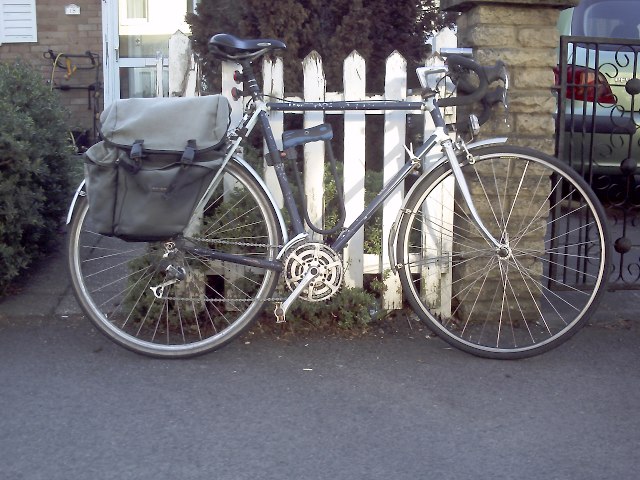
My Old Bike
My Old Bike

It’s definitely not my best bike (that’s my old ‘racing’ bike), it’s not the bike that I cover the most miles on (that’s my touring bike), but it is the bike that I use the most often. I have had it for nearly twenty years now, . It lives outside the front door, ready for action. It’s the bike I ride to the shops, to the pub and occasionally when the work I have to carry out and the sites I need to visit on a particular day fit in, the bike I ride to work.

It was found in a skip, although probably the only part of it that is left from the original bike is the frame. The handlebars and brake levers were salvaged from a bike that a friend of mine had wrecked. He did quite a good job, the handle bars were just about the only part that was reusable. How he managed to do it without causing similar damage to himself is still a source of amazement. Some bits, like the super-duper suspension seat post, were bought for another bike, then discovered to be the wrong size when I got them home. Other parts were acquired from my other bikes as they wear out, or are replaced by something newer and shinier.
Below is a slide-show illustrating some of the unique features, such as the aerodynamically enhanced duct-taped mudguard, the custom ‘chipped’ paint job, the Christmas tree of lights (in the hope that Wallington drivers will actually see me on winter nights) and last but not least the ‘D’ lock that is probably worth more than the bike itself.

This slideshow requires JavaScript.