
Category Archives: Domestic (UK)

Rupert Murdoch, Phone Hacking and Press Regulation

Will Cookson has an interesting post on media regulation, where he argues against our current media ownership rules. He says;.

We need to look at the ownership rules of the media for our country. They are not like other goods and services. They can strike at the root of our democracy. If someone like Rupert Murdoch can summon senior politicians at short notice to the other side of the world because of his power then that is bad for democracy.

The media should only be allowed to be owned by UK citizens resident in this country. Political parties are no longer allowed to receive gifts from overseas residents and the same should apply to the media ownership.

Not that much for me to disagree with there, though drafting legislation in such a way that it cannot be challenged (especially under EU competition law) will be difficult. Plus all our main political parties and the City do not think that nationality of ownership is anything that we should worry about. Convincing them otherwise without voting for a UKIP or a Socialist Workers Party government at the next election will be difficult.

Where I tend to disagree with Will  is on his proposals for regulation, which I think have implications around freedom of the press, and freedom of speech in general. He says;

We must have an external independent ombudsman for the media whatever the media throw at the politicians (and be prepared for some very nasty stories about politicians with innuendo and smears in the early autumn).

Newspapers have always been the tools and playthings of the rich and powerful. Owners in the past like Lord Beaverbrook and the Rothermeres  (owners of the Daily Mail) have always used their publications to persuade, bribe (by granting or withholding support) and if necessary bully governments into doing their bidding. Whether Rupert Murdoch has a larger and more insidious influence is a moot point

I am sure that journalists on the past bought information and were on far too friendly terms with various police officers. They didn’t hack mobile phones (they didn’t exist), but probably had ways of tapping landlines if they thought that the story would be worth the risk. But the sins of the past do not excuse the sins of the present day.

Even phone hacking gets a bit tricky. I don’t want my mobile hacked. I don’t want Milly Dowler’s parents’ phones hacked. Neither do I want the phones and emails of relatives of service personnel killed in Iraq and Afghanistan hacked. But, say a newspaper has very tenuous evidence that a senior politician is accepting bribes to influence the placing of government contracts , would I worry if the newspaper hacked his or her phone as part of their investigation?

The hard question is what to do about it. It is without doubt that what happened at the News of the World was beyond the competency of the Press Complaints Commission as it is presently set up. The PCC does valuable arbitration and conciliation work and it needs to carry on doing it, but without increased powers it should drop the pretence that it is a regulator.

A truly effective regulator has to have the powers to stop a story being published in the first place. Our ridiculous libel laws (“super-injunctions”) are often used by celebrities to just that end. The publishing of a story , or putting a celebrity adulterer’s name to a twitter #hashtag. puts the information into the public domain. Taking it back is impossible. The regulator can do nothing other than deal with the complaints.

The idea of a state appointed “independent” press regulator worries me. Would a state appointed regulator have allowed the Daily Telegraph break the story of the MP’s expenses scandal? MP’s, and probably not just the guilty parties, would have complained to the regulator and asked for the suspension of the story. The Telegraph bought the information. The information, was probably stolen. I think that an independent regulator would have prevented the Telegraph publishing the story.

How far will the press regulators powers go? Will every story in every newspaper need submitting to him or her before publication? If not, what will be criteria that triggers the need for submission? If a newspaper (or other outlet like say a blog) publishes an unsuitable story what powers will the regulator have to correct them? Will the regulators powers only apply to newspapers, or will they extend to include all publications? If the regulators powers cover all publications, will I have to send my blog posts, will they come back with the spelling and grammar corrected and will the regulator reading my blog posts show up in my statistics? Do we want to regulate unsuitable stories or just unsuitable methods of journalism?
We must have these, and probably more questions satisfactorily before we head down this path.

I think that keeping press regulation voluntary, with the PCC having increased powers to demand retractions and insist on the positioning of the retractions within the newspaper, and possibly even suspending a publication in the worst cases might work. If, as is currently the case with the Express group newspapers, they refuse to be bound by the PCC rulings then OFCOM will take over their regulation. OFCOM has the powers to insist that the owners of a non compliant company sell their stakes in it (at a loss if necessary).

Oh, and applying the law, not just to “rogue” reporters, but extending culpability to those who employ them.The possibility of the Rupert and James Murdoch, Andy Coulson and Rebekah Wade, spending some time behind bars would really get the attention of the owners and editors of newspapers. I understand that the instances of phone hacking have dropped to round about zero since Glenn Mulcaire and Clive Goodman were jailed.
I am also sure that it is against the law for police officers to pass confidential information to third parties, with or without money changing hands. If the law needs clarifying then clarify it, but again applying the law will be more effective.
Debt Crises and Paying Your Taxes.

The budgetary problems of Greece are again making the headlines. The country is in a mess, and because of it the Euro-zone is also potentially in a mess. If the Euro goes tits up, the banking crisis of 2008 will look like a bun-fight at the church fête. The question I want to explore is how did we get here?

There are two basic reasons why Greece got itself in to its current situation:

  • The previous government cooked the books
  • Paying your taxes is seen as a voluntary activity – especially by the rich

Philip Inman in exploring the possible outcomes of the crisis, states this as part of the most optimistic (and least likely) scenario:

Greece’s rich landowners, shipping magnates, doctors and dentists all agree to pay their taxes. As City credit analyst Jan Randolph of IHS says: “The Achilles heel of the Greek economy is tax evasion. If the rich paid their taxes there wouldn’t be a problem.”

Grecian doctors and dentists apparently use accountancy systems that British “cash-in-hand” builders might be advised to study. The mega-rich just avoid paying taxes at all.

Jason Rosehouse touches on this in the context of American politics

The power brokers in the Republican party are primarily Wall Street barons and other members of the super rich. On domestic policy they care almost exclusively about redistributing wealth upwards and in creating an entirely unregulated environment for corporations. The flip side is that anything that might benefit poor or middle class people they oppose. That is why they will fight tooth and nail to oppose the tiniest tax increase on millionaires, but will then turn around and accuse schoolteachers (!!) of being greedy. It is why they openly despise the public schools, and propose ludicrous, unworkable tax schemes that overwhelmingly benefit the super rich. It’s why they are so horrified by the idea that the health care system might be reformed to make it possible for millions of uninsured to obtain insurance. (It’s certainly not that they had a better idea for reforming the system. And notice that when they controlled both Congress and the Presidency from 2000-2006, they never even mentioned the health care crisis. As far as they are concerned, forty million people without health insurance simply isn’t a problem.)

This increasingly the situation throughout the western world. The rich basically want it all. They want the state to educate and train their workforce. Suitably trained they want our labour at the lowest possible price. They expect the state to protect their property, to make sure that the transport system and services work, and in the last resort to bail them out. But they are more and more reluctant to pay for any of it.

They demand lower corporation tax. They demand that the 50% income tax rate be removed. Multi-nationals declare their profits where ever it suits them, regardless of where those profits have been earned. Thus they deprive developing nations of large amounts of needed and legitimate revenue.

The middle classes in the west used to think that at least we had a share in all this corporate greed through our pension schemes, but even that is going. We are now too expensive to keep in our old age, and paying into a employee pension scheme damages corporate profitability. Besides the middle classes are no longer needed by the Masters of the Universe©. Someone on the other side of the globe can do (with a few exceptions) your job just as easily and for half, or less, the wage that you need to live on in the west.

When Bill Clinton left office in 2001 the American Federal Budget was in surplus, now it is in massive deficit, essentially because tax cuts for billionaires, one and a half unnecessary wars and allowing the banks to run amok. Many of the Republican candidates for the 2012 presidential elections are making noises about cutting taxes for the rich, and cutting corporation tax, “balancing” the budget by cutting environmental protection and programs such as Medicaid and Medicare. One of them Michelle Bachmann is proposing increasing the tax burden on the working classes to help offset this.

In this country the Tories haven’t gone that far yet. They would like to abolish the 50% income tax rate for high earners. They would like to cut corporation tax. But it is difficult to do so when you are trying to claim that the country is bankrupt. If you are lopping £20 billion of the NHS budget and closing Sure Start Centres, a give away to the rich just might be the trigger for either riots or the LibDems to develop a bit of backbone, neither of which is desirable from a Tory point of view.

Getting back to my original point; Government is a necessity in any community over about one hundred and fifty, and governments need to raise revenue. Graduated taxation of income is the fairest way to do it.
If the rich are not prepared to pay their share, which they did (up to a point) in the past, then all the west is heading in the same direction as Greece.

I’m Voting Yes to AV

Why I am voting yes on the 5th of May

  1. The Alternative Vote is not perfect but it is more democratic than the system we currently use.
  2. It ensures that our elected representative has the approval (except under fairly unlikely circumstances) of at least 50% of the people who could be bothered to vote.
  3. If we don’t vote for this small improvement in out electoral system, any hope of the major change that is required will be lost for a generation.
  4. Voting for AV will seriously upset the Tories and John Reid – got to be a good thing.
  5. I don’t like kittens 😉

This is much important for our democracy than some people think. Resist the urge, those of you who support Labour to stick one to Nick Clegg, he’ll get his just desserts soon enough.

Just vote tomorrow, and vote ‘Yes’ .

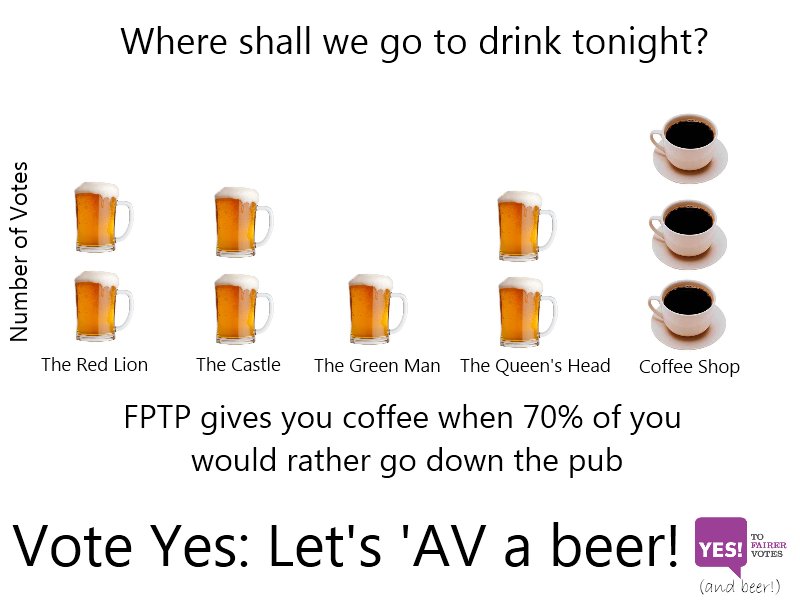
Best Argument yet for AV

You know AV makes sense.

The arguments just needed to be put in a way that even a man can understand.

Let's AV a beer

Vote yes next Thursday – unfortunately we can’t promise free beer. 😦

AV is the Only Game in Town.

Jonathan Freedland in today’s Guardian tells us why we need to vote yes to the Alternative Vote on May the 5th. Most people in favour of a proportional system of electing our government will fully acknowledge that it is in Nick Clegg’s words a ‘Baby step on the way to Electoral Reform’. But it is a crucial step, it is the first step on the way to meaningful reform and if we do not take it, there will be no more steps for a long time.

We can argue the merits of Single Transferable Vote over the Additional Member System ’till we are blue, red, yellow or green in the face. We can agree that either would be infinitely superior to AV, but what we can’t do is refuse to vote for AV because it doesn’t give us everything we want.

Jonathan Freedland concludes with this lesson from Australia:

Of course AV is miles from perfect, even if it does allow voters to express more fully their true preferences; most reformers would prefer PR. But it’s naive to think that defeat next week would keep progressives’ powder dry, allowing for a future push for full-blooded electoral reform. That’s rarely how politics works. It’s success, not failure, that breeds success.

That lesson was taught in 1999, when Australia held a referendum on whether to remove the Queen as head of state. The alternative on offer was another “miserable little compromise” – with MPs, not the people, electing a new head of state – and some republicans preferred to let it fail and wait for something better. They’re still waiting – and Elizabeth II is still Queen of Australia.

Let’s not let the perfect be the enemy of the good

Voting Reform – First Past The Post

First Past The Post (FPP) is the system of electing our MPs, and, in England at least, most of our other elected officials. How it works is simple to understand. You are presented with a list of candidates and you put your “X” against the one you dislike the least. After the polls close the votes are counted and the person with the most votes wins. Dead simple, your dog could understand it, so why don’t I like it?

The first reason that I don’t like FPP is that it wastes my vote and thousands of other people’s votes. Where I live, in the area of South London that has Surrey as its postal address, if I vote the way I would naturally, for the Labour Party, my vote is wasted, it has no effect on the result of the election because it is completely outweighed by the Lib Dems and the Tories.

My guess is that roughly 25% of the population, in this area, would normally support the Labour party, about 35% would normally vote Tory and a slightly lesser percentage vote Lib Dem, with the remainder voting UKIP, Green and etc. So one in four of the local constituencies should have a Labour MP, err no…. Either Tory or Lib Dem. Strangely enough the current system probably means that the Lib Dems are over represented in this area due to a lot of Labour and Green supporters voting for them to try to keep the Tories out.

The second reason that I am against FPP is that it creates safe seats, where as the saying goes you could put a pig up as candidate and providing it was wearing the right colour rosette it would be elected. I know much has been written in the past day or two about the demise of the Liberal Democrats in the Barnsley by-election, but it does not disguise the fact that only Labour could win there, and that the winning candidate Dan Jarvis now has a job for life if he wants it. Unless of course he finds himself with  same accounting problems that his predecessor encountered. And again how many votes were wasted in this election? I would argue that every vote cast for a candidate other than the winner was wasted and about half the votes that were cast for him. The turn out for the by-election was 36.5% – roughly two-thirds of eligible voters stayed at home. Why? a wet and cold Thursday in early March probably did not help, but largely they stayed at home because the outcome was certain and they felt that it wasn’t worth the effort of going to the polling station.

If we want – and almost every politician of every hue say they want it – increased voter participation then we need an electoral system that makes every vote count for some thing.

The third reason that I am against FPP is that it encourages, even demands, tactical voting. In a two-way marginal seat, the supporters of the minority parties are almost obliged to vote against the candidate they like least, rather than voting for the candidate they like best. This depresses the vote of the minority parties and reduces their voice in the public square. For example at the last general election the green candidate for my constituency was a friend, and while my political leanings tip slightly more toward red than green, under any sensible voting system I would have voted for him, knowing that he would be unlikely to be elected in a single constituency vote, but knowing also that my vote is not wasted as my second and third preference votes, will still count if he is eliminated. This would give not only a fairer system of voting but also a clearer picture of the actual level of support for political parties. What happened in reality, I voted Liberal Democrat in the hope of keeping the Tories out. Which it did in this constituency, but for all the practical good it did the country, I would have been better voting Green.

The fourth reason I am against FPP is that it allows single party majority governments to be formed with considerably less than 50% of the votes cast, let alone the votes of 50% of the electorate at large. Even at its peak in 1997 Labour won 63% of the seats with only 43% of the votes cast. Admittedly the current coalition government took about 59% of the popular vote between the two parties, but this is genuinely the exception that proves the rule.

My conclusion about First Past The Post, it is better than no vote at all, but it is time that we ditched it in favour of a more democratic system that allows all voices to be heard and not just the biggest and loudest ones.

More Voting Reform – Single Transferable Vote (STV)

Anyone who has been reading my posts  on voting reform (if anyone has been reading them apart from possibly Grace) they will probably have noticed that I am trying to work out what I think  about it.

I am convinced that our current first past the post system is not good for democracy in the long, or even the short-term. I am not quite so sure what to put in its place, hence the series of posts.

“I am convinced that our current first past the post system is not good for democracy in the long, or even the short-term.”

This time I am going to look at the voting system known as the Single Transferable Vote (referred to from now on as STV to save typing). This is the system that has caught my imagination the most.

I’ll explain how I think it works, then look at the advantages and disadvantages of the system.

The STV is based on the idea of proportional representation and preferential voting. Initially your vote is cast for the your preferred candidate and then after candidates are either elected or eliminated, transferred to other candidates in line with the your stated preferences. The system minimises ‘wasted’ votes. You are also voting for individual candidates rather than party lists.

How it works

STV works by using multi-member constituencies. As with all alternative vote electoral methods, you rank the candidates in order of preference, 1 to however many candidates you care to vote for. You do not have to cast a preference for a candidate that you abhor. So you just number your preferences 1 to 11 and leave the twelfth candidate out. In the event of your preferred candidates being eliminated or elected your vote will not be transferred to them.

Candidates are generally elected using the following formula:

So in a constituency that elects 6 members, if there were, say 150,000 valid votes cast, each elected candidate would need to get 21,430 votes to be elected.

After you have cast your vote the system works like this:

All the First preference votes are counted, one candidate has 30,000 votes and is elected, but none of the others have enough first preference votes to get over the electoral thresh old. Candidate one has 8,570 surplus votes, so they are distributed among the remaining candidates according to the second preferences of the voters.

The votes are counted again and still no candidate reaches the magic figure, so the candidate with the lowest number of votes is eliminated and his or her second preference votes are redistributed among the other candidates. This process goes on until all the vacant seats are filled.

Ireland uses this system for its elections and if you want to see how this works in practice look at the results for the Dun Laoghaire Constituency in Ireland’s 2007 Elections.

The Electoral Reform Society has an example of a model STV Election here

Advantages

STV gives us as voters much more choice than any other system. We determine who is going to be elected. Under the current system part officials, especially in ‘safe’ seats, essentially decide who our MP will be long before we get a chance to vote. Under STV MP’s responsibilities will be more to the people who elected them than to their parties.

  • Fewer votes are ‘wasted’, either by being cast for a candidate with little or no chance of being elected, being cast as surplus votes for a winning candidate.  What this means is that most, if not all, voters will be able to identify representative that they helped to elect. This link in turn helps to increase the representatives accountability.
  • Post election STV gives voters a choice of representatives to approach with their concerns, rather than just the one, who may be indifferent or actively opposed to the concerns of the voter. Indeed in some cases the representative may be the cause of the concerns.
  • Competition, we are constantly told, is a good thing, and generally this is the case. Competition to provide a good service to constituents is no different.
  • Because there are no safe seats under STV,  candidates cannot be complacent and parties must campaign everywhere, and not just in marginal seats. This also means that candidates with in a party must find their own voice. It is extremely unlikely that if a party puts up a full slate of candidates (i.e. six candidates for a six member constituency) they will all be elected. So candidates with in a party will have to be able to sell themselves to the electorate as well as their party manifesto.
  • Because we rank candidates, the most disliked and/or extreme candidates cannot win, because they are no good at picking up second, third and lower-preference votes.
  • There is no longer any need for tactical voting. Vote for the candidates you want, not against the candidates that you don’t want.
    All my life for some reason or other I have managed to find myself living in Conservative/Liberal Democrat marginals. All my life this greenish, left leaning voter has been voting Lib Dem, in the hopes of keeping the Tories out. Under STV I will no longer have to do this.
  • Because there will be a more sophisticated link between a constituency and its representatives,  there will be an increased incentive to campaign and work on a more personal and local level, but also, the constituencies are likely to be more sensible reflections of where community feeling lies.

Disadvantages

To be honest I don’t think there are many. Most of the ‘disadvantages’  cites by supporters of ‘first past the post’ such as loss of connection between the representative and the constituents are red herrings. True STV is much more likely to give rise to coalition government, but current examples aside, is this necessarily a bad thing. However there are some potential problems.

  • If a representative dies in office, or resigns how do you replace them?
  • Counting of the votes will take longer than under the current system (or AV) so the results will not be declared on the night of the election.
  • In some parts of the country, notably the Scottish Highlands STV will result in massive constituencies.
  • Some voters find doing anything other than putting an ‘X’ in a box to complicated for them, therefore there will be an increase in spoiled votes.

To my mind none of these disadvantages come anywhere near to outweighing the advantages of  STV.

Summary

Give my choice STV is the electoral system I would choose. Unfortunately it is not the choice that we are being offered. The choice is between the current system (first past the post) and the Alternative Vote.