Category Archives: Domestic (UK)

Is the Green Party the Answer for the Left?

The Green Party has recently seen a surge in the opinion polls and its members. Depending on how you count them they now have more members than the Liberal Democrats and possibly by the time the votes are counted on the 7th of May more MPs. However I have always had my doubts about the Green Party. Neither because I am a climate change denier nor because I don’t believe that we need to be careful about what we do to our planet, but because I feel that at a basic level what the propose probably won’t work.

The reason that I say this is because I do not think they have a theory of the generation and distribution of  wealth. All the other parties have a theory for both these functions. Sometimes the theory is fairly explicit as in the case of the Labour party, with others, especially the Conservatives it is implicit. I am not the only person who feels this, Suzanne Moore thinks the same.
As she says:

We would like our politics to be bigger not smaller and for a moment to be able to think the anonymous “market” doesn’t always win. Some of us would like to vote for something unashamedly leftwing. Syriza’s Alexis Tsipras goes to lay flowers on the graves of communist fighters. He is unashamed of being who he is. The man is a radical who knows how to wear a suit, just as his finance minister, Yanis Varoufakis, knows his poetry as well as his economics.

&nbsp
Syriza is a seriously radical party of the left. The Green party isn’t. They portray themselves as the only anti-austerity party in Britain, but don’t tell us how they will meet this aims economically. Do they favour tax rises and if so what tax rises?  What do they plan to cut, apart from the Trident programme – something incidentally I also think should be cut. The estimated cost of replacement at £34 billion, although some estimates go as high as £130 billion. This (£34b) is less than a third of the cost of running the NHS for one year.

Their one policy in this arena “The Citizen’s Income” which is an unconditional, non means tested, non-withdrawable income for every person, including children. It is, I think ,intended to be linked to citizenship and it replaces personal tax allowances, and most means-tested benefits. It will do away with jobseeker’s allowance, child benefit, the basic state pension and tax credits. There is one major problem; without means testing the poor will be worse off.

A second point is that if there is a link between Citizen’s Income and citizenship where does that leave foreign nationals working legally in the UK?  For example an EC citizen would lose all his or her tax allowances and be entitled to nothing in return. They would not be entitled to job-seeker’s allowance if they found themselves out of work nor tax credits if they are in a low paid job. It sounds more like a policy that UKIP would come up with than the policy of a party of the left. I also think that it would be in breach of EU employment law.

My other major gripe about the Greens is their anti-science bias. Significant  numbers of Green Party members seem to believe that the NHS should provide alternative treatments including homoeopathy as a matter of course.

As what is now unofficially known as “Minchin’s Law” states :

Alternative medicine has either not been proven to work or has been proven not to work. Do you know what they call alternative medicine that has been proven to work? Medicine!

 
Still treating people using sugar pills and water must be cheaper than using the current methods. Chuck in a bit of Reiki and Crystal Healing and we should be able to get the cost of running the NHS down from £115 billion a year to £5.35 plus the water bill.

Ask your average Green party member if they accept the scientific consensus on Climate Change and you will get close to 100% affirmation. Ask if they what they think about safety of Genetically Modified Crops and they will that they are not sure and that we need to be cautious. Point out that the science behind the safety of GM crops is at least as sound as the science behind Climate Change and you will still be told that we should apply the precautionary principle. This is the same argument that Climate Change deniers make.

Similarly with Fracking. The process is safe, but you won’t hear that from the Green Party. There are very good environmental arguments for leaving as much oil and natural gas as possible in the ground. Instead of making the hard argument that making hydrocarbon fuels more expensive is in the long run a good thing, the Green Party prefers the easy but untrue argument that it is dangerous. But I suppose on the basis that all publicity is good publicity, getting your one and only MP arrested at a Fracking protest gets you in the news.

If you want to know what a Green Party government might look like take a look at the one place where they are in charge; Brighton. A Green Party has managed to reduce recycling rates and delivered a greater series of cuts and privatisations than the Tories had planned.

As Steve Bassam (former Labour Leader of Brighton and Hove Council) says;

You just have to look at my home city, Brighton and Hove, where the Green Party run the council, to see what an unrealistic agenda looks like. Indeed, they have given radicalism a bad name, with unwanted gesture politics and unattainable promises.

 
I don’t know how Syriza is going to work out for Greece, but Greece does need something radical, and I wish them well. Radicalism must be rooted in reality and I’m afraid that the Green Party isn’t.
To the Green Party I would say come back and see me when you have worked out something like an economic policy and when you are prepared to accept the scientific evidence, even when it doesn’t fit your prejudices, in the meantime I’ll stick with the Labour Party and hope that it can grow a bit of a backbone.

I know voting Labour isn’t a particularly exciting vote, but we don’t have a Syriza or a Podemos to vote for in the UK and Labour is as close to a radical party as we have. Perhaps as Suzanne Moore says;

If we actually want a leftwing party in Britain then we may have to do something quite green. Grow our own.


The original stating of “Minchins Law” can be found at about the 3:00 minute mark in the video (NSFW it’s a bit sweary). It also gives a very funny takedown of a certain type of person who probably votes green (if they can be bothered to vote at all)

Re-ordering the United Kingdom

Following the Scottish Independence Referendum it is generally agreed that how we govern the United Kingdom needs to be overhauled and dragged into the 21st century.

David Cameron thinks that it can all be stitched up neatly by a Cabinet committee.  However it only takes about two seconds of thought to understand that his proposal for “English votes on English Laws” (EVEL) is nothing but a piece of low politics, designed to make it difficult if not impossible for the Labour party to form an effective government.

As Vernon Bogador (Professor of Government at King’s College London) says:

But the British constitution is not the private property of the Conservative party or, for that matter, the Labour party or the Liberal Democrats. A constitutional settlement, if it is to be lasting, needs the support of all parties, and endorsement by the people as a whole after measured debate. It is hardly suited to the hurly-burly of the hustings.

 
His article on the subject essentially demolishes Cameron’s plans.

Ed Milliband and the Labour party propose a constitutional convention, which if it isn’t used as an excuse to do nothing, is the way forward. With a bit of luck we might even come up with a proper constitution; i.e. a written one, at the end of it

UKIP, I think, wants to re-build Hadrian’s wall. I can’t find any official Liberal Democrat policy, the only thing I can find is this on the Liberal Democrat Voice blog (not an official outlet) which says “Err… not sure…let’s hold our horses”

Here are my ideas on what we need to do about re-ordering the way we govern ourselves. The first draft of my submission to the constitutional convention if you like.

Federal System

In my opinion we need to move to a federal system of government. Scotland, Wales and Northern Ireland already have their own devolved assemblies. Some have proposed that England should have its own assembly as well. England’s population is around fifty million. It is too large and too London-centric to have an effective devolved government covering the whole of the country. In my opinion power needs to be handed down to smaller areas to provide an effective local devolution  I would suggest looking at how the German Länder system works, or, if we want to stick to the Anglo-Saxon world the American, Canadian or Australian systems would be suitable starting points.

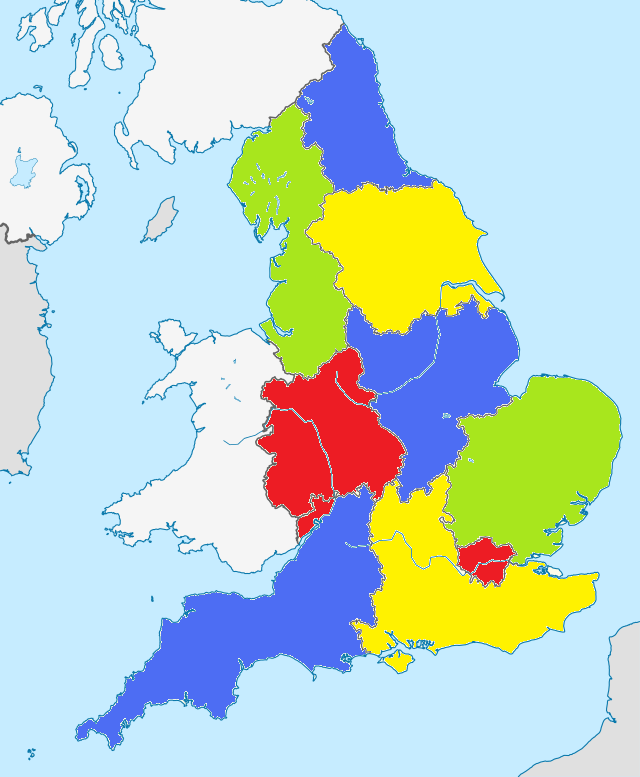
9RegionsColourSome have proposed that power be devolved to the cities, Each of the major cities should have its own assembly, possibly modelled on the London assembly complete with elected mayor. The problem with this is that it leaves those parts of the country that aren’t major cities with a bit of a democratic deficit. Others, have proposed devolving greater powers to the counties and unitary authorities. I feel that they are too small to wield  power effectively.

My proposal is this:
The nine regions of England, the North East, North West, Yorkshire and Humberside, East Midlands, West Midlands, East Anglia, London, The South East and the South West, have very roughly similar populations. They should each be given their own regional assembly with powers at least equal to those of the Welsh assembly. They would be funded initially according to the Barnet formula. The members would be elected by proportional representation. I would think that each regional assembly would have between 50 and 80 members.

The Welsh, Scottish and Northern Irish Assemblies would obviously continue as they are.

The North East rejected a regional assembly in 2004 and some people argue that this shows that there is no desire for regional devolution in England. However what was on offer in 2004 was not devolution but a regional talking shop. As the Newcastle Journal says in an editorial:

The North East rejected the creation of a new regional assembly in a referendum in 2004.

What was on offer then was NOT devolved powers, but a talking shop with no authority.

Devolution is not about creating a new class of politician. It’s about bringing powers and control over funding to the region – so that we can set our own priorities for training, education, health services and more, and carry out vital infrastructure projects without going cap in hand to Whitehall.

There needs to be a debate about who would exercise these powers, but there is already a tier of local government involving councils working together in a combined authority.

Our MPs must also play a role – and their voices must be heard at Westminster, too.

But let’s be loud and clear about one thing, so that the message reaches those in the Westminster bubble. The North East did not reject devolved powers in the assembly vote. The powers were never there.

 
I think that there is an appetite for genuine devolution in the regions of England.

Reduced size House of Commons

With Regional Assemblies in place doing most of the spade work of governing I would question whether we still need a House of Commons of six-hundred plus members. I think that it could be reduced to around two-hundred and fifty, elected by some form of proportional representation.

Its remit would be to consider the aspects of policy that would remain at national (federal) level. Aspects such as foreign policy, defence and overall fiscal policy. It would also be responsible for aspects of policy devolved to regional level, that need national co-ordination, for example transport.

Abolish the House of Lords

The House of Lords obviously has to go. It needs to be replaced by an elected assembly which I propose should be known as The Senate. The Senate would be elected from the regions, with each region supplying the same number of Senators. I would suggest six per region giving a total of 72. Again they would be elected by proportional representation, probably on a region wide basis. The Senate would be mainly a revising chamber. It would have the power to amend legislation and send it back to the Other House 1 for further consideration, but would not have the power to block legislation. It could also propose legislation, but such legislation would have to be passed by the Other House

Proportional Representation

All members of all the various assemblies would be elected by a system of proportional representation . My preferred system  is the Single Transferable Vote but we can argue about the details later.

Reduce the Voting Age to 16

When the SNP decided to lower the voting age to sixteen for the referendum I was sceptical. My thinking was that they hoped to tap into naïve patriotism and that most 16 to 18 year olds would vote yes. This did not prove to be the case. As the campaign went on it became obvious that they were listening to and participating in the discussion on both sides before making their own minds up.

I now think that the franchise should be extended to sixteen year olds in all elections.

The way forward:

If you agree with what I have said here, Unlock Democracy have an E-petition calling for a UK Constitutional Convention.  2014_Sept_Constitution_Convention_Petition_FB_Square I would ask you to think about signing.

1.I haven’t, as yet,thought of a name for what is currently known as The House of Commons

Margaret Thatcher: let her rest in peace

Any one who knows me and my politics will understand that I opposed almost everything that Margaret Thatcher stood for. In fact the only thing that I can think of that she did that I approved of was creating more comprehensive schools than any Education Secretary before or since. And helping get rid of the military government in Argentina.
However, this thought occurred to me while dodging the piles of dog poo on my walk to the station this morning: Would we have experienced the same levels of hatred and gut level loathing if a Michael Thatcher had been Prime Minister during the 1980’s?
We shouldn’t forget her, but let’s not waste our righteous anger on her when her successors are hell bent on destroying the foundations of the United Kingdom in a way that she would not have dared to, and without her electoral mandate.

Political Clichés

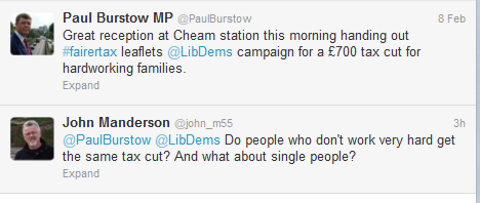
I am not fond of clichés, I am even less fond of political clichés and of all the clichés dredged up by our current generation of brain-dead politicians this one, tweeted to me by a local M.P., most likely to make me want to throw up.

PBtweet

We are not all families, some of us are single. We are not all hard-working, some people do the least they can get away with. Some people get paid quite a lot for doing nothing that benefits society at all. And, as Deborah Orr points out (among other things), a lot of people work very hard at things that do benefit society but won’t get any benefit from a tax cut because they don’t earn enough to pay tax.

I have decided on a new rule; No politician who invokes “Hard-working families” will get my vote.

This was his reply to me:
TweetPB

Which is sort of true, but didn’t exactly answer my question of how he is going to make sure that only *Hard-working families* are going to receive the tax cut.

Boris, Ken, or someone else?

Non-Londoners can skip this post, I won’t be offended.

The time has come for those of us who live in The Great Wen to decide who we want to be Mayor of this great metropolis for the next four years. Although there are seven candidates, unfortunately I think our choice probably boils down to, do we dislike Ken more than Boris or vice versa?

Here, in alphabetical order are the seven candidates and the parties they represent:

Candidates
Name Party
Siobhan BENITA Independant
Carlos CORTIGLIA British National Party
Boris JOHNSON The Conservative Party Candidate
Jenny JONES Green Party
Ken LIVINGSTONE The Labour Party Candidate
Brian PADDICK London Liberal Democrats
Lawrence James WEBB Fresh Choice for London (UKIP)

Clicking on the candidate’s name will take you to their website, except for the B.N.P. candidate, who does not seem to have a dedicated website, so clicking on his name takes you to his Wikipedia entry.

Lets take a quick look at the minor candidates first.

Both the BNP and UKIP seem to think that the Mayor of London has more powers than he actually has. The BNP wants their Mayor to build a better NHS and pledges that they will not allow an amnesty for illegal immigrants. I might be wrong, but building (or currently destroying) the NHS is probably down to the Secretary of State for Health and granting an amnesty for illegal immigrants (not that there has ever been one suggested by either of the main parties) would probably come under the Home Secretaries remit. The UKIP Mayoral candidate, judging by his policies appears to think that the Mayor can unilaterally withdraw London from the EU. Both of them also seem to think that the Mayor can ban non-UK citizens from working in London.
If they don’t know what they Mayor can and can’t do then I think we can move on.

Siobhan Benita, the Independent candidate, is more interesting. I can agree with a lot of her ideas, especially on education, housing and infrastructure. Interestingly she is the only candidate to advocate building a third runway at Heathrow. If she was standing as the Labour or Liberal Democrat candidate (her ideas would fit reasonably well with both parties) I might consider giving her my vote, but as an Independent, she will find it difficult to garner the support she needs.

Jenny Jones, the Green Party candidate, is the only candidate with a well thought out and practical plan to turn London into a cycling city, along the lines of Amsterdam or Copenhagen, and for that alone you should consider voting for her. While cycling in London isn’t a dangerous as it is often perceived to be, it is not safe either, as she says:

It may well be fine if you are confident, experienced and physically fit, but we want roads where everyone feels safe whether you are 7 years old or 70.

Some of the other policies I am a bit more ambivalent about, though she is good on transport and recycling, slightly less so on what to do with non-recyclable waste.

Brian Paddick, probably doesn’t see himself as a minor candidate, but he is. He is not going to win, but the second preference votes of people who vote for him might, in fact probably will, decide who does.
He builds is candidacy on the following facts. For the first time the Mayor will be directly responsible for the Metropolitan Police, and he was a police officer for over 30 years. I will admit that during his time as Borough Commander he came up with some interesting and moderately radical (too radical for the Daily Mail) ideas on policing. The “big idea” on policing seems to be this:

If elected Mayor and London’s “Police and Crime Commissioner” I would make it my top priority to bring the police and public together, so that criminals don’t stand a chance.

Reading his manifesto it seems to me that he isn’t actually running for Mayor the position he wants is Commissioner of Police of the Metropolis. I want to elect a Mayor not a police chief. He is also a Liberal Democrat and I haven’t forgiven them yet.

Boris or Ken?

Here we have our choice then Boris or Ken, Punch or Judy, Scylla or Charybdis?
The best thing I can say about Boris Johnson is that he wasn’t (quite) as big a disaster for London as I feared he might be. He comes across as a cuddly buffoon, but is actually a very calculating politician.
There are two Londons, the divide is not between Inner London and the Outer London suburbs as some suppose, and Boris Johnson tries to pretend, the divide is between the City of London and Greater London.
The London that he has been Mayor for is not Greater London, he has been Mayor for the City of London.
Billy Bragg links to a story in the Sunday Telegraph and points out:

Two headlines from the Sunday Telegraph today – ‘Boris Johnson: We need more tax cuts’ and ‘Rich get richer’. Could the two be in some way connected?

The one thing that people will probably remember him for, the TFL Cycle Hire scheme a.k.a “Boris Bikes” wasn’t even his idea. Jenny Jones (the Green candidate) came up with it and Ken Livingstone adopted it during his last period as Mayor. It just happened to be introduced during his term in office, but he gives himself the credit for it. Similarly with introducing Oyster Cards on the rail system in London. The donkey work was done before his election in 2008, all he had to do was dot the i’s and cross the t’s.
What have his achievements been, well, he got rid of ‘bendy buses’ to keep the cab drivers happy and replaced them with white elephants, sorry Modern Routemasters, that is if they ever get enough built.
His reaction to last summer’s riots was late, ineffective and patronising, to put it mildly.
I won’t be voting for Mr Johnson.

That leaves Ken Livingstone, Mayor of London from 2000 to 2008, Leader of the GLC before its abolition by Margaret Thatcher back in the 1980’s and known to most Londoners as ‘Ken’.

In years gone by I would have said “Vote for Ken, he is the only candidate who actually understands London.” This time I am not so sure. I could be that I think he has been around too long – he is 67 this year – I think that Labour would have been better with Oona King as their candidate, but they plumped for the devil they knew instead. A few other things are also bothering me. There is a vague whiff of Anti-Semitism around some of his statements. There is also a feeling that he has been opaque about his financial affairs. Having said all that, his policies, cutting public transport fares and the reintroduction (in London) of the Educational Maintenance Allowance, and support for childcare, seem to me to be the best package on offer and look affordable.
Along with every other candidate he pledges to reduce crime and make housing more affordable. I can’t recall ever having heard a politician pledge to allow crime to increase, so I think we will ignore that one. Making housing more affordable is more easily said than done and while I am sure they are all sincere in their wish to get housing cost down, again I think that should be taken with a pinch of salt.

My vote, without any great enthusiasm will be cast for Ken Livingston. As the Mayoral election is a sort of Alternative Vote, I was toying with the idea of giving my first preference to either Siobhan Benita or Jenny Jones, with my second preference to Ken Livingstone, but I think I might as well just vote for him and leave the second preference blank. There is no point in putting a minor candidate as your second choice, because they will all be out by the time the second choice votes are counted. If you want to support a minor candidate put them as your first choice and the vote for Livingstone as your second preference.

As for the London Assembly my advice is this vote Labour for the Constituency Member (elected on First Past the Post) and vote Green for the London wide additional member – we need some greens on the assembly to make sure that the other parties keep to their pledges on the environment.

So to summarise this is how I recommend that you vote

  • Mayor – Ken Livingston – reluctantly
  • Constituency Member – Labour
  • London Wide – Green

A letter to my MP #NHSBILL

Below is the text of a letter (well email actually) that I have sent to my MP. He is Tom Brake (Lib Dem) Carshalton & Wallington.

Mr. Brake,
I am writing to you as a constituent who believes that the purpose of the NHS bill is not to improve the National Health Service but to facilitate its systematic destruction.

Given that all the Royal Medical Colleges, and everyone who has thought about the NHS bill consider that it will be disastrous for the National Health Service and ultimately for the majority of the people in this country.
This is the introduction to a piece in the British Medical Journal:

“Entitlement to free health services in England will be curtailed by the Health and Social Care Bill currently before parliament. The bill sets out a new statutory framework that would abolish the duty of primary care trusts (PCTs) to secure health services for everyone living in a defined geographical area. New clinical commissioning groups (CCGs) will arrange provision of fewer government funded health services and determine the scope of these services independently of the secretary of state for health. They may delegate this decision to commercial companies. The bill also provides for health services to be arranged by local authorities, with provision for new charging powers for services currently provided free through the NHS (clauses 1, 12, 13, 17, and 49), and it will give the secretary of state an extraordinary power to exclude people from the health service. Taken together the measures would facilitate the transition from tax financed healthcare to the mixed financing model of the United States. We provide an analysis of the key legal reforms that will govern policy development and implementation if the bill is enacted.”

The full article can be found here I strongly recommend you read this.
As you can see the authors consider that the Bill will allow charging for NHS services currently provided free at he point of delivery and allow the exclusion of groups of people from receiving treatment under the NHS completely.

I would urge you read it consider the opinions set out in it and vote against the bill.
Regards
John Manderson

If you care about what this bill proposes, which in my opinion is the dismantling of the National Health Service and its replacement with something along the lines of the American health care model, I would urge you to write to your MP expressing your opposition.
If you aren’t sure who your MP is or how to contact them this link http://www.theyworkforyou.com/ will help you find them.
As Ben Goldacre (@bengoldacre) tweeted

NHS is a historical aberration, built at a time when ppl better than us gave a shit. When it goes, it won’t be rebuilt

Write to your MP especially if he or she is a Liberal Democrat. They are all seriously worried that they will be out of a job come the next election when the Labour supporters (like me) that have elected them since 1997 decide to vote Labour again – even if it does mean I end up with Tory MP.

Cameron’s Tories are the wrong kind of right.

Tim Mongomerie editor of the Conservative Home* blog had a piece in yesterday’s Guardian in which he argues that David Cameron is not pursuing the right kind of right-wing policies.

I believe that Britain wants a party with rightwing policies but it wants a rightwing party that demonstrates a deep concern for the ordinary voter. In other words, we are talking about a party that occupies the common ground rather than some milk-and-water centre ground. A party of the common ground takes a tough approach to immigration, crime and welfare, but also wants to protect the NHS and look after the poor. Cameron should have aimed to turn the Conservatives into a rightwing party with a heart; instead he turned it into a leftwing party with cuts.

So a bit more like the UKIP or the BNP and a bit less like the LibDems then Tim?

*Excessive reading of this blog may cause an uncontrollable increase in blood pressure and a reduction in IQ

Shami Chakrabarti defends the Human Rights Act

Today’s Guardian featured a discussion between Liberty director Shami Chakrabarti and a Tory MP (Dominic Raab) on the subject if the Human Rights Act. Chakrabarti won.

For those of you not aware of the background to this, the Tories would like to repeal the Human Rights Act and replace it with their ‘British Bill of Rights’. The ‘British Bill of Rights’ will include nothing that The Daily Mail might disagree with. It is possible that The Daily Mail may in fact be asked to produce the first draft. The Liberal Democrats, possibly for the first time are digging their heels in and saying NO! as is Ken Clarke (I think).

Anyway back to Shami Chakrabarti taking an ignorant Tory apart.

Dominic Raab: The tabloids blame everything on the Human Rights Act (HRA) and, in my view, the NGOs think it’s perfect. I think there’s a middle ground. The HRA didn’t do a great deal to protect some of our freedoms – against ID cards, the DNA database, against some of the surveillance where children were followed home from school to check their catchment area.

Shami Chakrabarti: That was our case, and we brought it under article 8 of the HRA, so I disagree with you.

That was just the start of it.

The bottom line of all of this is that for me as a middle class, middle aged, British born, white male, with all the privilege and entitlement that brings, a change from the Human Rights Act to what ever legislation the Tories might introduce probably wouldn’t make any difference. As long as we remain a democracy my human rights will probably be protected. The mark of what we are as a society is how we protect the human rights of people less lovable than me.

Rioting & Looting in London

I did try to put together some sort of post about the past few days events. But I found that after expressing my feelings of loss and dismay about Reeves Furniture Shop (a kind of iconic building in Croydon), and a fair bit of London Road being burnt down, all I was coming up with were worse platitudes than Boris Johnson. So I decided not to bother.

I did however come across this post by a blogger who goes by the name of Motown. He lives in Camberwell and gives his eye-witness account of the (comparatively) minor rioting/looting that took place in Camberwell on Monday evening.

But wait, there’s more

Billy Bragg on Murdoch Phone Hacking and the rest

Billy Bragg makes some very pertinent musical points about the Murdoch Empire:

The background (if you don’t know the story already) to his chorus line “Scousers never buy the Sun” is the virtual city-wide boycott of the Sun that has held for over twenty years. Following the disaster at the Hillsborough Stadium in which 96 Liverpool fans were killed, the Sun published various disgusting and untrue allegations about the conduct of the Liverpool fans at the game. This article gives the background