This time from Garry Trudeau (Doonesbury)

Lets go with the 1%

This time from Garry Trudeau (Doonesbury)
Lets go with the 1%
The Web Comic XKCD – Which comes with the following warning;
Warning: this comic occasionally contains strong language (which may be unsuitable for children), unusual humor (which may be unsuitable for adults), and advanced mathematics (which may be unsuitable for liberal-arts majors)
recently published this:

It is easy to deny climate change, to say “Global Warming, nothing to worry about. it just means that we will be able to grow grapes in Yorkshire”. The reality is that if we don’t stop pumping CO2 into the atmosphere we will be producing a climate that is as different from today’s as today’s from that of the last ice age.
We finally have a respite from the storms that have battered Britain. The storms have been ongoing since about a fortnight before Christmas. It has been even longer if you count the St Jude Storm. This storm was so-called because it was at its height on October the 28th. That date is the feast of St Jude the Apostle.
I found this video on YouTube. Various climate scientists explain that what we see happening before our eyes is essentially what we can expect to see.
In The Observer, Henry Porter challenges the climate change skeptics. He asks them to coherently explain what is happening. He also questions why we don’t need to do anything about it. Having berated the media, especially the Today programme, for trying to pretend that man-made climate change is still an open question;
For the moment, however, they have a disproportionate influence because they’ve created the illusion that this is a finely balanced discussion where a person can reasonably support either side. They empower a certain amount of stupidity, laziness, selfishness and ignorance in the minds of many, and I hope some of the younger deniers, though few, live to acknowledge responsibility.
He does give a very logical reason about why the sceptics deny the facts when presented to them.
I mentioned that most deniers come from the right and it is true the uninterrupted business of capitalism, which often entails waste of resources and energy, is a priority, but there is something deeper that explains why there are so few deniers from the left and that is to do with conservative mind. In his 1956 essay “On Being Conservative”, the philosopher Michael Oakeshott wrote that the man of conservative temperament is “not in love with what is dangerous and difficult; he is unadventurous; he has no impulse to sail uncharted seas. What others plausibly identify as timidity, he recognises in himself as rational prudence. He eyes the situation in terms of its propensity to disrupt the familiarity of the features of his world”.
We are all slightly conservative. Very few of us want the familiar features of our world disrupted. But unless we start to take action soon, our little world is going to be disrupted. The video shows this will happen whether we like it or not.
Go read the full article here
Weather, we seem to have had a lot of it recently. Since about a fortnight before Christmas It seems as if we have had a never-ending sequence of heavy rain accompanied by gale force winds, with the occasional hour or two of sunshine in between. The south of England has experienced the wettest January in two hundred and fifty years and the weather patterns show no signs of letting up.

Almost incessant storms battering the South-west coast lead to the railway line to Cornwall being washed away, considerable damage to coastal defences, not to mention Cornish beach cafés, as well as some quite spectacular photos.

The explanation for this is fairly simple. The jet stream, which drives North Atlantic weather is running further south than normal. This drives the low pressure systems, which normally run northwards into the gap between Scotland and Iceland into the southern part of the Great Britain. This also explains why, if you look at the map, the Northwest of Scotland has only had about 85% of its normal rainfall this January (although it has probably still been pretty damp).
This is obviously what can be described as an extreme weather event, and while I would agree that no one weather event can be ascribed to Global Climate Change, this is the type of event that climate change models predict will occur with increasing regularity. If this is going to be the case what steps will we need to take to alleviate the situation. Politicians and business leaders world-wide show no signs of being willing or able to address the fundamental cause of Climate Change, i.e. the amount of Carbon Dioxide we are pumping into the atmosphere.
I feel for the people who live on the Somerset Levels, which have been underwater for about six weeks now. They may have a point that increased dredging of their rivers and drainage canals might have lessened the flooding. Having said that there are others who say that, with the volume of water involved, it wouldn’t have made any difference. A more fundamental question is this; If this current pattern of winter weather becomes the norm, is trying to preserve this area, which is below sea level, as agricultural land practical, or should we let it revert to salt-marsh? Looking wider, we will need to make a choice between flooding agricultural land to absorb the excess waters in our rivers or allowing towns downstream to be flooded. Always remembering that all this costs money, and while the Daily Mail believes that “Something must be done”© the Daily Mail and a lot of the British public are not keen on the tax rises that may be required to fund such programmes.
The railway line to Cornwall can be routed inland. There is a line that was axed by Dr Beeching’s notorious cuts to the railway network that used to link Exeter to Plymouth by an alternative route. Apparently the rail bed is still more or less intact, and while it probably wouldn’t be cheap, it shouldn’t be any harder to do than reinstating the Waverley Line. Though I must admit that section of the line at Dawlish is quite spectacular.
Unfortunately I don’t have any answers, just questions. Any effective answers will ultimately need to come from politicians who can’t tell the truth, because we their electorate don’t want to hear it.
At least it has stopped raining for the time being, though it will be back on Tuesday, possibly in spades.
I have blogged about light pollution and the needed for dark skies before. Miriam O’ Reilly writes about the subject in today’s Guardian.
It’s just after midnight. There’s no moon, and hardly any cloud. A few street lights burn in the village below, but on the hill where I’m standing they have no impact on the brilliance of the night sky. Brilliant, because I’m looking into a canopy of stars too numerous to count.
She lives in a village on the edge of Snowdonia, the reality for most of us is different.
The latest annual star count survey by the Campaign to Protect Rural England (CPRE) and the Campaign for Dark Skies (CfDS) showed 53% of those taking part on a clear night earlier this year could see 10 stars or fewer within the major constellation of Orion. Only 9% could see between 21 and 30 stars within the constellation, and just 2% had really dark skies above them and so were able to see 31 or more stars. Our skies are so “saturated” with glaring light, according to campaigners, that many of us are unnecessarily denied access to the wonders of the night sky.
In South London, where I live it is worse than that.
We needed to do something about this. We need to see the stars otherwise we lose something, partly our sense of wonder, partly our connection with the universe and the idea that we are a small part of it, but mostly the sheer joy of being out on a clear moonless night and looking up at the stars.
Posted from WordPress for Android
A few facts to start with. Kielder Water is Britain’s largest man-made lake set in England’s largest man-made forest. The reservoir supplies water to Newcastle and the North East. The project which involved flooding a large part of the North Tyne valley started in the early 1970’s and was finally completed in 1982. The dam itself is surprisingly unobtrusive.
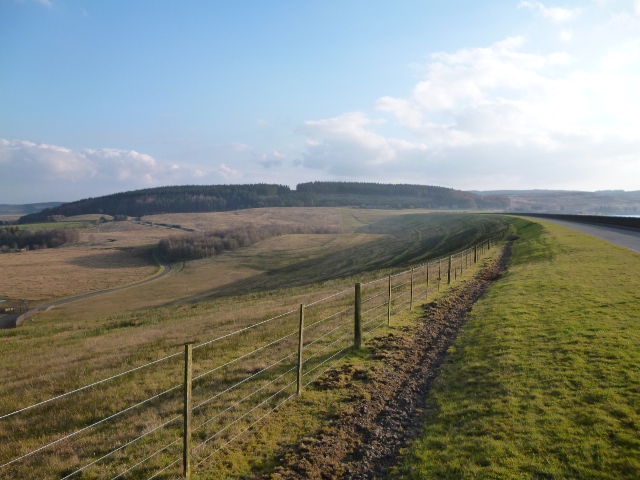
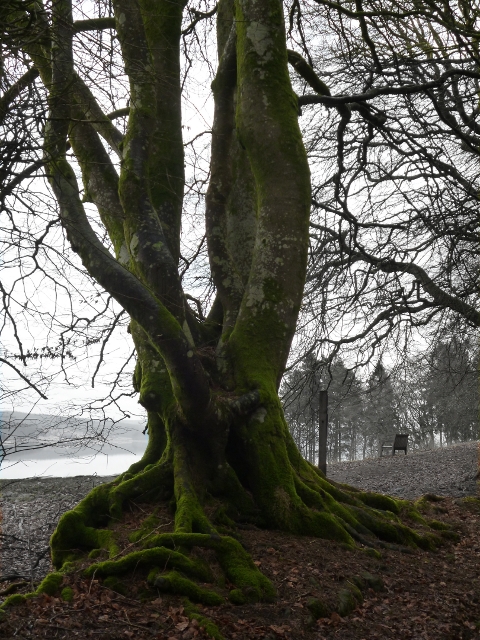
Today we went for a walk around a small part of the lake. This tree is a bit of an oddity in Kielder Forest, almost all the trees are conifers, but I liked it.
When we started out the lake was incredibly calm with reflections that were almost surreal.
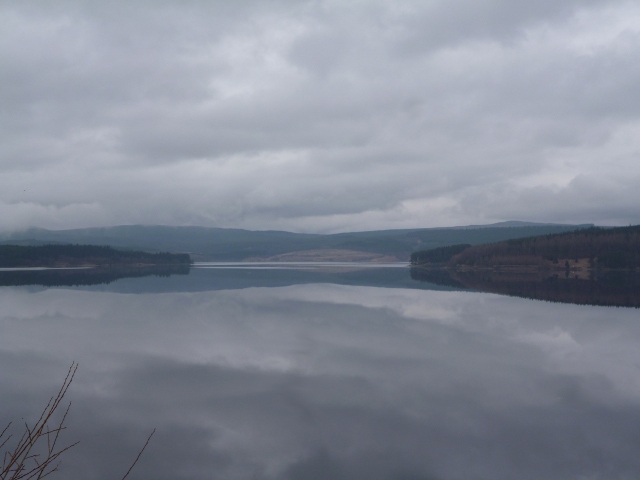
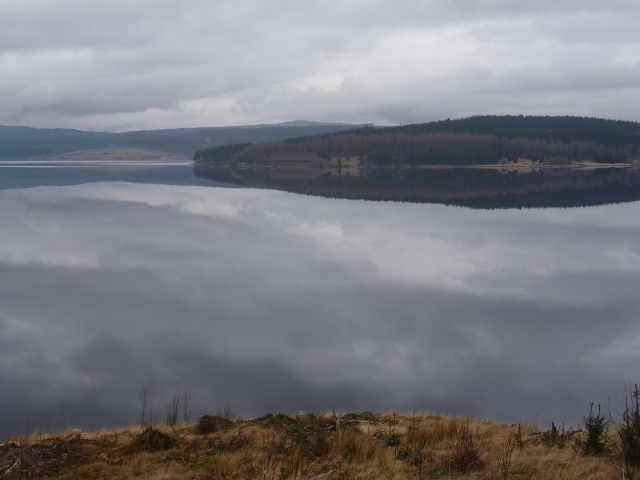
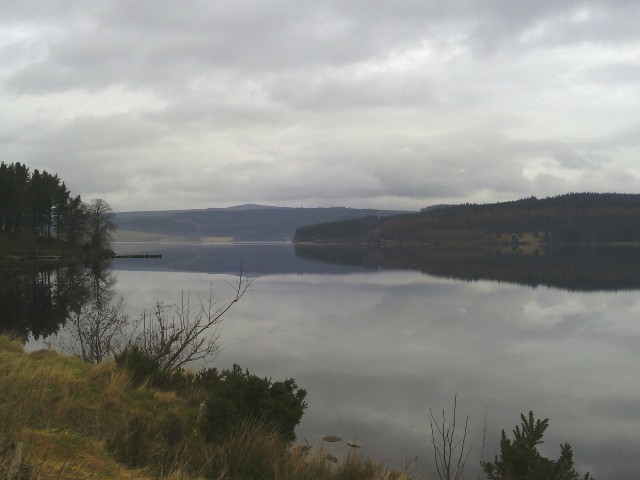
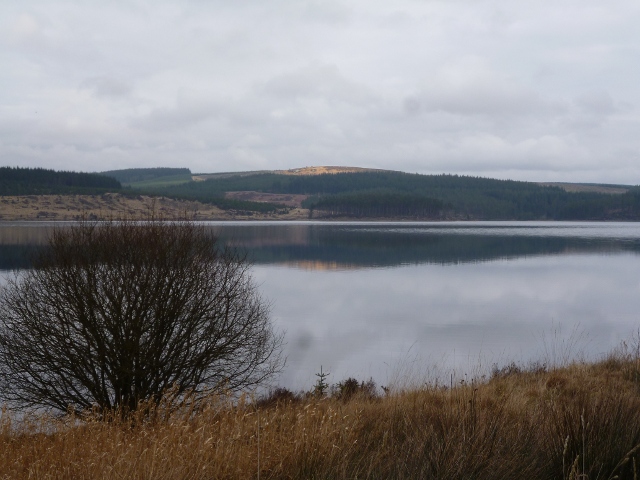
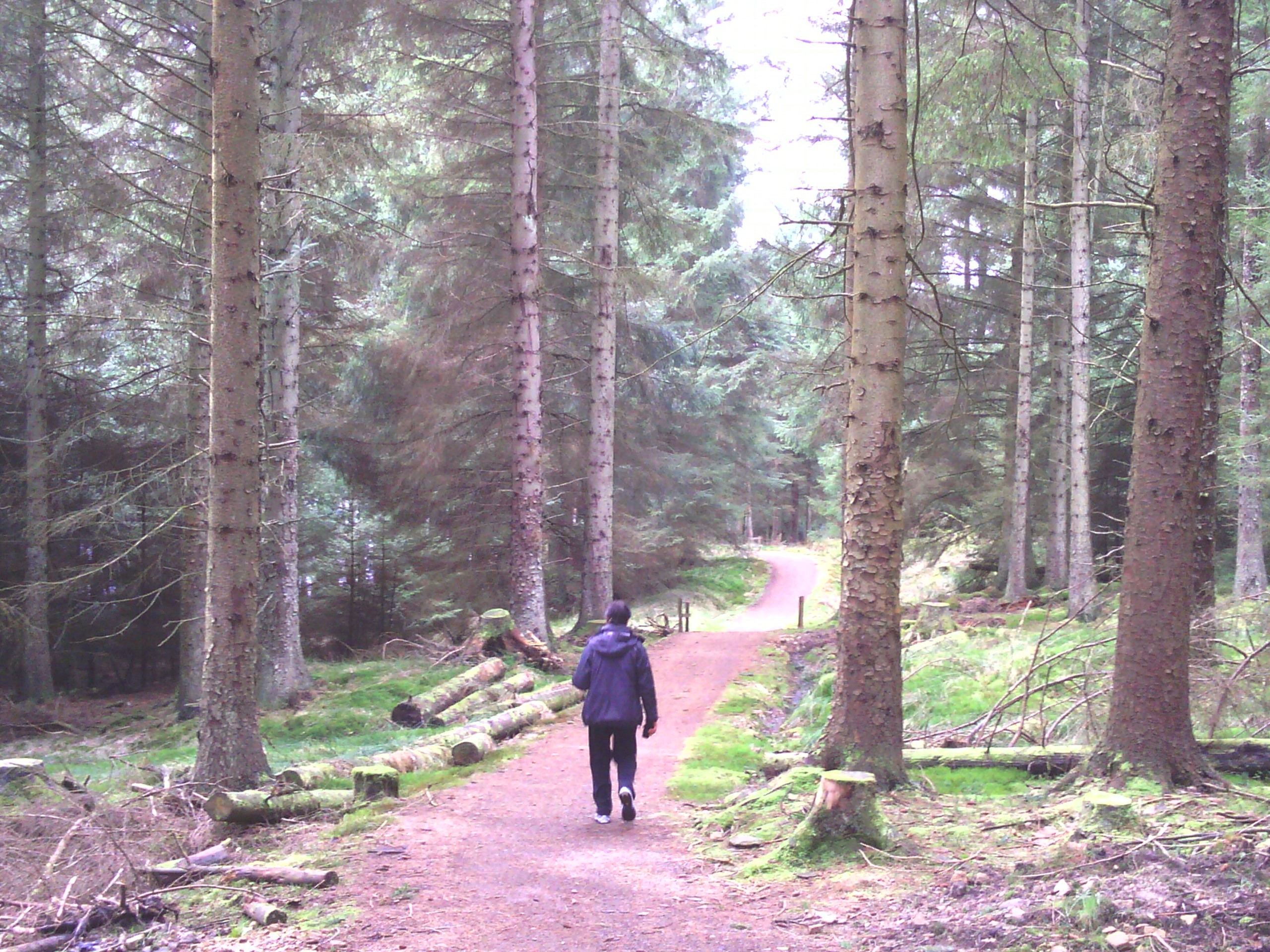
The walk we did was about six miles in length. It was well marked and easy to follow without map. The packed shingle surface was easy to walk on. Surprisingly for a route chosen by mrsjohnm55 there was very little mud.
Other interesting features of the walk were what I can only describe as modern follies. The most interesting of which was “Freyas Cabin”
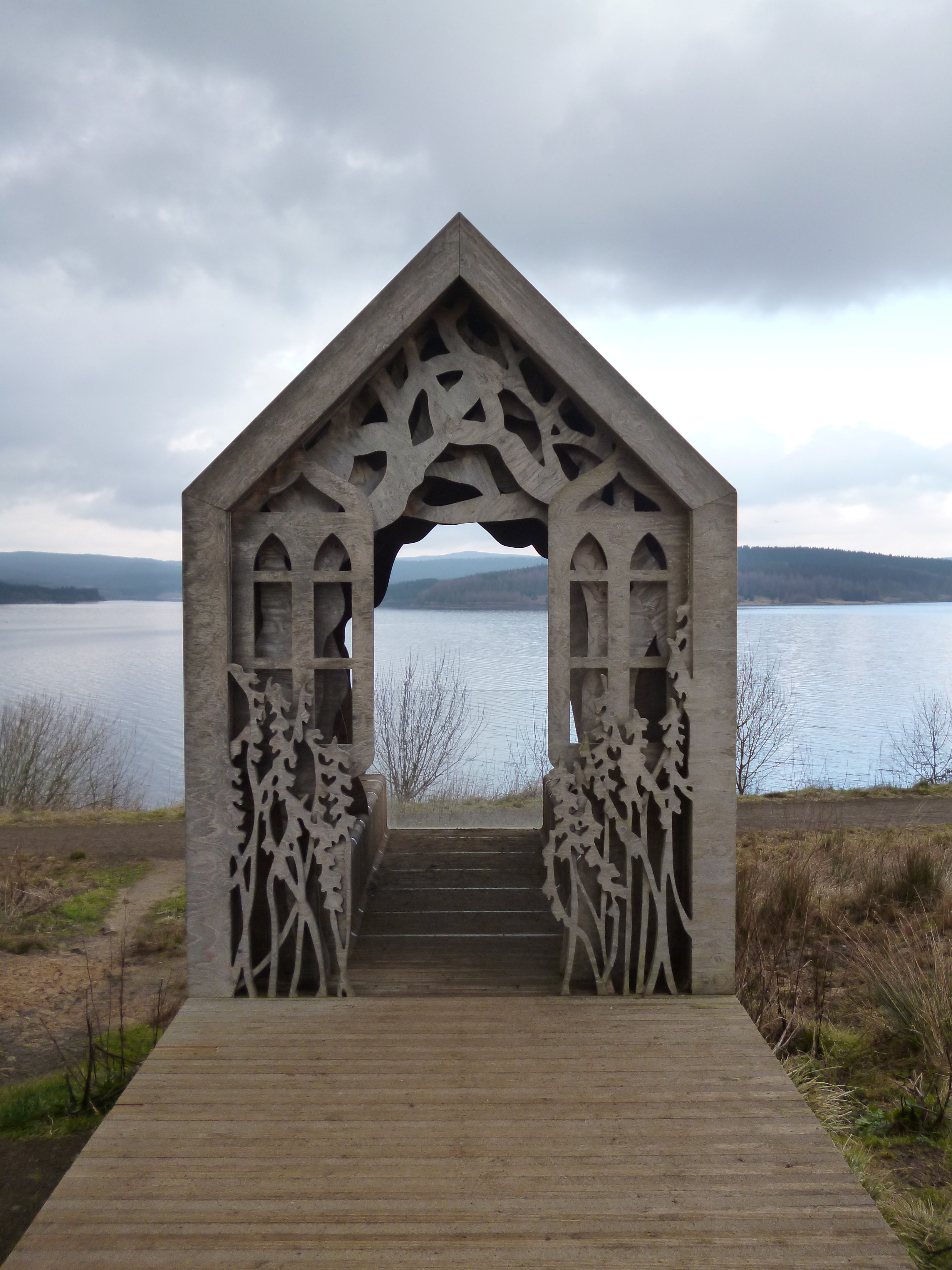
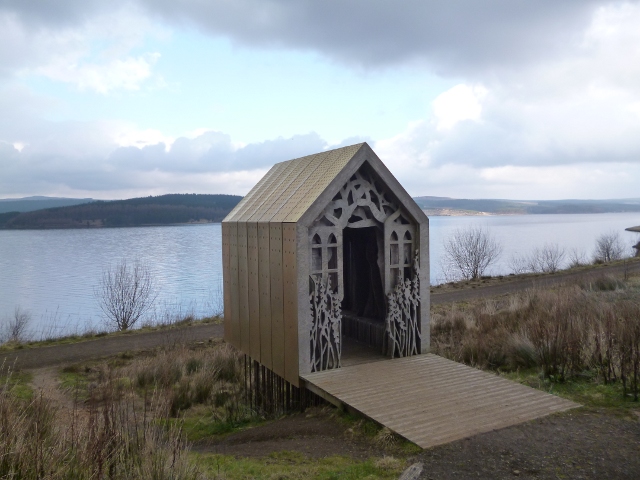
A company (art collective?) called Studio Weave designed and built “Freyas Cabin” and its companion “Robin’s Hut” which can be seen on the opposite shore.. The full story can be found on their website They made up a story about Freya and Robin and how they met which I quote below.
Freya and Robin
Not so long ago, not so very far from here, there lived a beautiful lady named Freya. Freya loved flowers. She loved the Wood Aven with its little strawberry flowers that smell like Christmas and protect against evil. She loved the Red Campion with their hoof-like petals stretching from the tips of magenta pods, decorated with tiny white curls. But most of all, she loved Foxgloves, tall figures dressed in soft bells, some in pink, some in white, and some spotted with the fingerprints of elves. Freya liked to think of the foxes ringing the bells to warn each other of danger and insects sheltering from the rain under their gentle parasols.
You could find Freya wandering across the moors wearing long dresses with big soft pockets full of flowers she’d collected. She carefully took her pickings home, and pressed them for keeping and to decorate everything around her.
Not so very far away from her, lived Robin. Robin lived in a wooden hut in the woodlands over the water from Freya. He spent his days walking through the woods, looking after the trees and the animals that lived in them. He liked climbing trees and building little wooden houses for the birds to lay their eggs in. He dashed about the forest playing swift and intelligent games with the deer and scrambled about helping the squirrels find their buried nuts.
Freya could see Robin across the water. She could see he was kind and careful with the trees and the animals and that he loved them as much as she loved the flowers. Mostly, he skipped about playing, but sometimes, Freya saw him standing, perhaps sadly, she thought, looking out over the water. She longed to be able to talk to him, to ask him if he was all right or what it was he was dreaming of. So one day, Freya decided to make Robin a gift of a wonderful cabin. She hoped that he would see the cabin from his wooden hut and then maybe he would make a raft or a boat and come to see it.
Over the next few weeks, Freya worked very hard to collect flowers and plants and small branches. She made a big flower press and carefully laid out her collection in the shape of a woodland, just like she imagined the one Robin lived in. For the walls, she arranged the strongest branches from thick to thin. And for the roof she made an enchanted forest ceiling with twisted branches tickling each other. She decorated the entrance with precious Foxgloves to invite the fairies in. Then she pressed everything tight together so they would be strong and crisp and last forever.
While she was making the cabin, she noticed that Robin spent more and more time dreamily looking across the water. She was thrilled for she thought he must be looking to see what she was up to. She was so excited that she went and collected as many tall, straight flowers as she could find and proudly balanced the cabin up on a thousand of the tallest straightest stems to be sure that Robin could see it properly. But Robin couldn’t see it properly; he couldn’t see it at all.
Freya lived on the South side of the lake, which meant that the sun’s rays lit up the landscape in front of her and she could see for miles. But Robin lived on the North of the lake, so when he looked towards the South the sun got in his eyes and all he could see was a golden blur above the lapping blue lake.
Actually, Robin was very fond of the golden blur and often stood admiring the hot fuzzy oranges and purples shimmer. It reminded him of an amazing place he had been told about when he was a little boy. He had heard the stories many times, that in the far North there is a magical place called Glimmerfell, where there are huge mountains pointing out above the clouds, covered with flowers growing from the rocks and the ice. Apparently, the flowers glow orange and purple because in Glimmerfell, it is always sunset. He found himself thinking of this place more and more, until eventually, one day, he decided to build a boat and set off to try to find it.
Of course, when Freya saw Robin collecting wood and beginning to build a boat, she was thrilled that he had seen that she had almost finished the cabin and was planning to row across the lake to see her. Over the next few days, Freya put the finishing touches onto the cabin and Robin built his boat and packed it with food for a long journey.
Then one morning, he untied the boat from its mooring, and set off. Freya watched expectantly as Robin rowed towards her. She felt she had never been so happy and excited in all her life. But after a short while, he seemed to be drifting away to the west and soon Freya realised that he wasn’t coming her way at all, but instead, was going in completely the opposite direction.
Freya couldn’t understand what she could have done so wrong. Not only did Robin not want to come and see the cabin she had made for him, he wanted to leave the lake completely. She sat down in the middle of the garden she’d planted by the cabin and began to cry. As Robin rowed further and further away, she became so upset, her tears turned into gold. She picked herself up and wrapped the cabin in the gold tears streaming from her eyes.Meanwhile, as Robin was rowing away, he turned his head to look back at the lake he loved. He hoped everyone would be all right while he was gone. As he watched the familiar woodland slipping further and further away, knowing that he might not see his home for a long time, he noticed something glinting in the distance. He thought it must just be the sun in his eyes, but as he took one last glance, he saw it again, even brighter. He was so curious that he decided to row back and find out what it was. After all, he hadn’t gone too far yet.
As Robin approached the glimmering, it grew brighter and brighter and he rowed with all his mightAs Robin approached the glimmering, it grew brighter and brighter and he rowed with all his might
As he approached the glimmering, it grew brighter and brighter and he rowed with all his might. Once he was quite near the shore he could see an unusual golden cabin that looked like it had a forest inside it. Then once he was very close, he could see that next to the cabin, someone was sitting and crying with her face buried in her dress. Robin quickly tied up his boat, rushed over, and gently swept the foxgloves so they sang soothingly. Freya lifted her head at the sound and saw Robin standing there with a concerned look on his face. A little embarrassed, she brushed the tears from her eyes and they fell like gold dew onto the surrounding grass. Robin offered his hand and she unruffled herself as he pulled her up. Seeing she was all right, Robin turned to the golden cabin. He was quite enchanted by it. Freya explained that she’d made it for him. Luckily, he had climbed inside for a better look just before she said this, so she didn’t see him blush!
Freya and Robin sat in the cabin all afternoon, talking about the trees and the flowers. Robin almost forgot he was planning to go to find Glimmerfell. He described to Freya, the cloud-collared mountains and the glowing ice-flowers. Freya was fascinated and asked him lots of questions he didn’t know the answers to because he hadn’t been there yet. Freya offered to lend Robin her flower press so he could collect some flowers to bring home. Robin said he wouldn’t know how to press the flowers properly and asked whether Freya would perhaps, like to go with him. Freya said she would love to.
So at sunset, having loaded Robin’s boat with some more food and Freya’s flower press, they set off on their adventure.
They didn’t leave very long ago, so they are still away adventuring, but if you can find them, you can see Robin’s wooden hut and the golden cabin that Freya made for him, facing each other across the lake, awaiting their return.
It is lovely area of the country and well worth a visit.
Update Sunday 04 March 2012
I have updated and modified this post, which was originally from my Android phone. For some reason it didn’t upload the images that I included. I have now added some images and added the story of Freya and Robin.
The Walking and Cycling group have released an interim report. It makes disappointing reading for those of us who see the bicycle as an essential part of a less energy intensive transport strategy. To sum the report up in a few words; The adult population of the UK just doesn’t get cycling, except as a leisure activity.
I’m trying to work out why? Does the image that we project as cyclists put people off? We are not all Lycra clad and super-fit, but if that is the image we project then it is understandable why the public think that they wont and don’t want to make the grade.
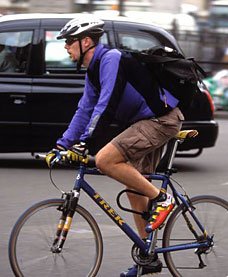
In the Netherlands, which in many ways is the European country that most resembles the United Kingdom, about 25% of all journeys are made by bicycle. In the United Kingdom it is about 2%. So what I want to explore is what makes the Dutch get on their bikes and the British get in their cars.
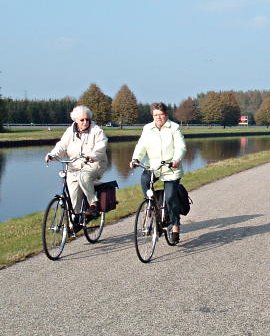
What are our reasons/excuses for using our cars and not our bikes?
The weather is often given as a reason, it rains a lot in Britain. It does if you live on the Northwest coast of Scotland or in Cumbria, but I refuse to believe that it rains more in the populated areas of Britain than it does in the Netherlands. Even if it does rain more, to quote some one, possibly Billy Connelly “there is no such thing as bad weather, just inappropriate clothing”
The Netherlands are much flatter than the United Kingdom claim the motorists. I will agree, that for the most part they are, but there are bits of the Netherlands that are far from flat, and large areas of the United Kingdom, such as London that are less than Alpine in their hilliness. Flatness of the countryside is a double-edged sword, as any one why has cycled across the Fens into a head wind will tell you.
In my opinion the biggest obstacle to getting the British on their bikes is a justified fear of the traffic in our cities and towns. I do think that the dangers of cycling in Britain are often overstated, but I cannot pretend that they are non-existent.
Mrs johnm55 loves cycling, put her on her bike out in the countryside, especially on a sunny day with the prospect of lunch at a country pub, and she is in heaven. But she hates cycling in London. She finds the conduct of a significant number of other road users intimidating. They rarely leave a safe distance between her and their vehicle, they overtake at inappropriate times and they are rude and impatient. As a result, when she does use her bike in London she tries to find routes that keep her away from traffic as much as possible. The problem with such routes are that they are usually rough surfaced, tend to take you away from populated areas, are often poorly lit after dark, and often have pedestrians wandering willy-nilly across them. Pedestrians who get upset, and as rude as any motorist, if you ring your bell to warn then that you are coming up behind them. (Possibly they would prefer it if you yelled “get out the #@*!#@!# way you moron.”, but Mrs johnm55 is a very polite woman and would never even think of saying things like that. johnm55 at times takes a different view.)
All this means is that compared to cycling on the road, cycling on traffic free routes, in London, often is a very slow way of getting from A to B.
Now, look at the photo of the Dutch cyclists above, what do you see under their wheels? Correct, a well surfaced (motor) traffic free cycle route. The Netherlands has a has a comprehensive network of traffic free cycle routes which is one reason for the Dutch getting on their bikes. When the cyclist In the Netherlands has to share the road with cars, as they have to, even with a well designed system of cycle routes, The Netherlands has another advantage. In common with most other European countries the Netherlands has what is often known as a law of Strict Liability. The law assumes that unless proven otherwise, if a car collides with a more vulnerable road user (cyclist or pedestrian) then the car driver is at fault. The video gives explains how it works:
Any law similar to the Dutch law is of course anathema to our motoring organisations and Jeremy Clarkson, so there is not a lot of chance of a law like it being passed in this country any time in the near future. Of course a law of strict liability only goes so far. Hopefully it will make drivers slightly more careful around cyclists and pedestrians. It is also comforting to know that your loved ones will be taken care of if you are crushed by a lorry, but it is probably fear of getting crushed by the lorry that stops you getting on your bike in the first place. So we are back to needing effective cycle routes.
London’s developing network of Cycle SuperHighways are a start, but the one I have used CS7 still allows cars to park on it, forcing you out into the main traffic. Car drivers also don’t seem to take all that much notice of the blue bit of the road surface that is for cyclists alone. Driver education might help. Getting more cyclists out on the road would definitely help to make life safer for all cyclists.
Possibly the choice of bikes on sale in the UK doesn’t help either. It is getting better, but if you go into the average bike shop in Britain you will be hard pushed to ride out on a bike that can be ridden wearing a suit. By that I mean a bike with full mud-guards, an effective chain guard, and an upright riding position. Strangely enough his type of bike is known in the UK as a Dutch roadster.
An additional problem is where people keep their bikes when they are not in use. I used to keep all my bikes safely locked up in the shed in my back garden. The five or six minutes it takes to get the bike out of the shed and on to the road, then make sure all the back doors and gates have been re-locked is not a big deal, if I am going out for an all day bike ride. However, if all I am doing is going along to the shops to get some bread and milk, it is easier to take the car. The car sits outside the front of the house, all I have to do is unlock it and jump in.
I overcame this problem by keeping my old bike locked to a strong point at the front of the house. This makes it at least as easy as using the car for short trips.
I was going to insert a mini rant about cycle helmets at this point, but he post is getting a bit long so I’ll save it for later.
To sum up; I feel we need to do the following to encourage more use of the bicycle for transport.
This study took place in Copenhagen, Denmark over 14.5 years. It found that cycling to work (an average of 3 hours cycling per week) decreased risk of mortality by about 40% compared to a sedentary control group. This study involved 30,000 people. The study took into account age, health status, and socio-economic factors such as education. It also found that older people gained even more from physical activity than younger people.
Next time for the sake of your health and the planet’s health, if you are going to the shops or the pub or to work, and the journey is five miles or less, think about walking or using your bike, it will probably be quicker anyway.

A report has been produced by The World Health Organisation, which, as far as I can see, says the there is no data that proves a causal link between mobile phone usage and brain cancer. It does, I will admit, also say that the risk cannot be ruled out. But why the headline like the one in today’s Guardian?
Mobile phone radiation is a possible cancer risk, warns WHO
As far as I can see there has been no new data, just a review of the existing evidence, which has always pointed to the conclusion that there is no obvious link between mobile phone usage and brain cancer, so why the change in emphasis?. This is their summary of the evidence;
.
The evidence was reviewed critically, and overall evaluated as being limited among users of wireless telephones for glioma and acoustic neuroma, and inadequate to draw conclusions for other types of cancers. The evidence from the occupational and environmental exposures mentioned above was similarly judged inadequate. The Working Group did not quantitate the risk; however, one study of past cell phone use (up to the year 2004), showed a 40% increased risk for gliomas in the highest category of heavy users (reported average: 30 minutes per day over a 10 year period).(my emphasis)
The one study they highlight appears to be an outlier (i.e data that while not ignored, would not normally be used to draw the conclusion, as it does not fit with the rest of the data). When the strongest words that they (the WHO) can find to describe their data are limited and inadequate do they up ante and say that using your mobile could cause cancer?
Orac gives a much more detailed account of the (lack of) evidence on his blog.
One of the things we as human beings have difficulty with is assessing risk. (This could be the subject of a future post.)
There is a proven casual link between driving cars and killing people. We think we know what the risk is, so we discount it and carry on driving, Mainly because we feel the inconvenience of not driving outweighs the risk of using the car. There is no casual link between the Measles Mumps Rubella (MMR) vaccine and autism. Certain newspapers, however, acted and reported as if there was. Because we as human beings had no way of assessing what the (non-existent) risk was, and the immediate downside of not having your child vaccinated seemed small, large numbers of people failed to have their children vaccinated. The result is we now see a significant increase in the frequency of a disease (Measles) that had become more or less non-existent in the United Kingdom. In the future, we may also see an increase in birth defects caused by Rubella during pregnancy as girls who missed their vaccination enter their child-bearing years.
So my conclusion; Will your mobile fry your brain? – No – but reading newspaper science reports without a pinch of salt and a close look at the data just might.
Update Saturday 04 July 2011 @ 10:30
Ben Goldacre writes about the report in his Bad Science column for the Guardian
He quantifies the increased risk that the worst case scenario points to (the study I referred to as an outlier). A forty percent increase would mean about 14 new brain tumours ber 100,000 people per year as opposed to 10 per 100,000.
Contrast that against this article
But I have to admit, this story from Kenya was the first time I heard of cell phones helping health workers speed up diagnoses and help fight preventable diseases. In this video, Steven Omollo, the health worker, even uses his phone to confirm a suspected case of malnutrition.
which I found on the Bread for the World’s blog. Watch the video embedded in the post. Risk versus reward anyone?
I grew up on a farm in the Scottish Borders. The nearest house to the one we lived in was about quarter of a mile away, the nearest town was about seven miles away and the nearest city about fifty miles away. When I went outside on a clear moonless night I have no idea how many stars I could see. Above me the of the universe was on display. Later in life I earned my living at sea. Sitting on the fo’c’sle on a warm tropical night looking up at the strange – to northern eyes – stars of the Southern Hemisphere is a memory I will always cherish. Now I live in the South London suburbs, I once counted the stars I could see on a clear moonless night. There were 42 visible. Where have all the stars I marvelled at in my youth gone. They are all still there. But our insistence that there be no difference between daylight and night drowns them out.
About two weeks ago we observed Earth Hour. We switched our lights off at 20:30, and discovered that with the light from the street lights at the front of the house, and our neighbour’s ‘security’ (as in blanket) light at the back, there was enough light, if not to read by, but to do most things.
Read On
 A Scotsman in Suburbia