
My mother has somewhere in her photo box this photograph of her great-grandfather (or my great-great grandfather) William Elliot. He was born (probably) in 1817 and died in 1897 . I don’t know exactly when it was taken, but he looks to be around sixty so I think it was probably 1880 give or take five years. It was around that time several of his sons emigrated to New Zealand, so my guess is that it was taken in order that they would have a memento of him.
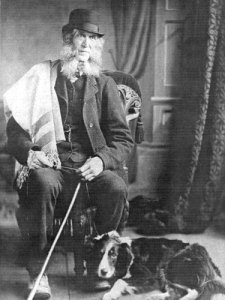
Looking at William Elliot’s photograph the thought occurred to me, that this may well have been the only photograph ever taken of him. I find it to be a powerful and evocative image. It is carefully composed, and although I am sure he is wearing his Sunday best, it includes elements that show that he was a shepherd, his dog, his crook, and he has his plaid over his shoulder. It would also have been costly to produce. I have no idea exactly how much, but my guess is at least a days wages and possibly more than a weeks. It is a valuable image in every sense of the word.
Do we still make valuable images, in the sense of images that are worth valuing, today?
As the digital camera, either as a standalone device, or built into our mobile phones, became ubiquitous the volume of photographs taken has since multiplied by a factor of gazillions.
When I was a child, being allowed to take a photograph, with mum and dad’s camera was an unusual event. I might waste a shot by taking a picture of my finger. That wasted shot still had to be processed and paid for. Today four-year olds happily snap away with mum’s digital camera, because we know that we can just delete any and every image that doesn’t work and keep the one or two that we find amusing.
In all of this we have, I think lost sense of the value that a photograph can have. We rarely take time to compose photographs, we just snap away, knowing, hoping, that one of the 6035 images on the SD Card might just be worth keeping. I don’t think that we in general even think about what we are photographing, and I am not even convinced that we even look at, let alone look properly at the images we produce.
Quite a while ago, before I owned a digital camera, I was sorting through a pile of snapshots that I had taken on holiday. I found that I could barely identify the location of quarter of them. I made a conscious decision that day to take less photographs and make more sketches. When I look back through my sketch books I can recall exactly where I was when I made that sketch. I can remember what was happening around me, and what I was feeling at the time. Because I took ten minutes to sit down and actually look at what I was recording, rather than two seconds to push a random shutter.
I’m not saying don’t take photographs, I still take, I might even say make, but that sounds a bit pretentious, photographs. I know that there are some things that can’t be easily captured in a sketch but are caught in a photograph. What I am saying is look at what you are photographing before you take it. Look at the result after you have taken it. Exercise some kind of quality control before you dump the latest batch of photos on Facebook or Flickr. Possibly restrict the number of shots you allow yourself to take to say 20 per day to force yourself to choose your subject.
If you do manage to produce a valuable image, get it printed, because my mother’s copy of William Elliot’s photo will still be around when my digital copy as vanished into hyperspace.
 A Scotsman in Suburbia