Category Archives: My Art

My own paintings and thought on the process of producing them

Bike ride to Scotland: Part 5 Egglestone to Wooler

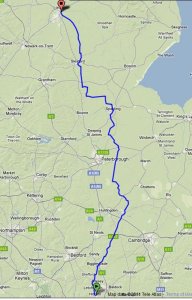
Day 5 – 08/05/2003 (Thursday) Egglestone to Wooler

The Moorcock Inn does a very good breakfast, but it also lies about its location. If you click-through to their website you will see its address given as Hilltop, Egglestone. This is a lie, it is nowhere near the top of the hill. Well, I suppose the road does go down slightly for the first half mile or so, but then it goes up and keeps going up, sometimes alarmingly steeply for a long, long time.
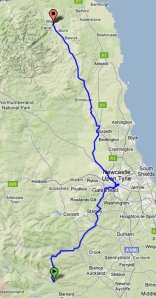

On top of that my nemesis of a couple of days ago, the wind, was back with a vengeance. The first ten miles from “Hilltop” over the real top of the hill and down to Stanhope took well over an hour. It was so windy I was having to pedal going down a 10% slope to keep my speed up. The scenery was spectacular, and I had plenty of time to appreciate it, especially on the way up.

I made an executive decision in Stanhope and abandoned my original route over the hills via Hexham and Rothbury and took the wind and incline assisted route down the Wear valley which would eventually take me to Newcastle. It helped for a while. Going down the valley with the wind behind me I probably averaged over 30 km/hour for the first half-hour or so, but eventually I had to get out of the Wear Valley and into the Tyne. That meant more hills, though not as long and steep and more wind in my face, though not as strong.
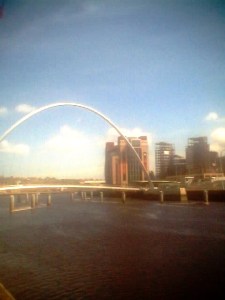
My route now took me into Newcastle. The last time I had been to Newcastle was back in my days as an Engineer Cadet at South Shields Marine and Technical College. That was about thirty years ago. I would probably have saved myself about five or six miles if I had crossed the Tyne at one of the up river bridges. I decided that having made this detour through Newcastle that I might as well make a further detour and cross the Tyne on the Millennium Cycle Bridge.

Newcastle has changed a bit since my student days. The Quayside area which was derelict coal staithes and warehouses is now all smarted up and trendy. The roads also seem to have altered. It took me a while to find a way out that didn’t involve an urban motorway, but I eventually made it onto the back roads from Ponteland to Morpeth.

At this point my intention was still to make it to Duns today, but time was getting on and I still had over fifty miles to go. I decided that going straight up the main road from Morpeth to Coldstream would be quicker than the back roads. The A697 isn’t usually too busy because most of the north bound traffic goes up the A1.

There was one memorable point on the journey. I was descending in to a valley,I think it was the Coquet, and I looked across and thought to my self, the climb out the other side can’t be as steep as it looks, it must be foreshortening. The I looked down at my computer and saw it reading 85km/h and thought maybe it is as steep as it looks.

By the time I was getting up to Wooler it was around seven in the evening. There were still at least two hours in the saddle to get to Duns. I decided to stay the night at the Wooler Youth Hostel. I called my mum to say that I wouldn’t make it that night, but she could have my lunch ready for me the next day if she wanted. My sister offered to come and collect me and the bike, but the idea was to cycle up to Duns not just to get there, so I said thanks, but no thanks and had a night on the town in Wooler.

< Part 4 York to Egglestone

Bike ride to Scotland: Part 4 York to Eggleston

Day 3 – 07/05/2003 (Wednesday) York to Egglestone

At least the wind died down today, or if there was any it was helpful, but we did find some hills. After two days in the flat-lands it was quite pleasant to be somewhere with contours.
Actually the first two-thirds of the trip was reasonably flat. I was climbing steadily and there were hills to my left and right but the roads were quiet (excluding the first few km up the A19) and it was pleasant cycling. It was only after Richmond, going on into Co. Durham that it became necessary to shift into the Granny Ring now and then.
Continue reading Bike ride to Scotland: Part 4 York to Eggleston

Bike ride to Scotland: Part 3 Lincoln to York

Day 3 – 06/05/2003 (Tuesday) Lincoln to York

This should have been an easy flat day. It was flat, for the most part, but it wasn’t easy. Most non-cyclists think that it is hills that make cycling hard work, they are correct, but only to a certain extent. The thing that makes cycling really hard work is wind coming from the wrong direction. Today I had wind from the north-west. I was riding roughly north-west. This resulted in a very hard day in the saddle. Psychologically wind is harder to deal with than hills. When you are riding a hill you know that sooner or later you will get to the top and at least for a while you can have a rest as you free-wheel down the other side. When you are riding into a head wind you get no relief. You know that the wind will be in your face all day. You have to work harder and you go slower. It feels unfair. All that extra effort and you go nowhere rather slowly

Continue reading Bike ride to Scotland: Part 3 Lincoln to York

Bike ride to Scotland: Part 2 Hitchin to Lincoln

Day 2 – 05/05/2003 (Monday) Hitchin to Lincoln

I underestimated the distance from Hitchin to Lincoln. I thought it was around a hundred miles, it turned out to be nearer one hundred and thirty. Most of the way was flat, well the first two-thirds of the route was across the Cambridgeshire and Lincolnshire Fens.

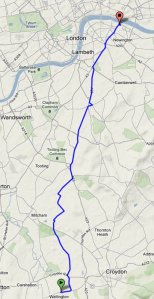
Click for a larger map

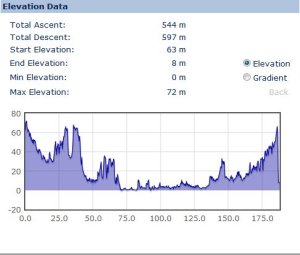
On the last third of the route, from Sleaford to Lincoln, I made the discovery, that contrary to popular belief Lincolnshire actually has hills. They are not the Alps, although I did see a sign advertising the head quarters of the local mountain rescue society in one of the villages. This Facebook page possibly belongs to them or their successors. However when the hills arrive in the last thirty miles of a long ride, one that is thirty miles further than you expected, they are hard enough. (The route profile does make them look a bit worse than they actually are).

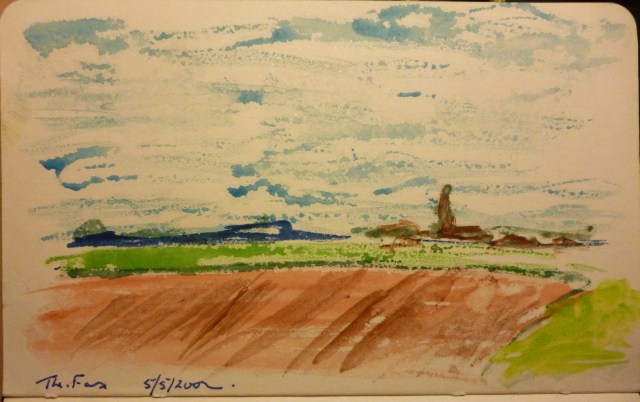
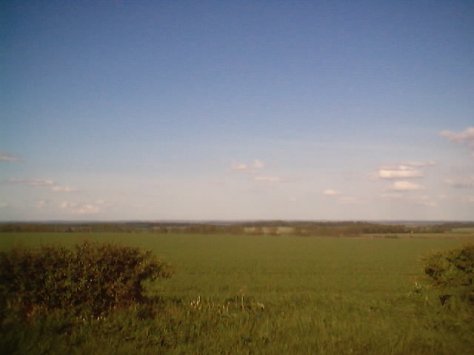
I had expected the countryside to be a bit boring and unattractive. In spite of the unremitting flatness and the difficulty in distinguishing one stretch of road from the next, I found the scenery quite attractive.
Watercolour Sketch of the Fens

I stopped for lunch in Spalding round about two pm. I found a café selling cheap carbohydrates and refueled. I have noticed that when I am touring, and especially doing longer distance, that my critical faculties as regards food drop off. As long as it fills the hole I am happy.

It was after I passed Sleaford that I entered the Lincolnshire Wolds and the road started to go up. After riding through flat-lands all day riding up the hills was initially a pleasant change. It is not that steep, but you are climbing constantly for thirty or so miles. I kept consoling myself with the thought that I would probably be able to free-wheel the last ten miles into Lincoln. Not quite. Yes I did free-wheel into Lincoln, but not in the gentle controlled way I had anticipated. All the height that I gained in two hours of climbing I dissipated in about three minutes as the road took the short route down a cliff face into Lincoln. You can see it if you look carefully at the elevation profile.


I stayed the night at the Lincoln Youth Hostel (which has sadly since been closed). I was too late for an evening meal at the Hostel, due to me taking about two and a half hours longer than anticipated because the route was thirty files longer than I thought it was. I wandered out into town had a look around and found myself a curry. Very nice it was too.

Part 1 Wallington to Hitchin

Part 3 Lincoln to York >

Bike ride to Scotland: Part 1 Wallington to Hitchin

Day 1 – 04/05/2003 (Sunday) London to Hitchin

Today didn’t work out that well. For various reasons, some good, some bad, I didn’t actually manage to leave until one-thirty in the afternoon, rather than seven or eight in the morning as I had planned. Never mind, I thought at least I had lunch before I left

Everything was going well, apart from a bit of hassle with the traffic in Brixton, until just after crossing London Bridge. I realised that I might have left the train ticket for the return journey lying on the kitchen table. A search through my bags confirmed that my thought was correct.

“Oh dear” I said to my self, well that wasn’t exactly what I said, but this blog tries to be suitable for all ages. I turned round and went back to London Bridge Station and caught a train to East Croydon, from where I cycled home and retrieved the ticket. I thought that while I was back home that I might as well unload the dishwasher and put the washing, which was now dry, away.

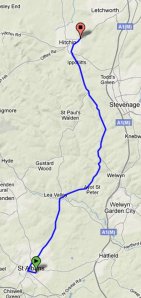
I cycled back to East Croydon and put the bike back on the train, this time to St Albans. My theory was that St Albans was roughly where I would have been if I hadn’t had to go back home to retrieve the ticket.

I decided to push on further. Eventually I decided that I would call it a day when I got to Hitchin, about 20 miles nearer to Duns. Then to cap, what was not the best day of the journey, the hotel I stayed at was not only the most expensive place I stayed at all trip it also, in retrospect, was the worst.

I plan my routes on BikeHike.co.uk which is a great little route planning website for cycling or walking. Your routes can be uploaded to or downloaded from a G.P.S. device if you own such a thing, or printed off if you don’t.

Part 2 Hitchin to Lincoln >

Old sketch books.

I was sorting through my art equipment this afternoon. Basically looking to see what was worth keeping and what needed to be thrown when I came across a couple of old sketch-books that I also used as diaries to record a couple of trips. For my younger readers, “Keeping a diary”, was a bit like blogging ,except you wrote your thoughts down on paper. Usually no one else read them, not that much different to blogging then.
I thought that I would re-write them as blog posts and include the (better) sketches.
The first series of posts will be about a bike trip I made to Scotland in 2003. Mrs johnm55 had gone off to Canada for the week without me, so I decided that it would be a good idea to go and visit my mum – on my bike.
Day one can be found here

Some Examples of my own art

I have talked about other people’s art reasonably regularly since I started this blog. I thought it was about time that I showed some of my work for every one else to criticise.


Pictures follow

Photography and the Digital Age

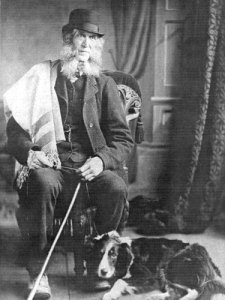
My mother has somewhere in her photo box this photograph of her great-grandfather (or my great-great grandfather) William Elliot. He was born (probably) in 1817 and died in 1897 . I don’t know exactly when it was taken, but he looks to be  around sixty  so I think it was probably 1880 give or take five years. It was around that time several of his sons emigrated to New Zealand, so my guess is that it was taken in order that they would have a memento of him.

William Elliot
William Elliot

Looking at William Elliot’s photograph the thought occurred to me, that this may well have been the only photograph ever taken of him. I find it to be a powerful and evocative image. It is carefully composed, and although I am sure he is wearing his Sunday best, it includes elements that show that he was a shepherd, his dog, his crook, and he has his plaid over his shoulder. It would also have been costly to produce. I have no idea exactly how much, but my guess is at least a days wages and possibly more than a weeks. It is a valuable image in every sense of the word.

Do we still make valuable images, in the sense of images that are worth valuing,  today?

As the digital camera, either as a standalone device, or built into our mobile phones, became ubiquitous the volume of photographs taken has since multiplied by a factor of gazillions.

When I was a child, being allowed to take a photograph, with mum and dad’s camera was an unusual event. I might waste a shot by taking a picture of my finger. That wasted shot still had to be processed and paid for. Today four-year olds  happily snap away with mum’s digital camera, because we know that we can just delete any and every image that doesn’t work and keep the one or two that we find amusing.

In all of this we have, I think lost sense of the value that a photograph can have. We rarely take time to compose photographs, we just snap away, knowing, hoping, that one of the 6035 images on the SD Card might just be worth keeping. I don’t think that we in general even think about what we are photographing, and I am not even convinced that we even look at, let alone look properly at the images we produce.

Quite a while ago, before I owned a digital camera, I was sorting through a pile of snapshots that I had taken on holiday. I found that I could barely identify the location of quarter of them. I made a conscious decision that day to take less photographs and make more sketches. When I look back through my sketch books I can recall exactly where I was when I made that sketch. I can remember what was happening around me, and what I was feeling at the time. Because I took ten minutes to sit down and actually look at what I was recording, rather than two seconds to push a random shutter.

I’m not saying don’t take photographs, I still take, I might even say make, but that sounds a bit pretentious, photographs. I know that there are some things that can’t be easily captured in a sketch but are caught in a photograph. What I am saying is look at what you are photographing before you take it. Look at the result after you have taken it. Exercise some kind of quality control before you dump the latest batch of photos on Facebook or Flickr. Possibly restrict the number of shots you allow yourself to take to say 20 per day to force yourself to choose your subject.

If you do manage to produce a valuable image, get it printed, because my mother’s copy of William Elliot’s photo will still be around when my digital copy as vanished into hyperspace.