My step-daughter very kindly bought me a birthday present last year, tickets for an exhibition of Monet’s paintings of London at the Courtauld Gallery.
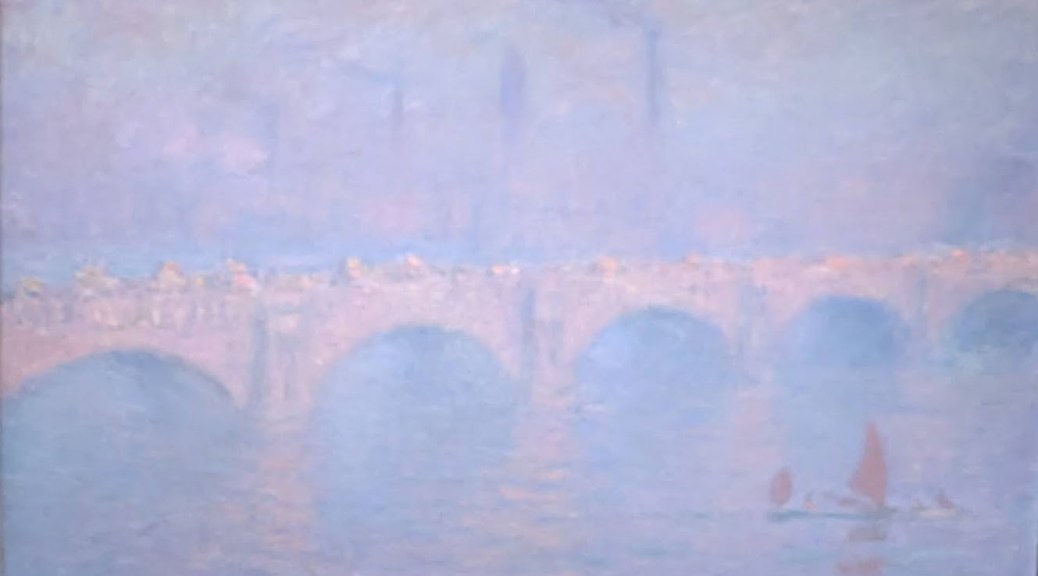
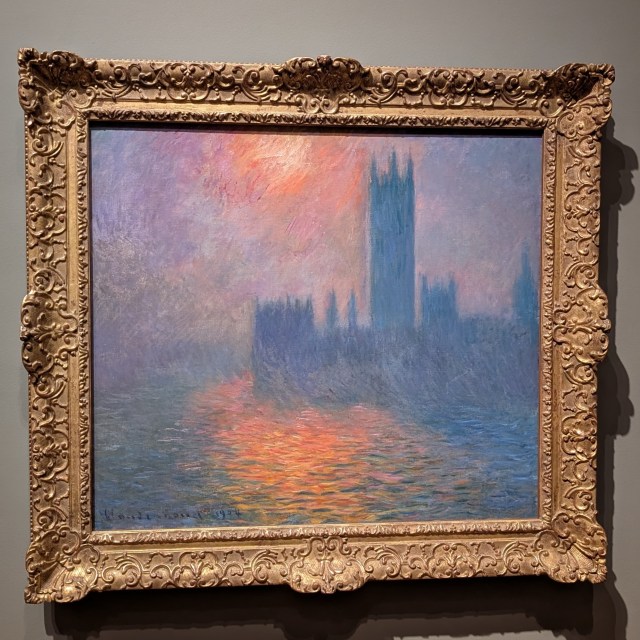
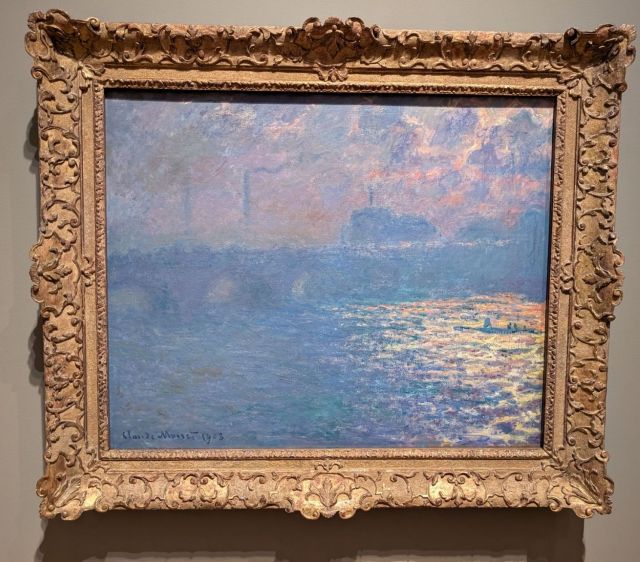
Monet was fascinated by the effects of sunlight. He loved its interaction with the fog and the smoke belching from the factories on the South Bank. Between 1899 and 1901, he made three extended trips to London to try and paint the effects. He stayed at the Savoy and set his easel up on a balcony overlooking the river. (No starving in a garret by this stage of his career) During his stays, he produced over a hundred unfinished canvases. From these, he eventually produced a series of thirty-seven paintings called View of the Thames. The paintings concentrate on just three sites, Charing Cross Bridge, Waterloo Bridge, and the Houses of Parliament. The views of the Houses of Parliament were painted from a terrace at St Thomas Hospital, on the South Bank.
The paintings were exhibited in Paris in 1904. The exhibition was a critical and commercial success. He had plans to repeat the exhibition in London in 1905. The plans fell through because of the commercial success of the Paris exhibition. (He couldn’t borrow back enough of the paintings he had sold) One hundred and twenty years later, twenty of the thirty-seven paintings are back together in London. The Courtauld Gallery is in Somerset House. It is about one hundred meters down river from the Savoy hotel, where they were originally painted.
The Exhibition.
The source of the paintings is familiar, as are the paintings themselves. With Monet’s views of the Thames it is difficult to feel surprised by any individual piece. But when presented with the ensemble, it is hard not to be impressed
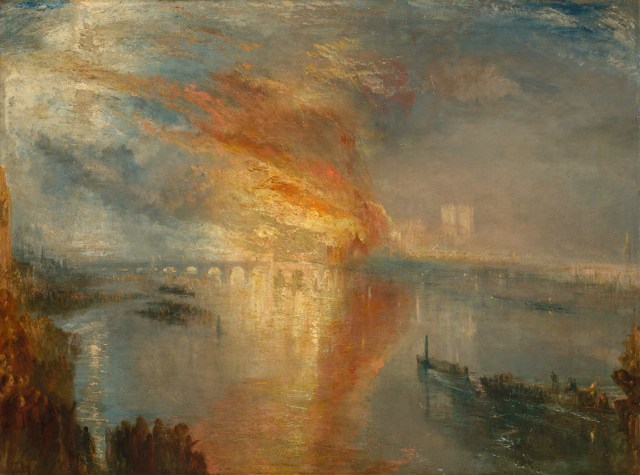
Although there are only three subjects, Monet imbues each painting with a different feel. Although Monet admired J.M.W. Turner, he never claimed him as an influence. Nevertheless, many of the paintings have a Turneresque feel to them. Though Turner only painted the Old Parliamentary buildings on fire
Parliament Claude MonetParliament J.M.W TurnerClick to enlarge.
The paintings of the bridges show that the sun does come out (occasionally).
The Waterloo Bridge that Monet painted was replaced by the current bridge in 1934 because of structural problems. Waterloo Bridge was falling down
Having completed his London series, Monet went on to work on his Waterlilies series, which took up his remaining years. In many of the paintings, but especially in the ones above, you can see the development of blending water, sky, and sunlight. That became one of the features of his Waterlilies.
It was an enjoyable, if not overly challenging exhibition. Not every exhibition has to be challenging or ground breaking.
The permanent collection is also worth an hour or two of your time.
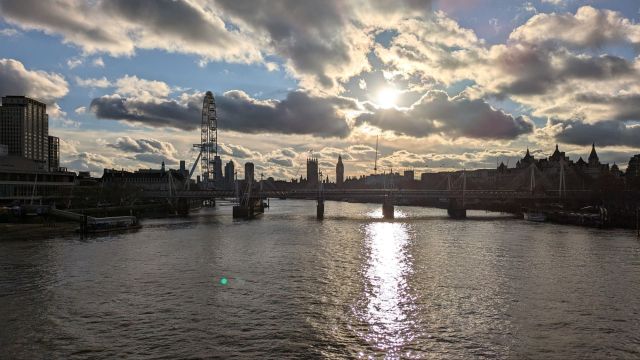
We couldn’t get onto a balcony at the Savoy, so we did our modern-day take on the scene from Waterloo Bridge. Fortunately, we no longer have the air pollution that created the effects that fascinated and, to an extent, frustrated. Monet. He found it frustrating because the light changed every five minutes.
Our adventures, which started back in October, were drawing to a close. Our last day had dawned.
After our day of decadence yesterday, today was always going to be more prosaic. So it was breakfast, then packing our cases for the last time. In the meantime, we had to figure out what to do after checking out at eleven. We had nine hours to fill before we would be picked up for our flight at eight p.m.
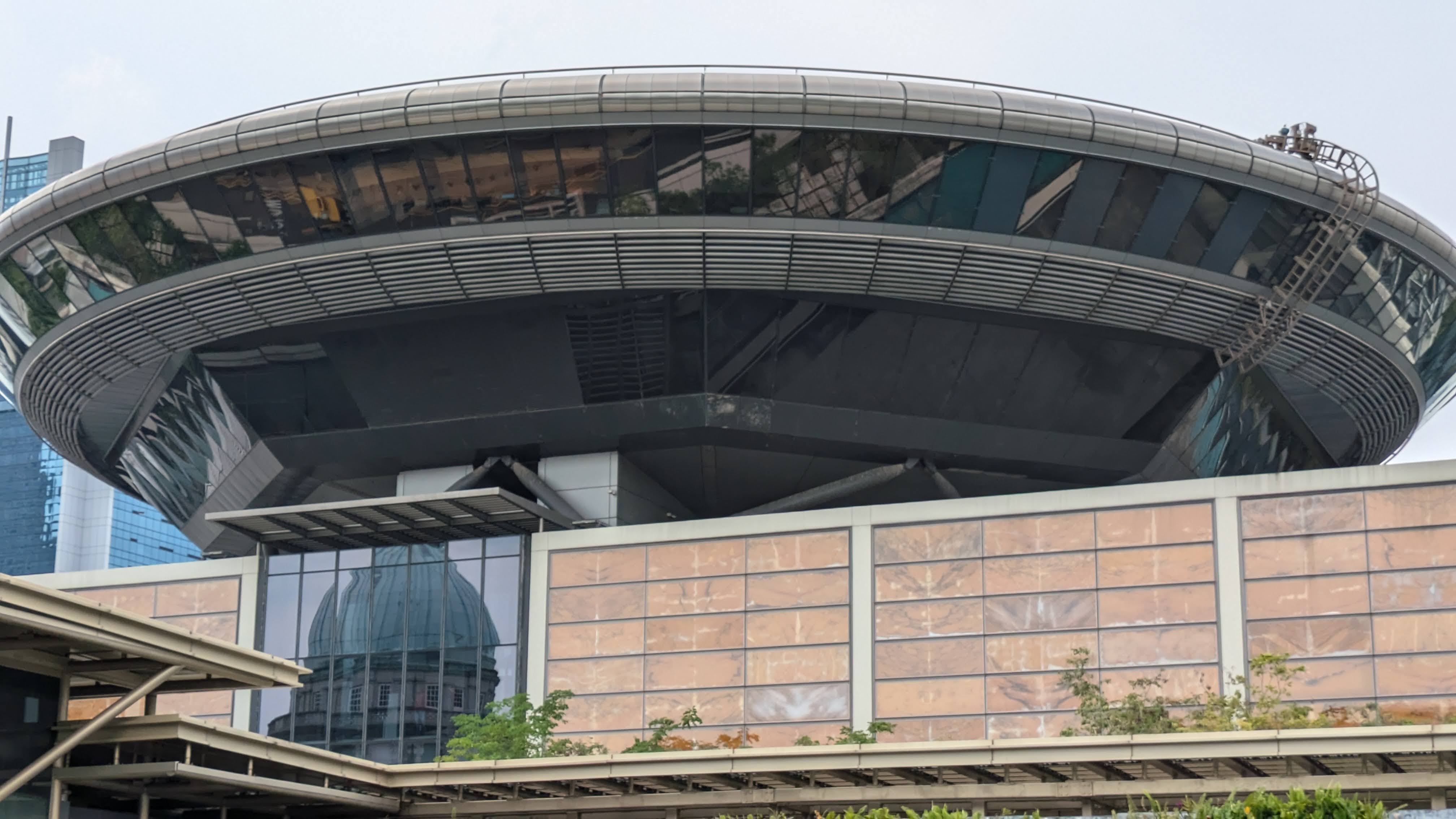
We decided on a visit to the National Gallery of Singapore . We left our luggage with the concierge. We decided to walk to the gallery. It was about a ten minute walk from the hotel. The walk took us down Bridge Street, across the river and past the Parliament Building.
Not an alien spaceship, but the new Supreme Court Building
The gallery is situated in what used to be the City Hall building and the old Supreme Court building. It is a confusing building to navigate. The two earlier buildings are separate but joined, making it difficult, for me at least, to know where I was.
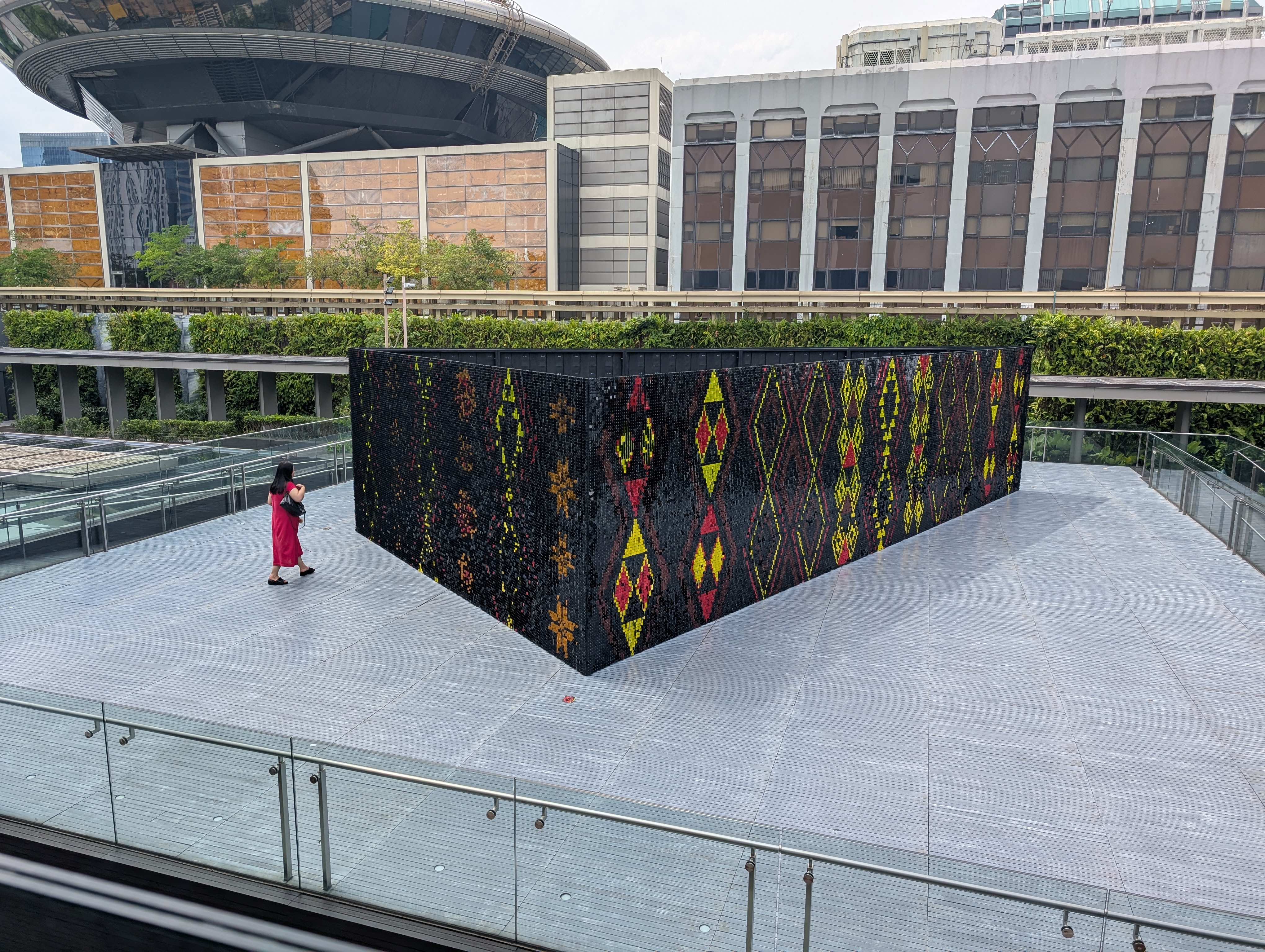
‘We visited one of the exhibitions named “Glisten”. It was located in the Roof Garden created by Aotearoa/New Zealand artist Lisa Reihana. A link to where we come from.
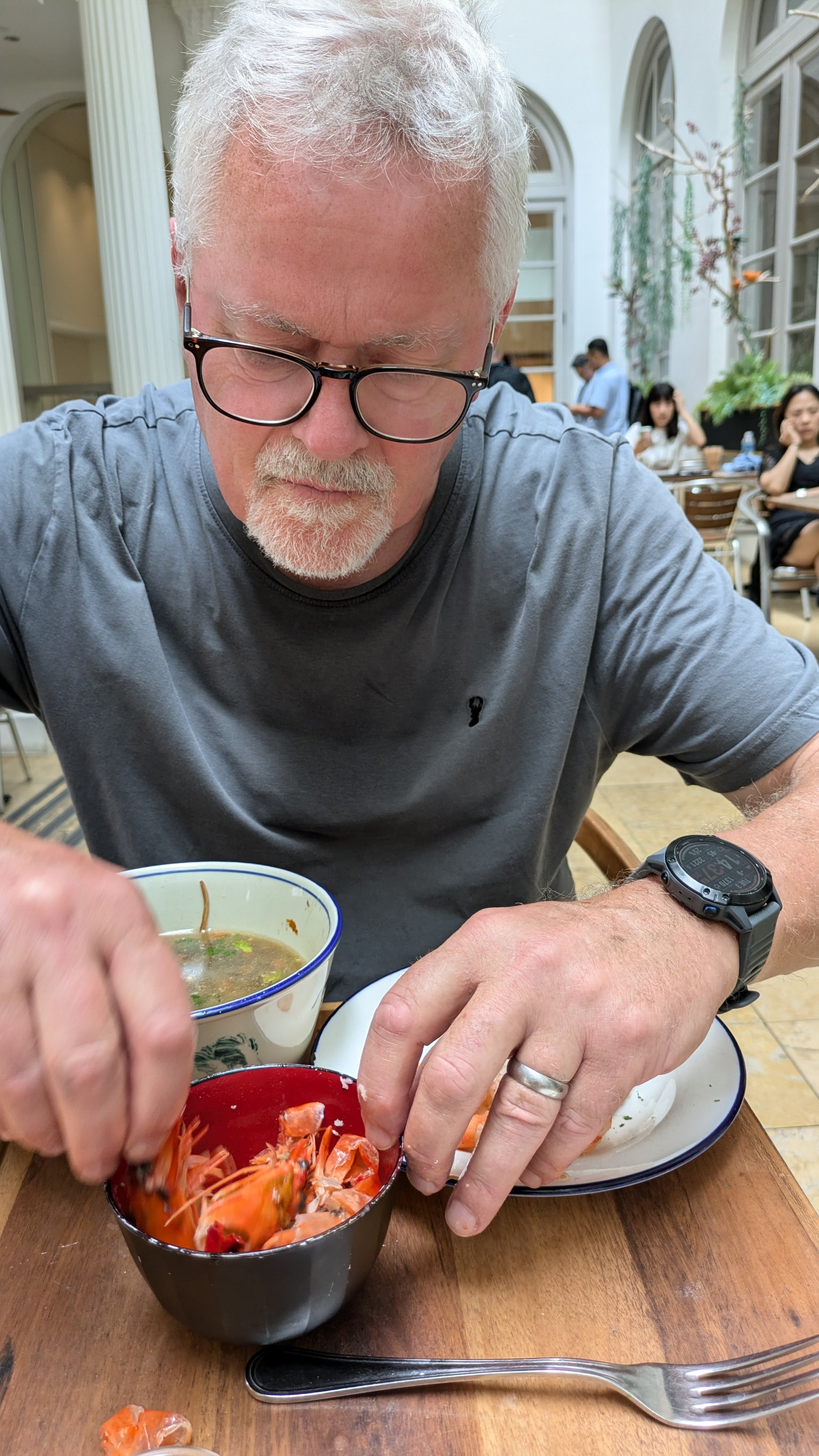
After that we decided to have lunch. There are a variety of restaurants and cuisines to chose from. They range from a three Michelin Star French Restaurant, through Cantonese to Japanese to Catalan. We settled on the Courtyard Café which does, in its own words “Straits Asian food”. It was good, even if I had to peel my own prawns.
I thought the prawns would be peeled
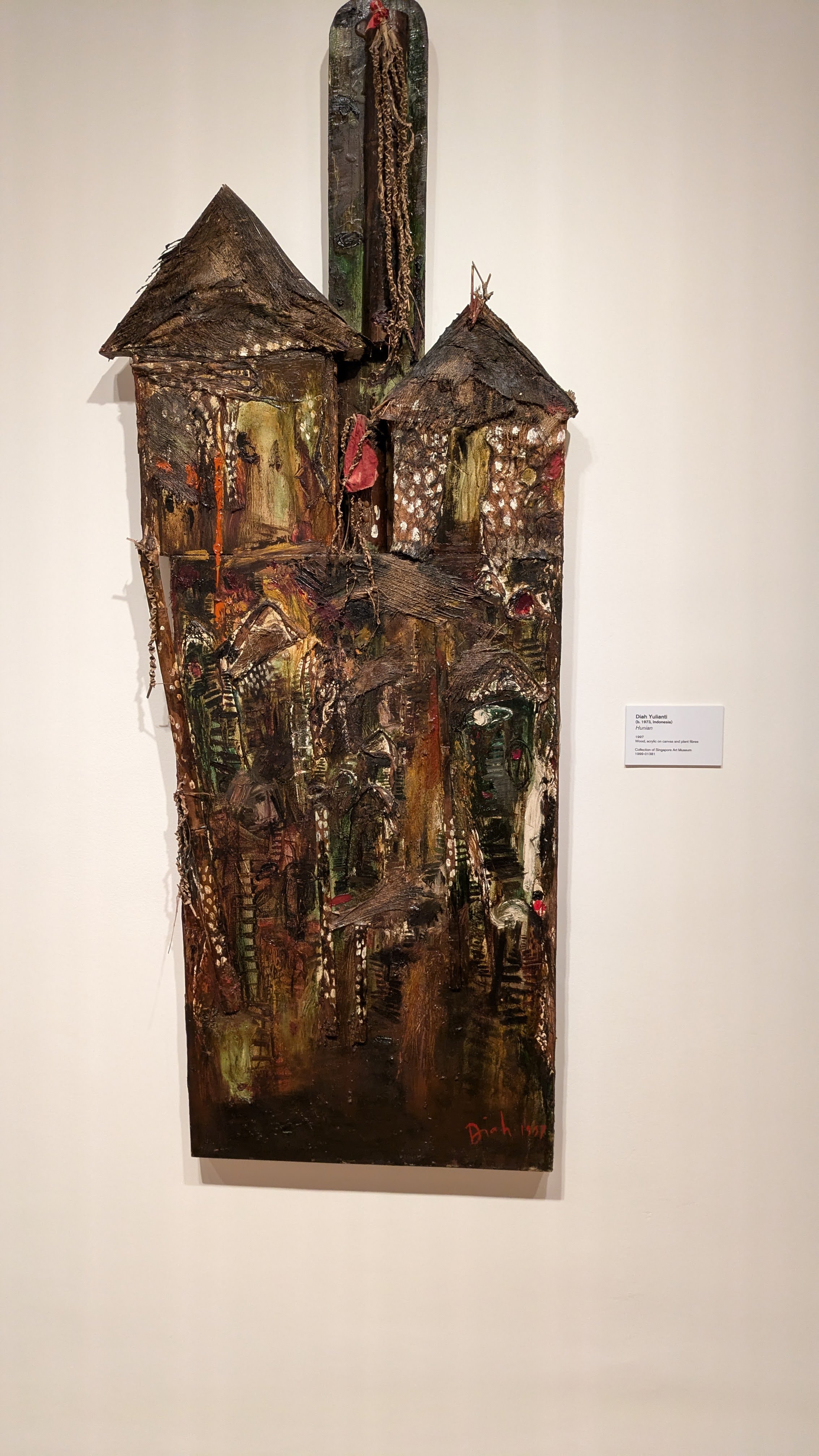
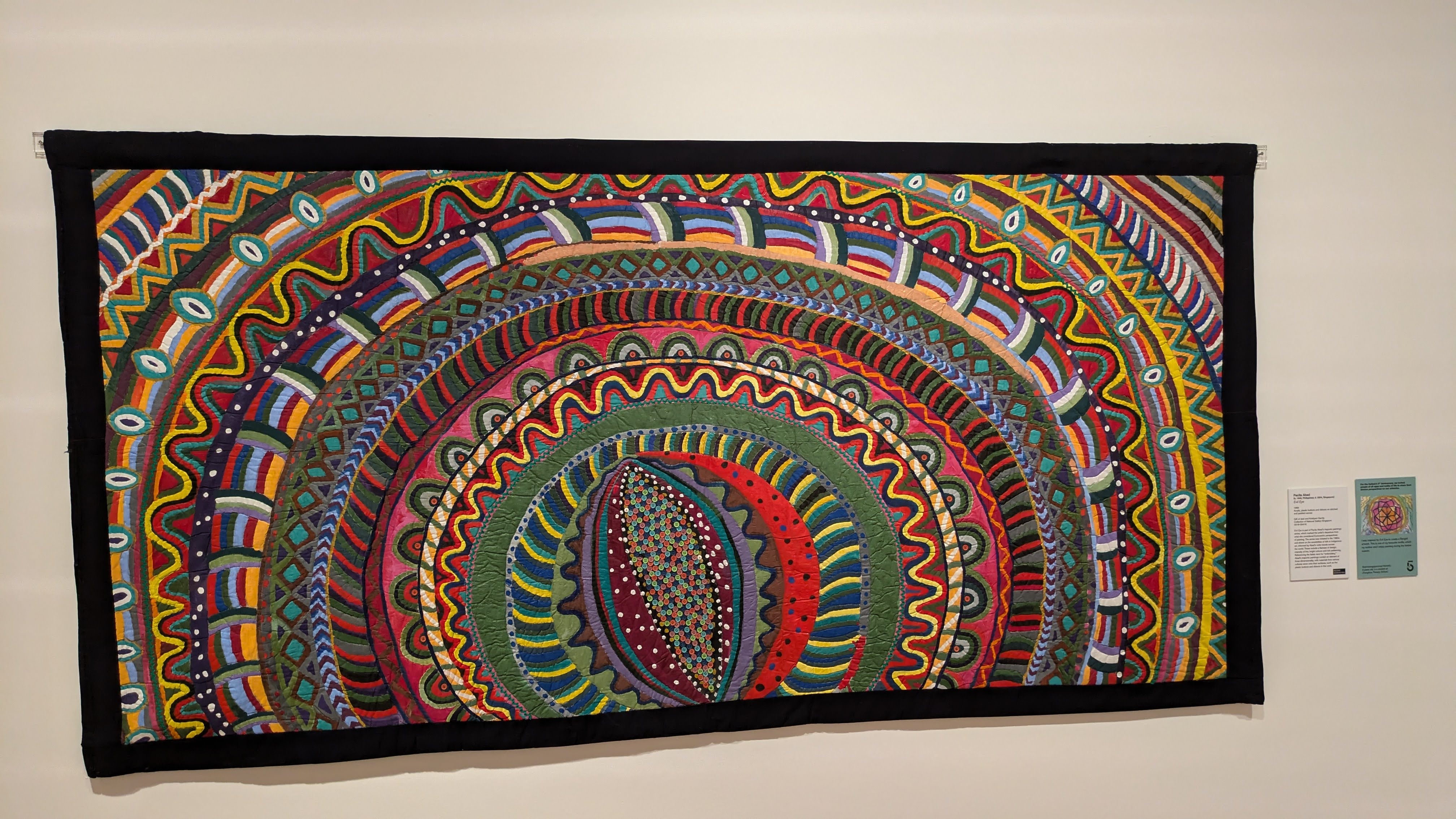
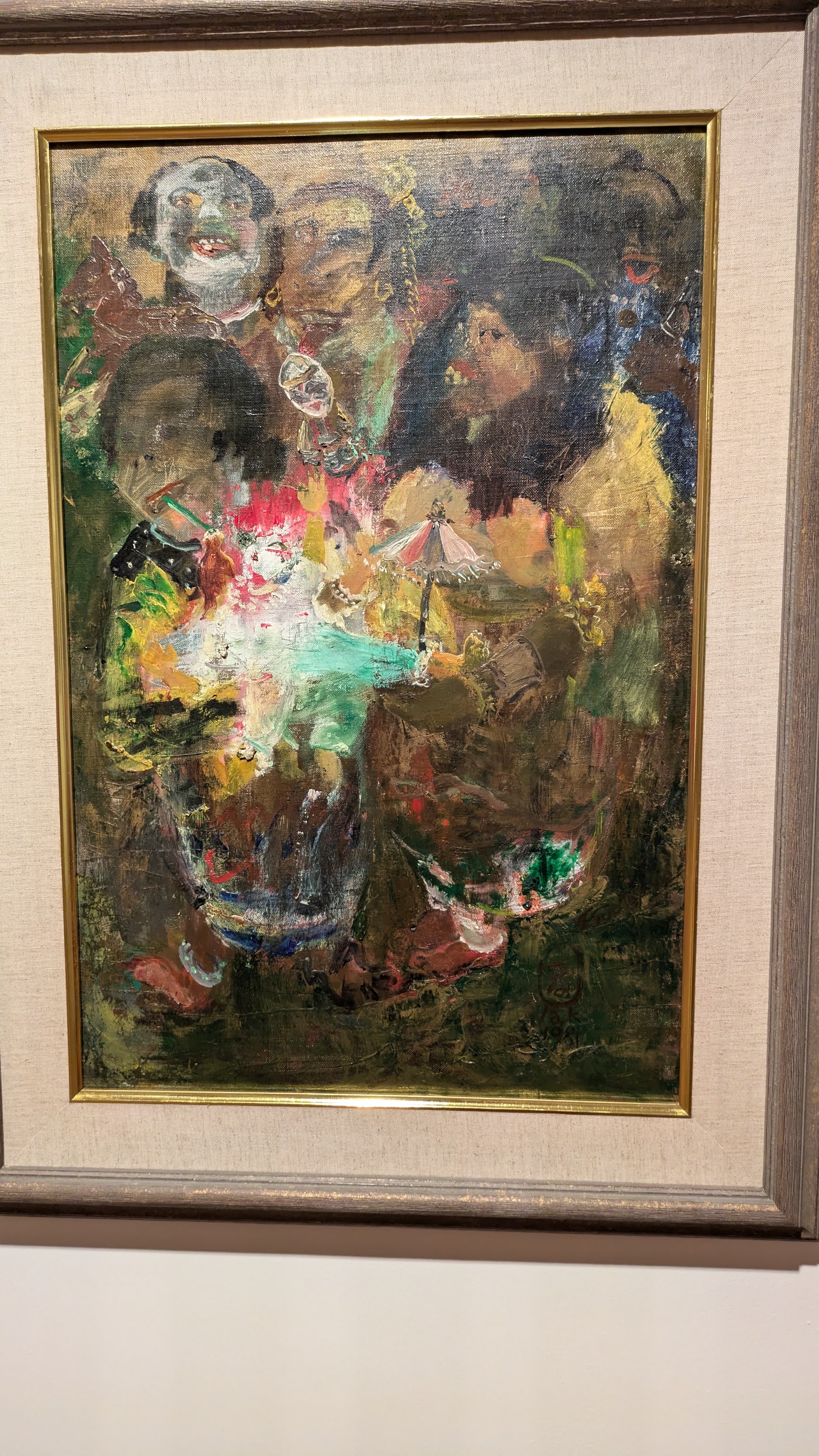
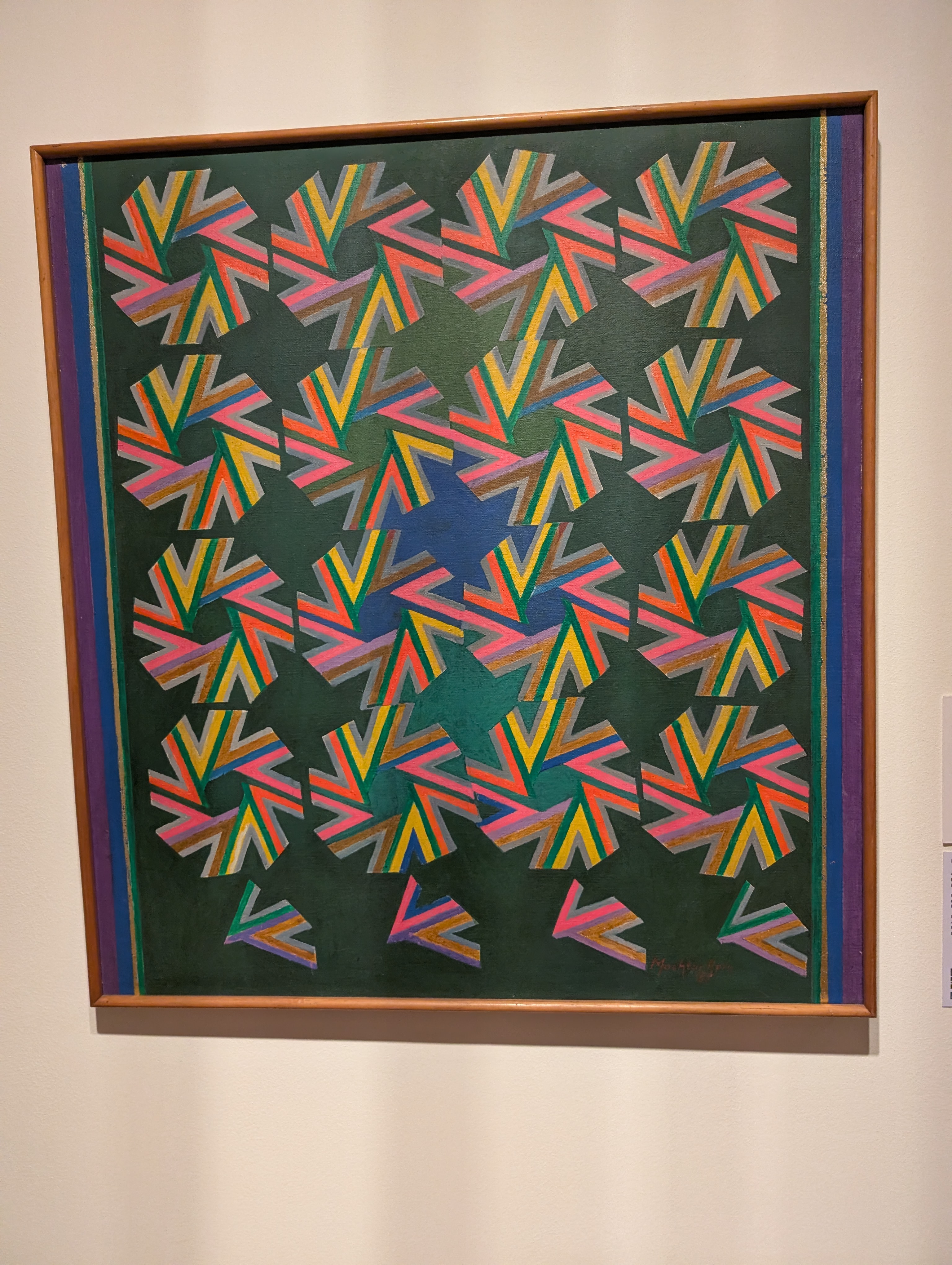
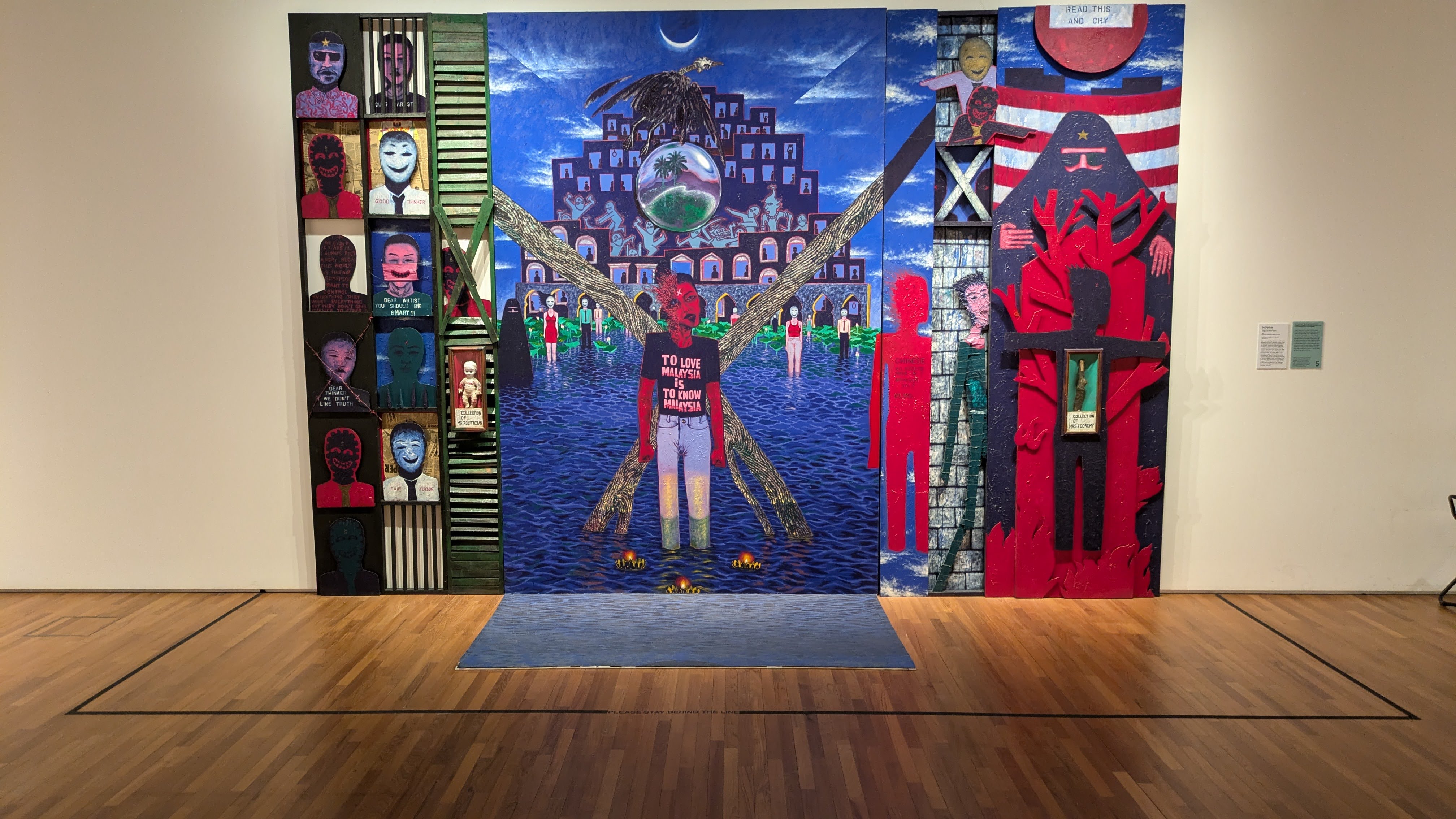
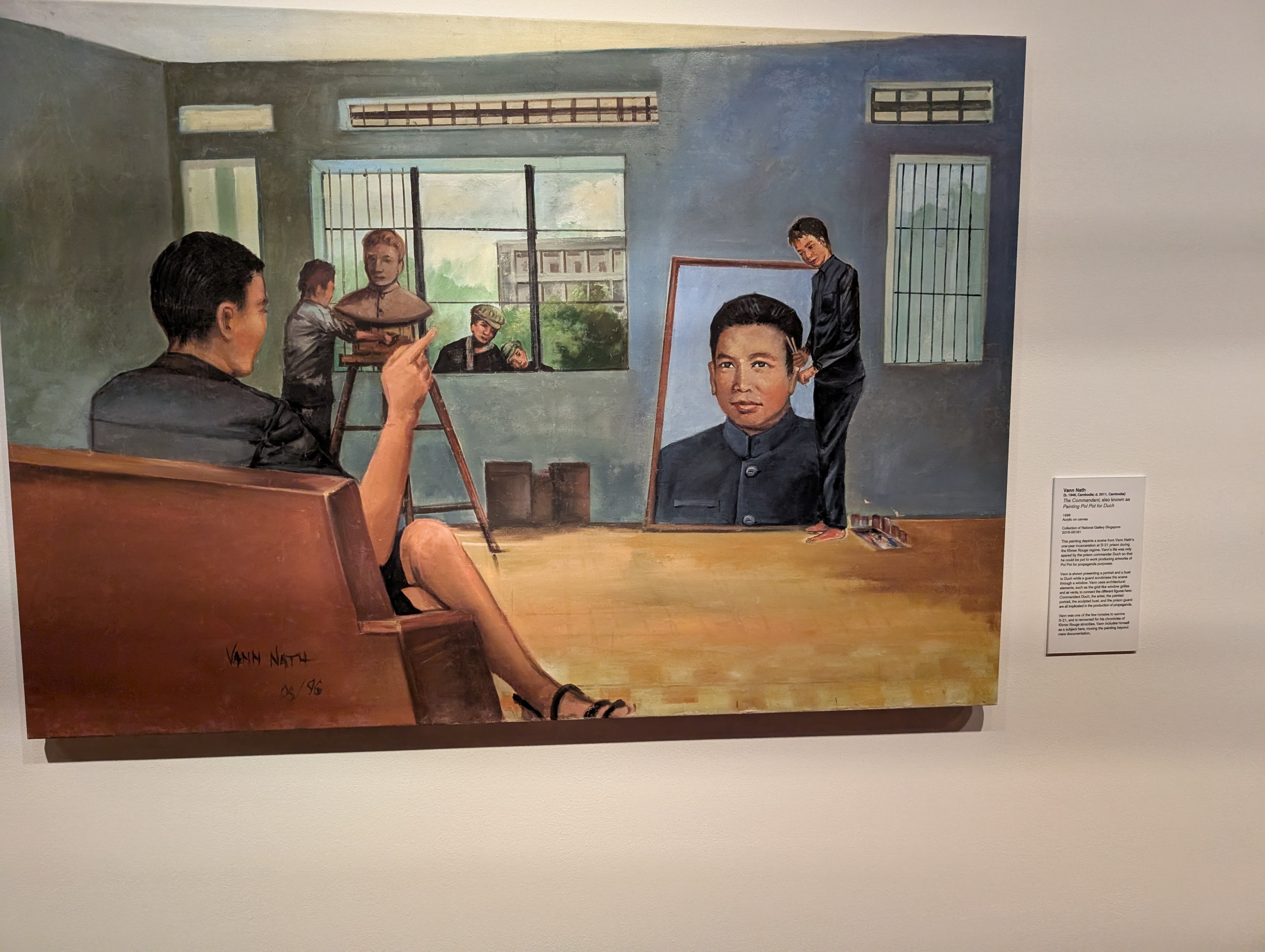
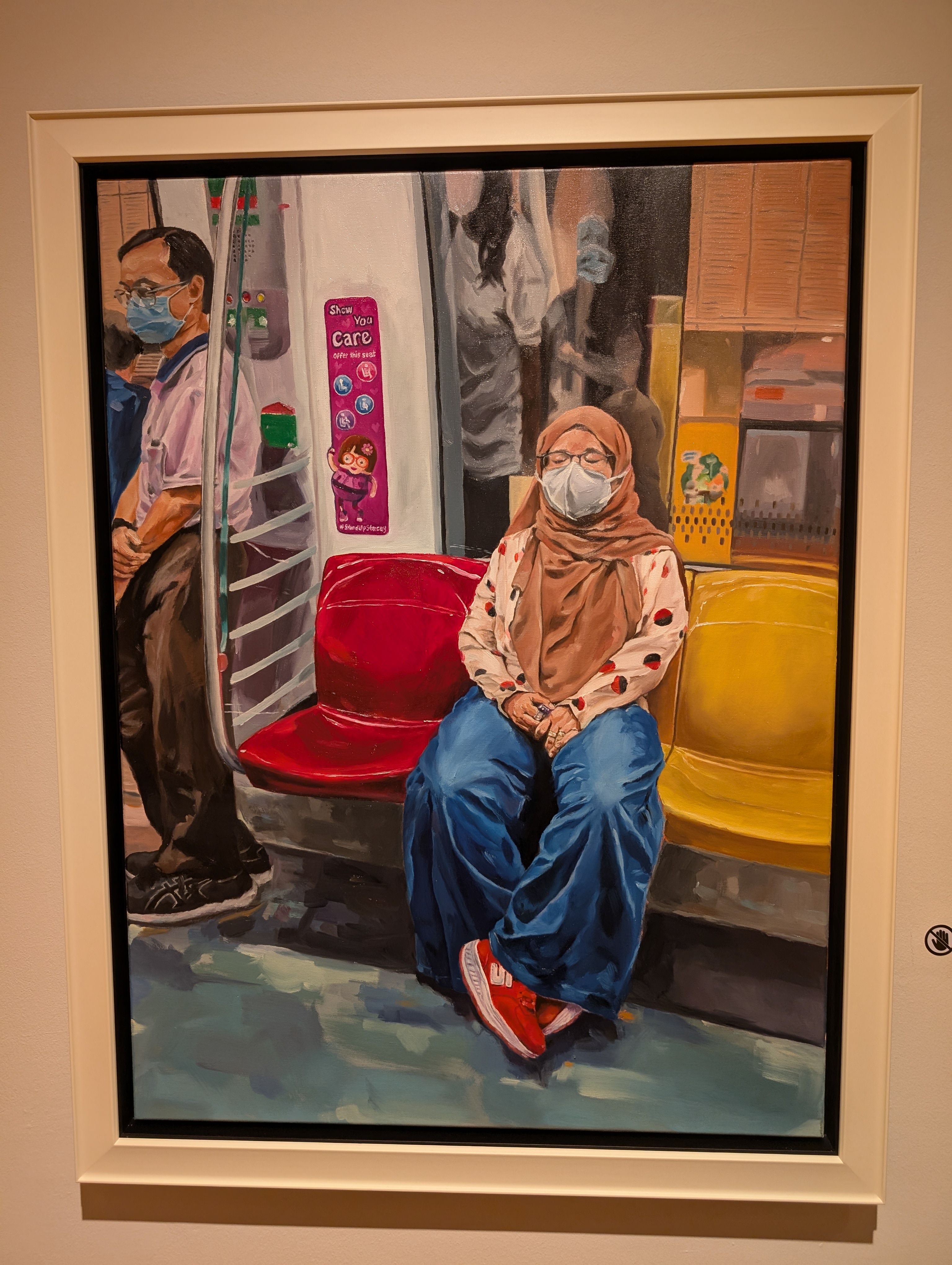
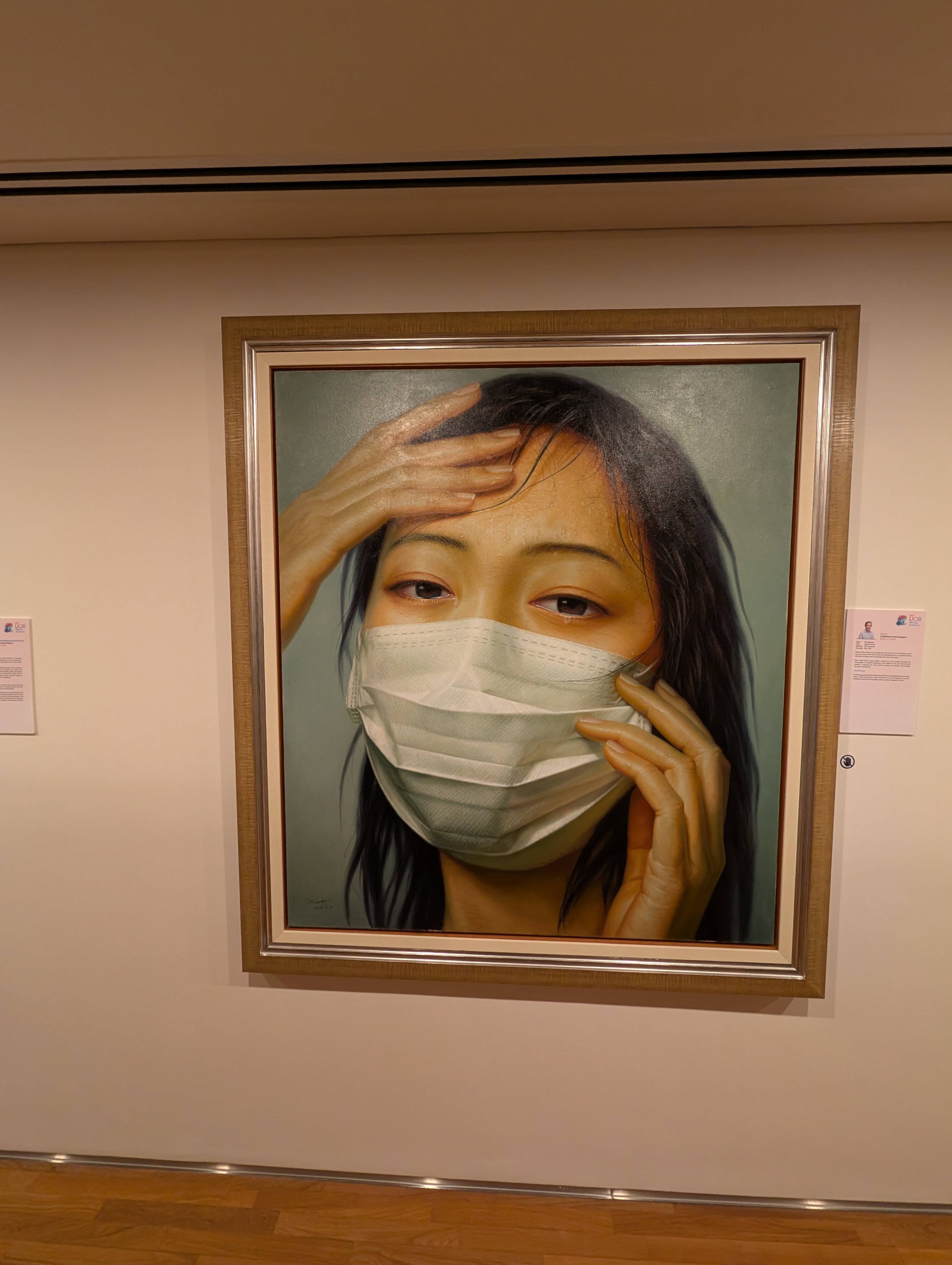
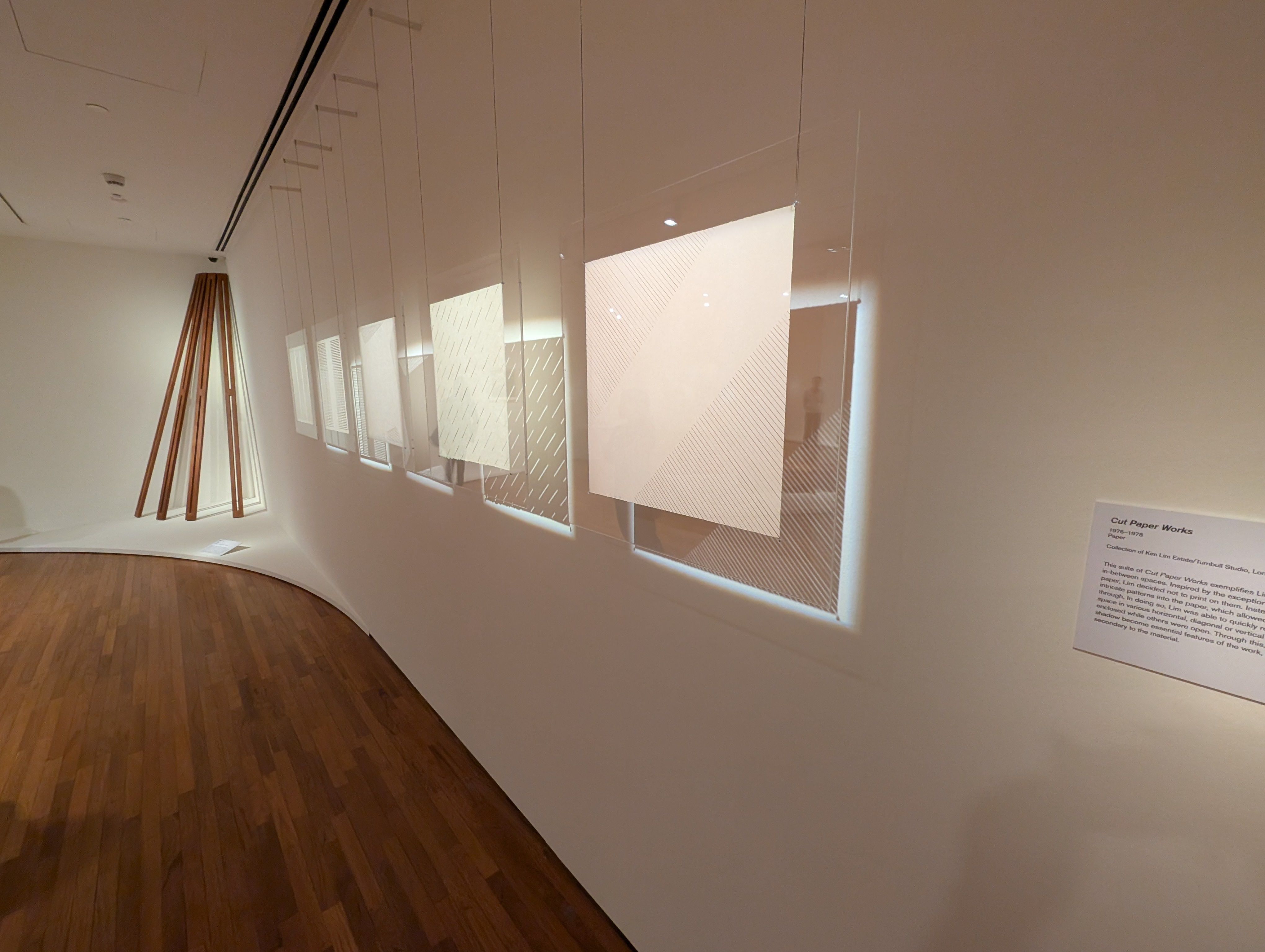
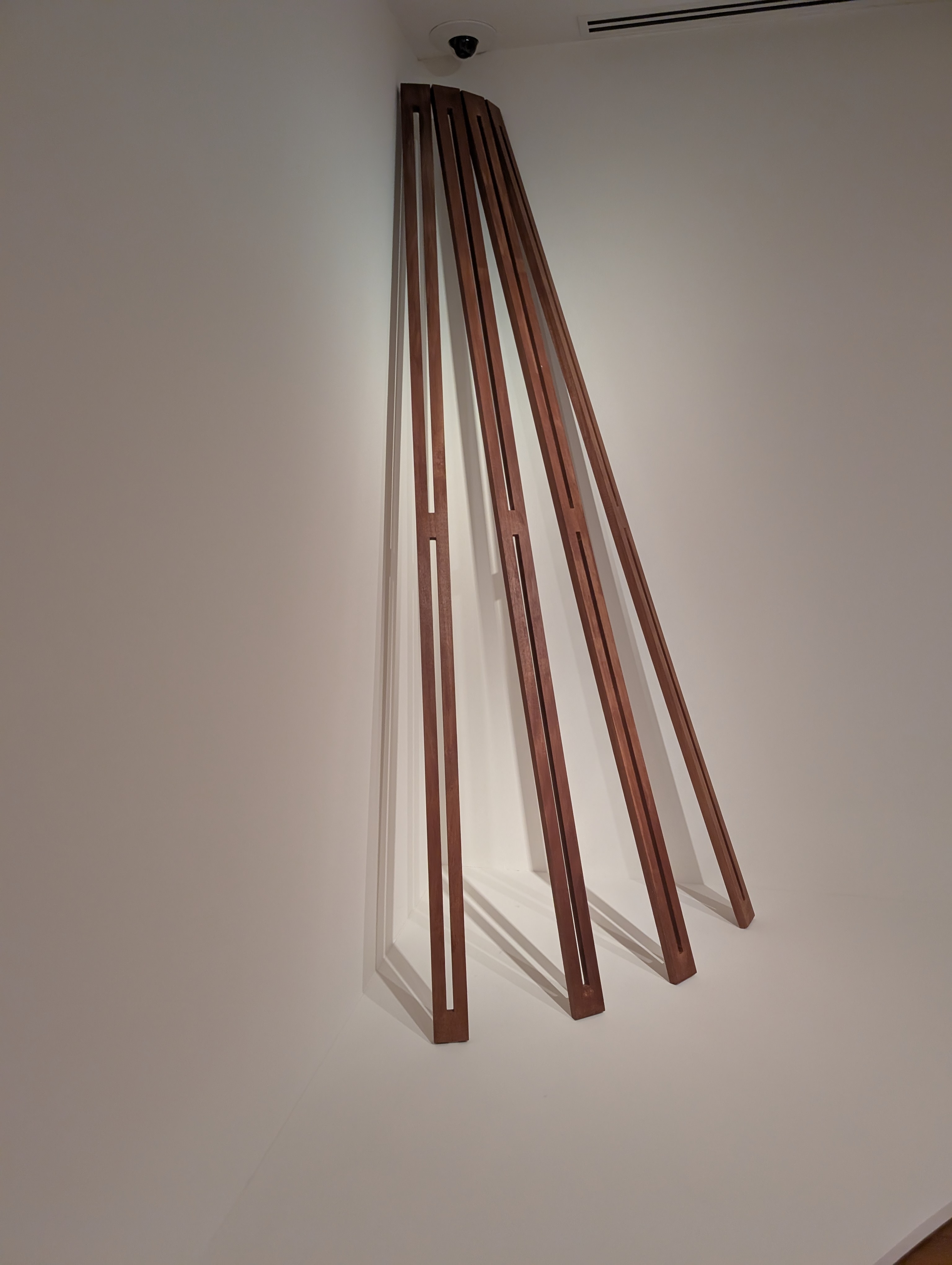
After lunch we went round four exhibitions. The first of which was an exhibition of the award winners in a South East Asian Art competition. It was interesting if varied in quality and style.
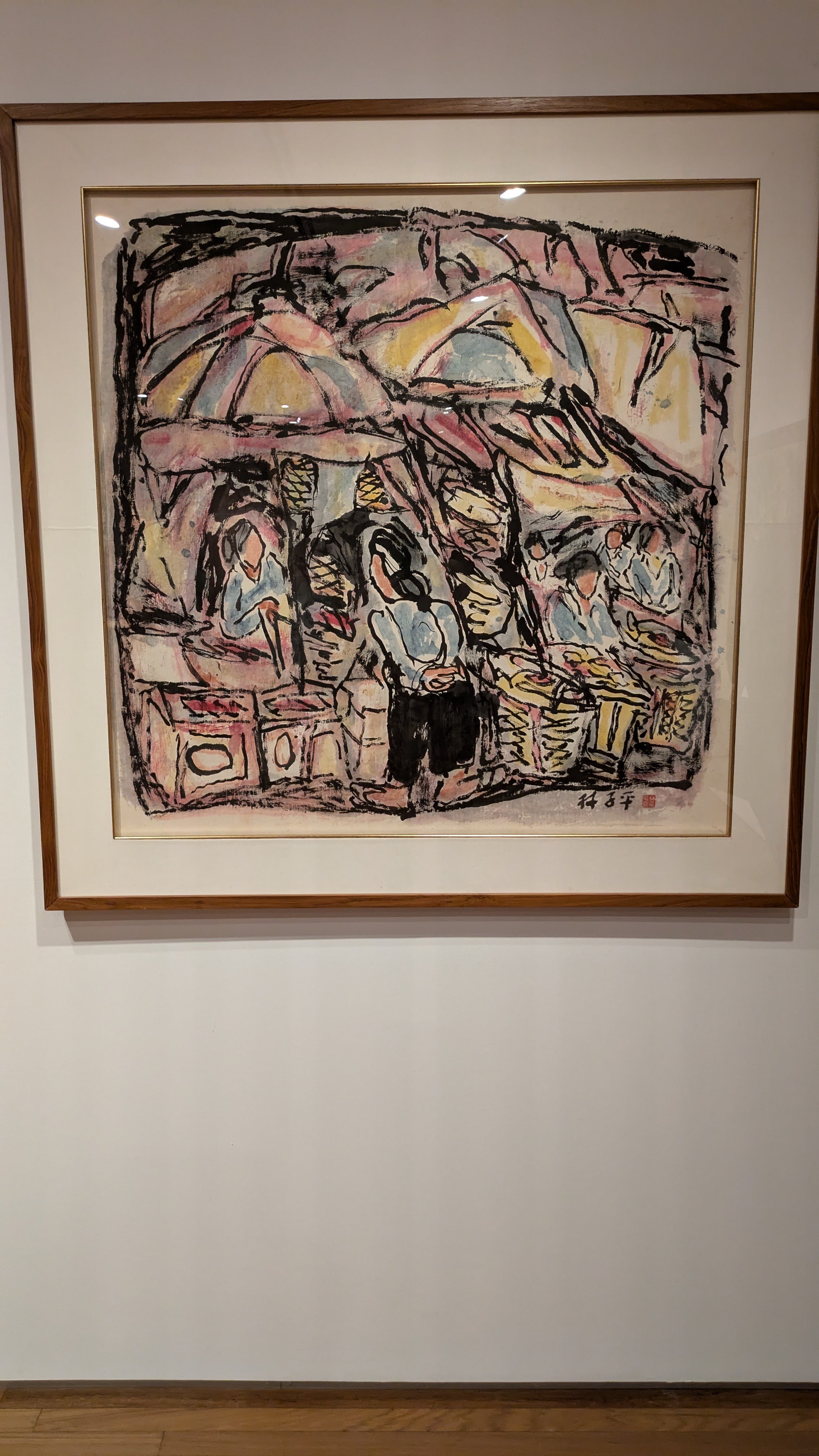
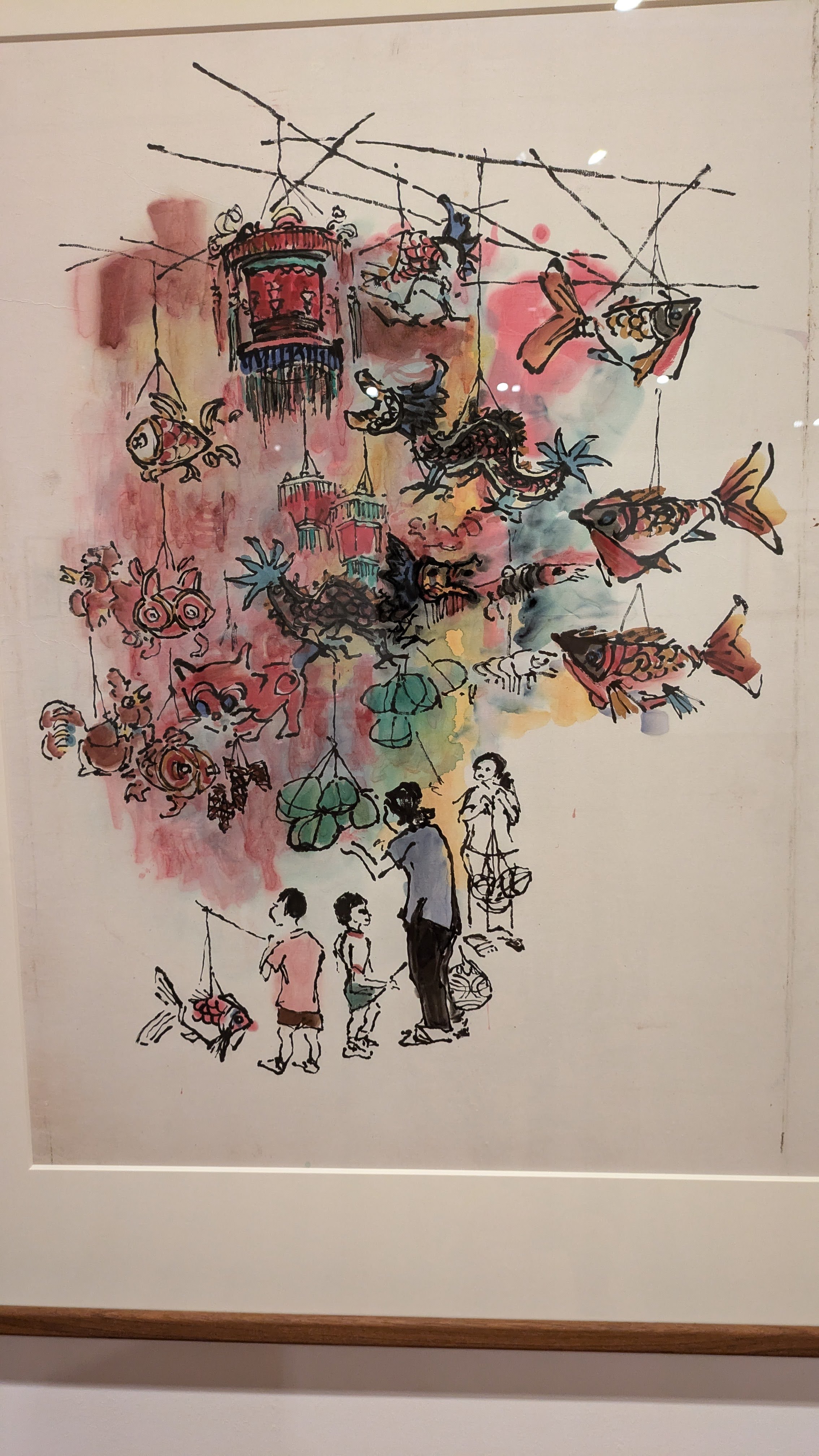
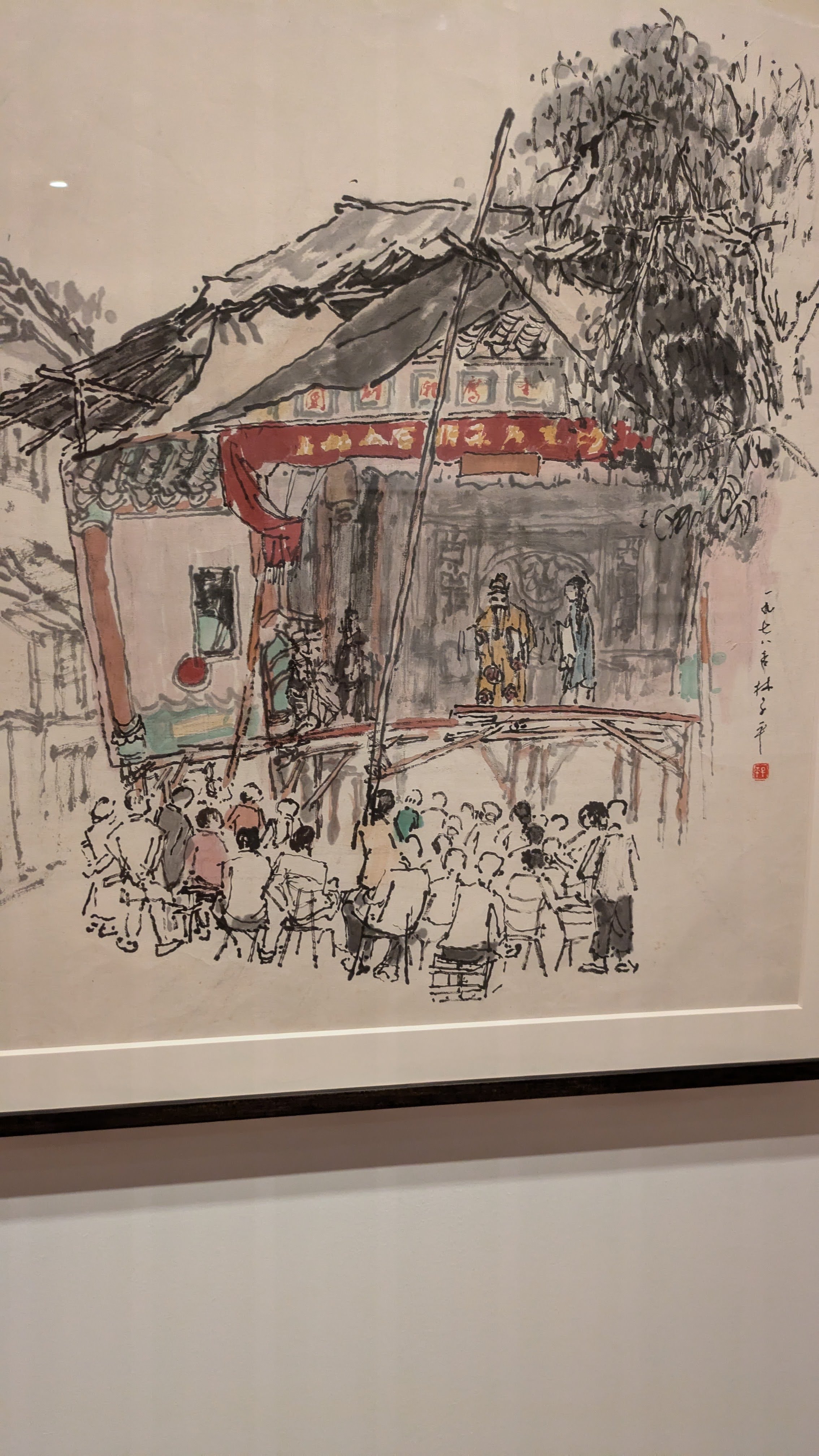
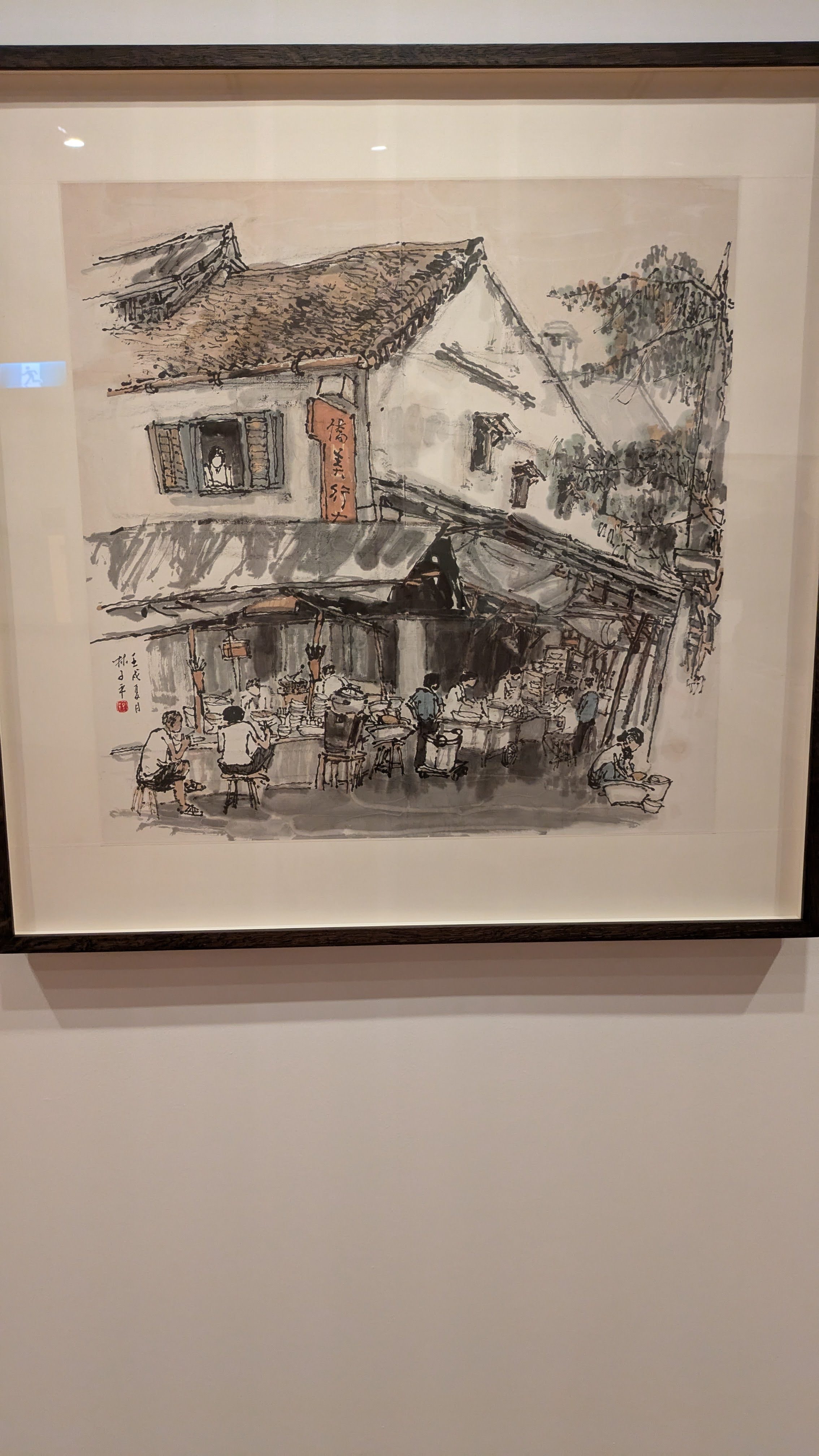
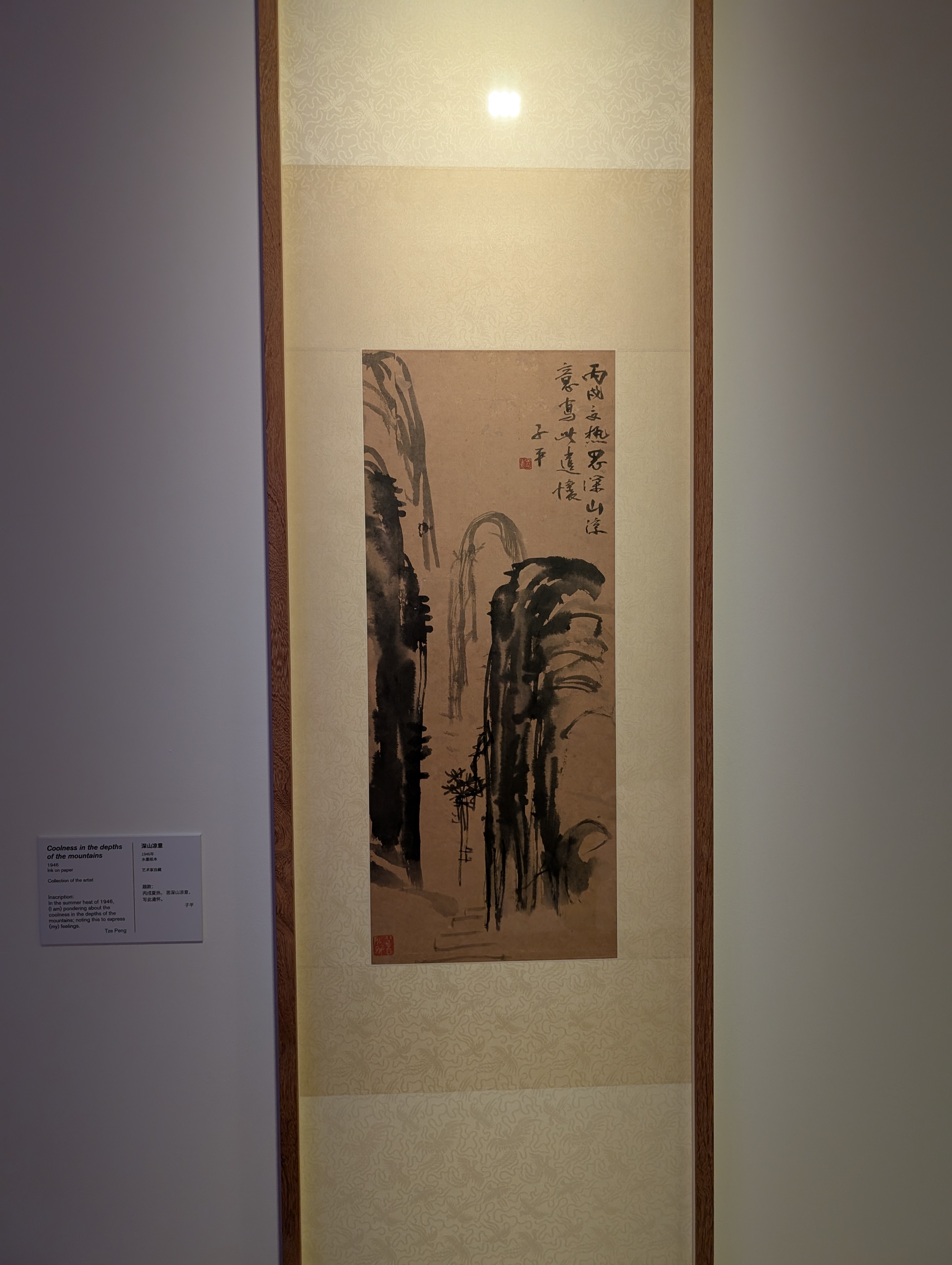
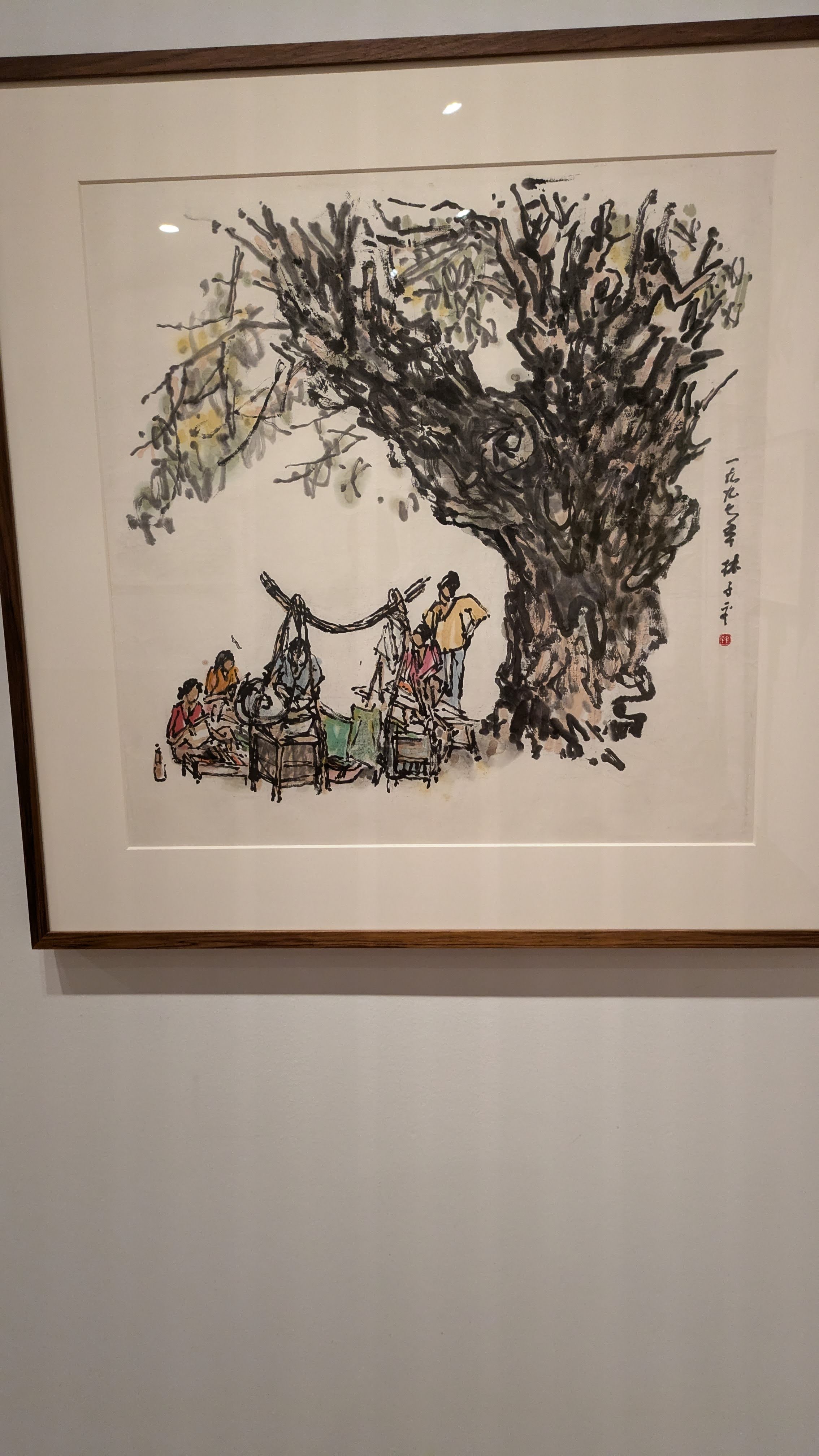
After that we saw, what was my favourite of the exhibitions, “Becoming Lim Tze Peng”. Lim Tze Peng is a one hundred and three year old Singapore born artist. The exhibition traces his development and his route to becoming a national treasure. He is viewed in Singapore in a similar way to David Hockney in the United Kingdom.
This is lazy on my part. But, I feel that the video above gives a better overview of an artist than I can. I knew nothing of her or her work before seeing the exhibition. I liked what I saw.
By this time, it was around 5:30. We were “arted” out. It had also started to rain. This was rain as I remembered it from my time in the Solomon Islands. Like a giant bucket of water being poured out. We decided to get a taxi back to the hotel. We would have drowned in the ten minute walk back. We already knew that taxi fares went up at peak times. Rain makes getting a cab more difficult and also, apparently, even more expensive.
Back at the Park Royal Pickering, we had a final dinner. Our faithful driver arrived at 8:00. He had been the same one for all our official excursions. He whisked us off to the airport and our flight home.
Our flight was delayed slightly but took off about one in the morning. Fourteen hours later we were back where we started thirty nine days earlier.
We had pre-booked a car. It took us back home to a cold and dreary New Malden by nine a.m. Duster was there to meet us, and I think he was pleased to see us.
We were still staying at Camping Playa Arenillas. Today we had decided to go to Bilbao, specifically to visit the Guggenheim Museum. The trip required two buses and although the information we had from the campsite was a bit vague, we thought we had it sorted.
Not quite. There was supposed to be a bus stop near the campsite, but we couldn’t see one, so we decided to walk along to the stop in the village. As we were walking along the bus went past. Diane elisted the help of a couple of local council workers, but they spoke as much English as we speak Spanish. They tried to get us a taxi, but to no avail. We gave up and they went back to doing what they should have been doing. Shortly after, a bus that wasn’t shown on our timetable appeared, to take us into Castro where we could get the bus to Bilbao.
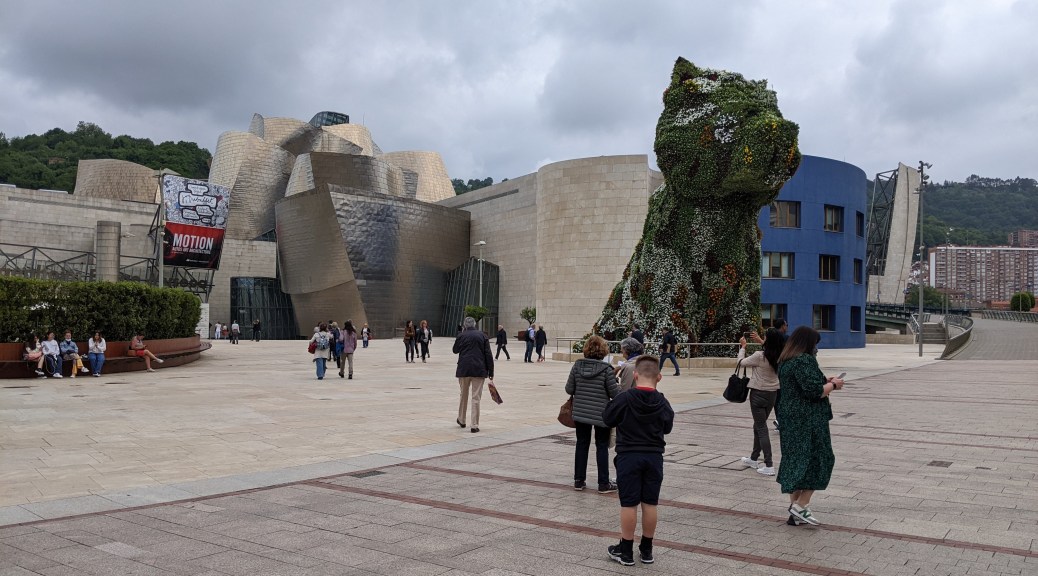
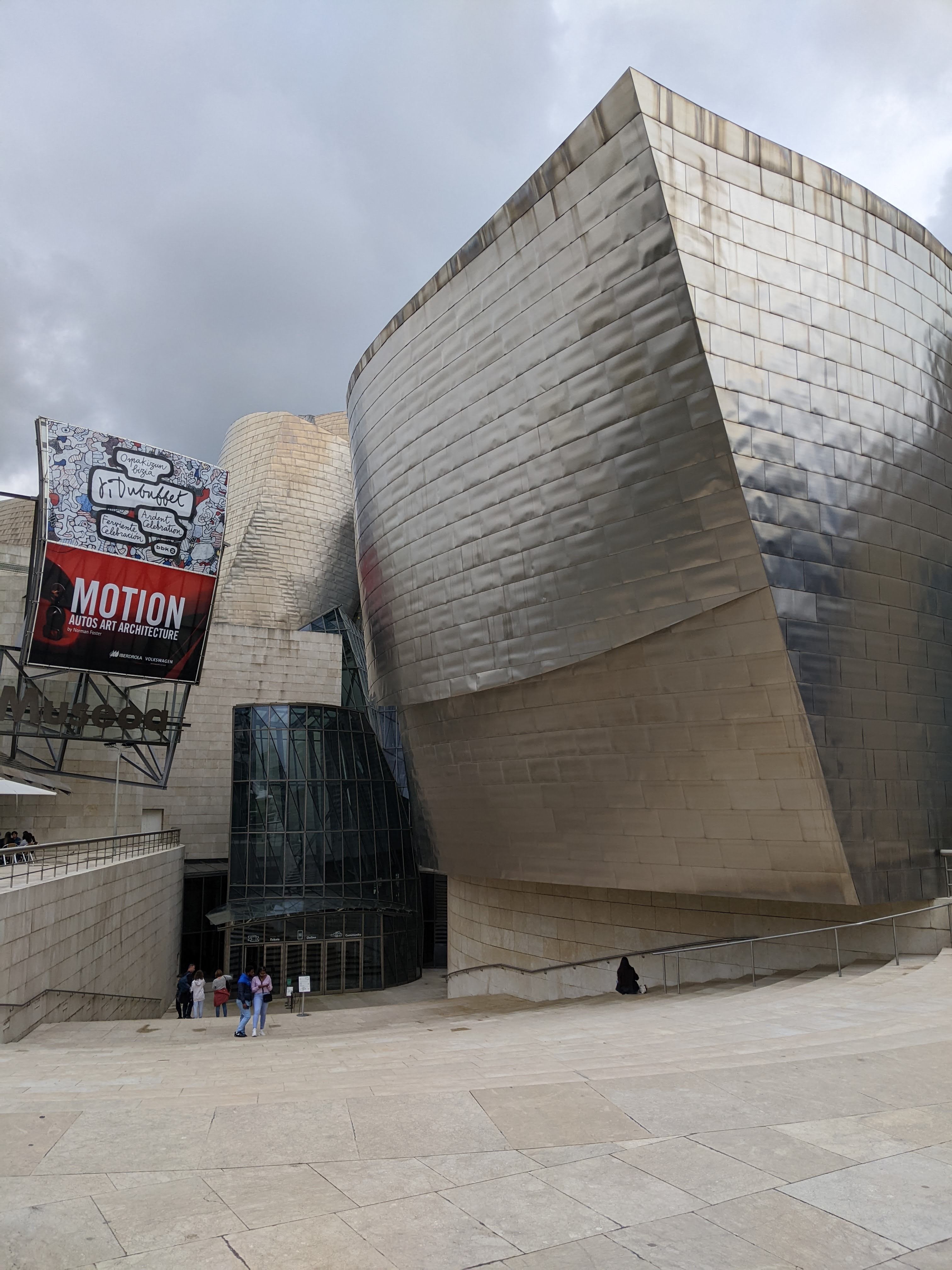
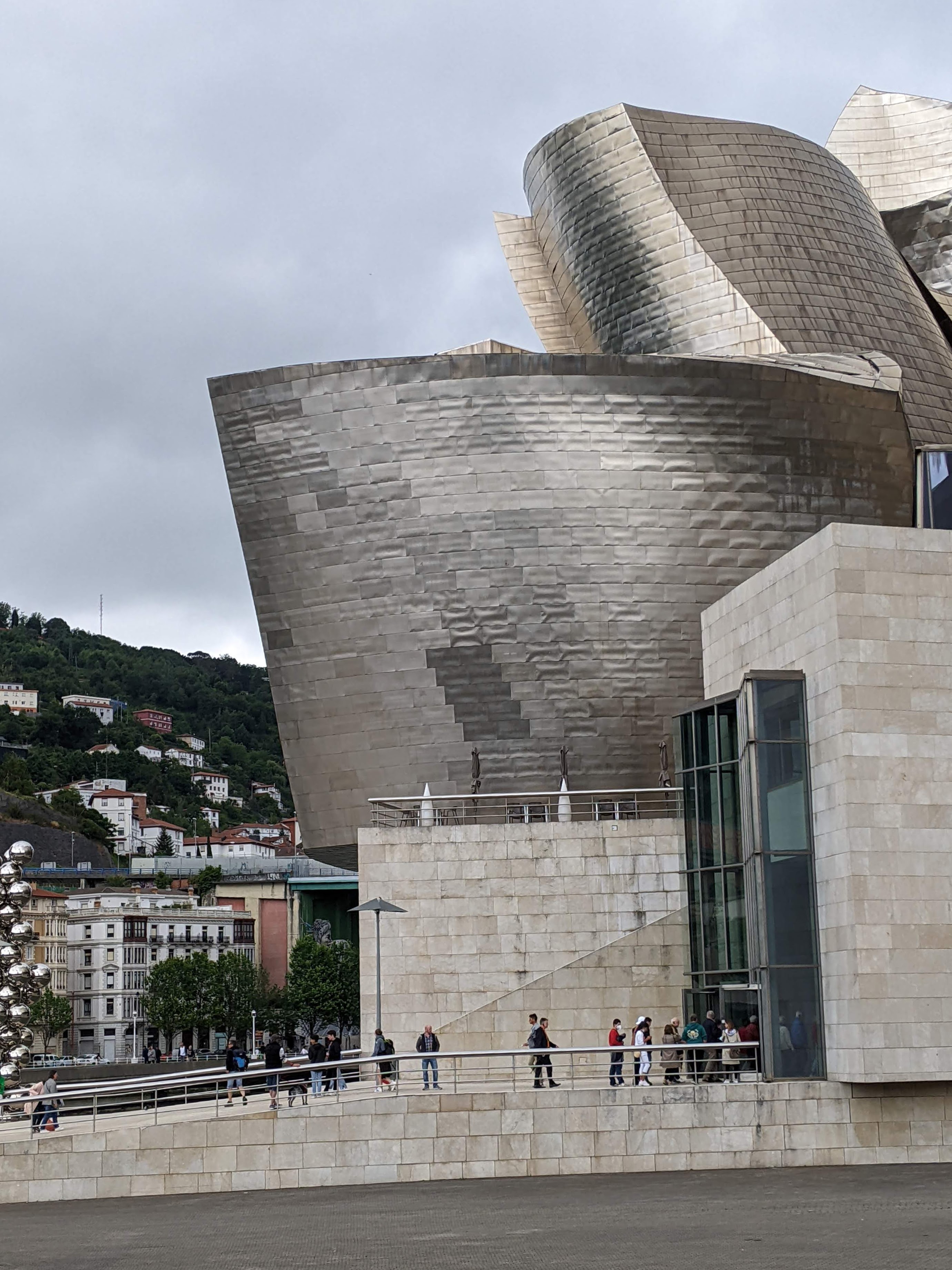
We got to Bilbao about twelve and found a taxi to take us to the Museum. It is an impressive building. Designed by Frank Gehry and opened in 1997. For more information follow this link
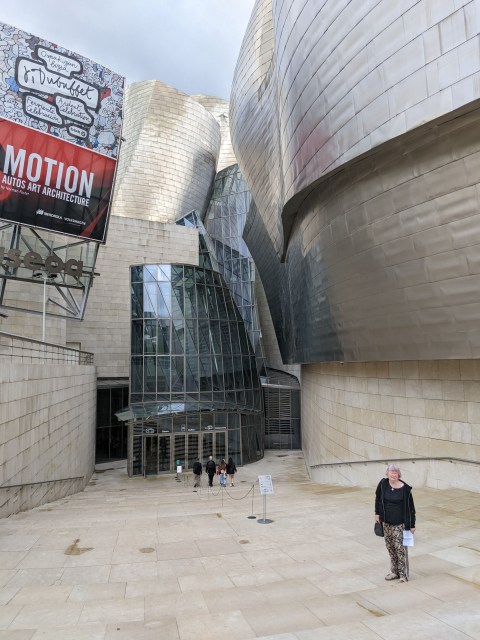
What we thought was the entrance.
We found our way in.
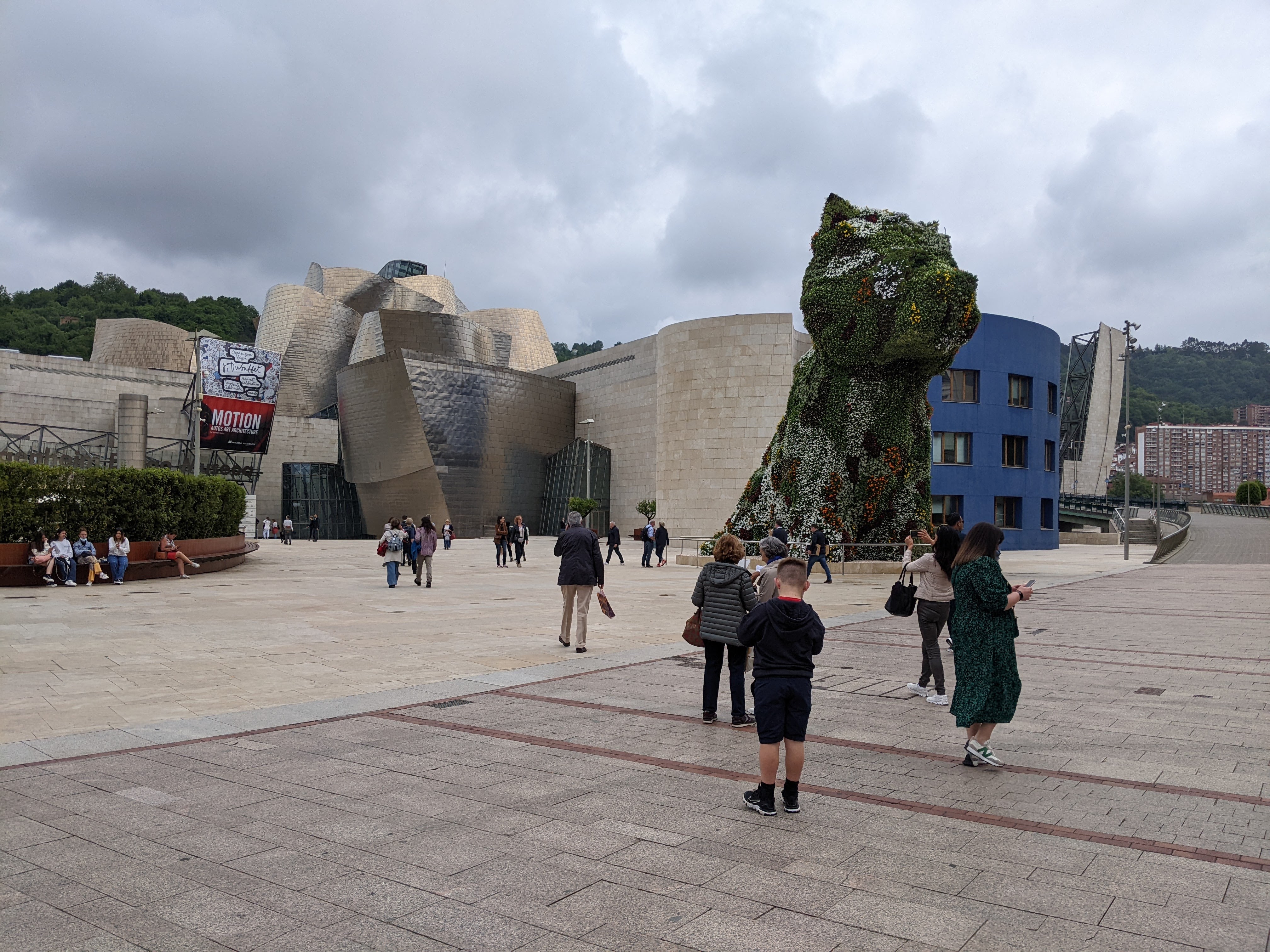
External views
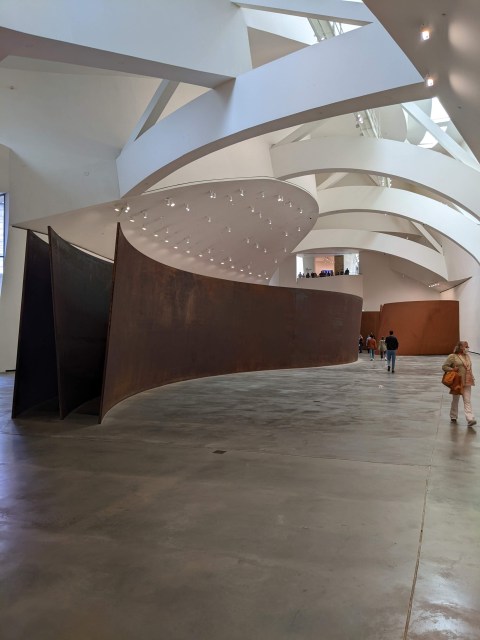
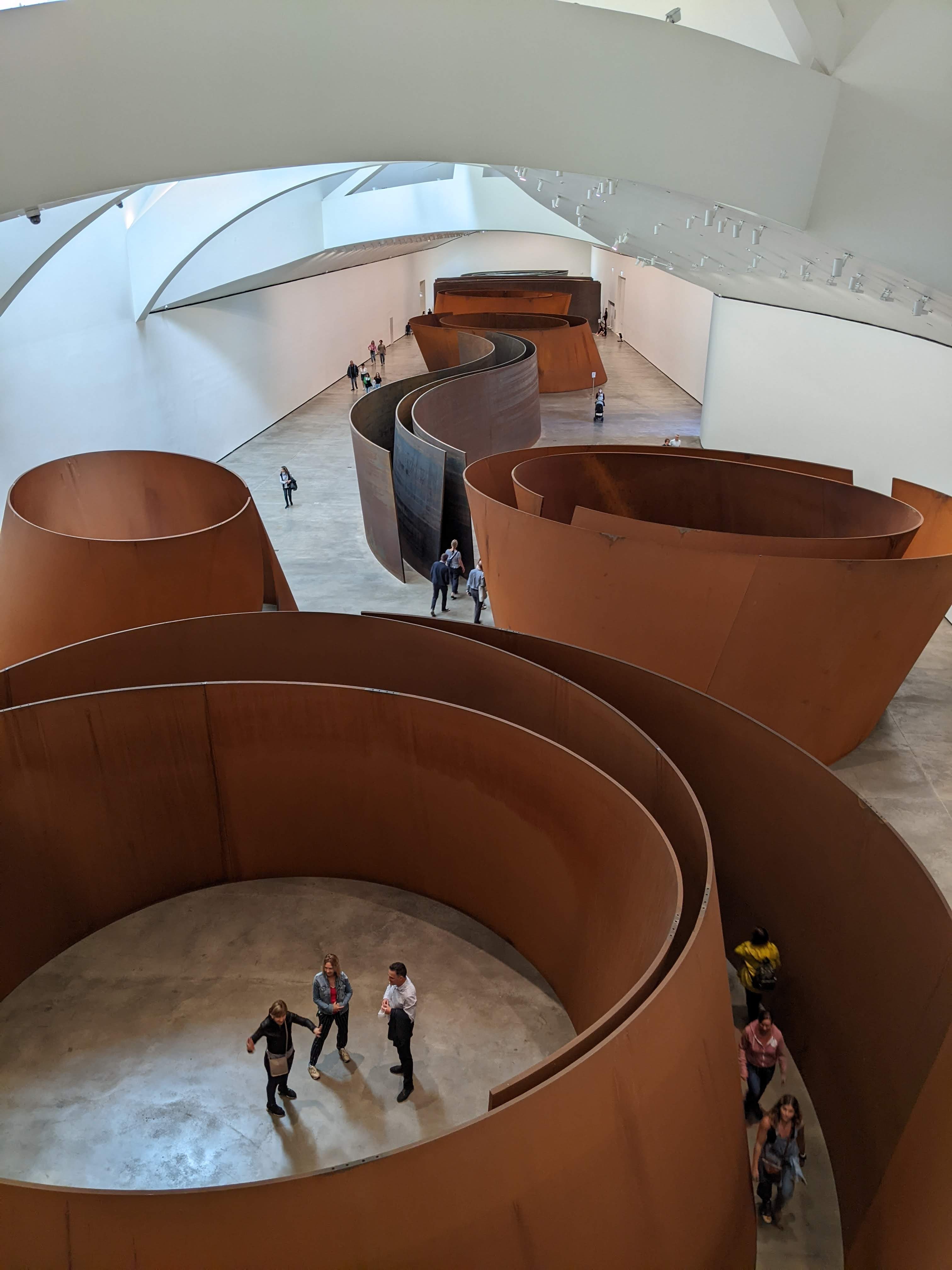
The ground floor is given over to exhibitions and installations. One in particular, which is site specific, Richard Serra’s “The Matter of Time” is highly impressive.
The Matter of Time
It is massive, sinuous and confusing to navigate. So in a sense it echos the museum. It is formed from large 50mm thick steel plates. So as well as being an amazing work of art, there was some serious engineering involved in its production.
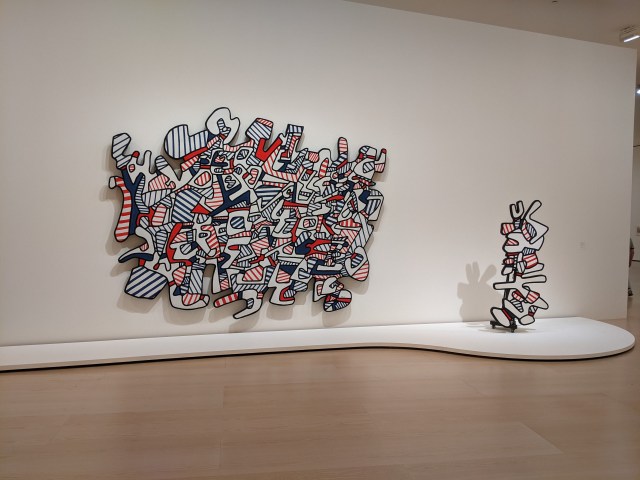
There were two exhibitions on at the time of our visit. The first was of the work of the French painter Jean Dubuffet.
Following the Second World War he decided to reject the conventional norms of aesthetic beauty, to create art in what he described as a more authentic manner. He adopted non-conventional materials. In some ways his art was informed by the same sensibilities as the contemporary Italian “Arte Povera” movement. Though how much contact they had is unclear. Ultimately what he produced was one of the foundations of what was known as the “Art Brut” movement.
Dubuffet
The second exhibition was titled “Motion, Autos, Art and Architecture” it is curated by Norman Foster. In some ways it was similar to an exhibition that the V&A put on a couple of years ago. The emphasis was slightly different. The V&A exhibition concentrated on the design of the car, whereas this exhibition concentrated on the vehicle as an art object. There were some beautiful cars, notably a Citroën DS and a 1959 Cadillac (the one with the tail fins). The cars were complimented by art contemporary to their creation. It worked well.
The top floor is dedicated to the permanent collection. There is a Rothko, an Yves Klien, a Cy Twombly series, as well as a few others.
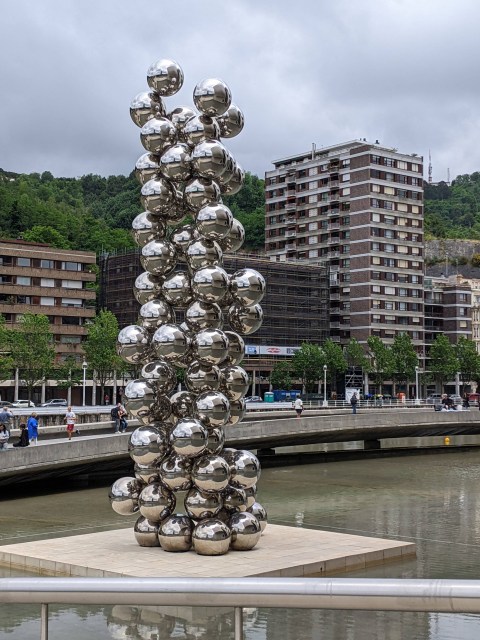
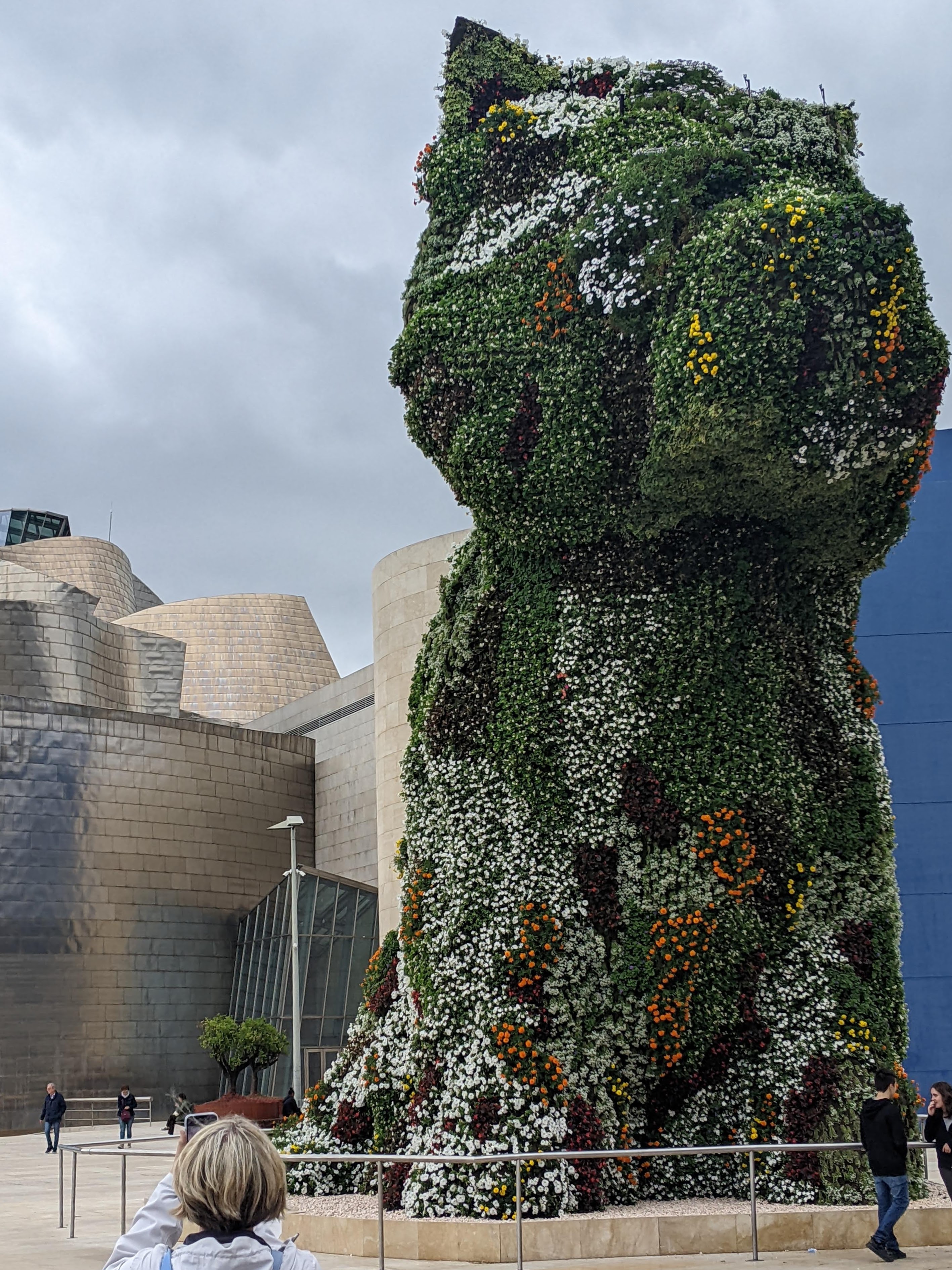
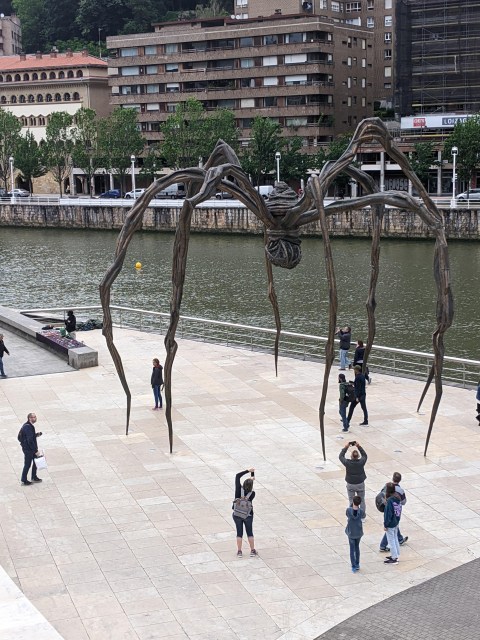
Outside the museum there are various large scale artworks, mainly by Jeff Koons, “Mamam” , Louise Bourgeois massive spider sculpture also features.
This is awesome. The astronomer Neil Tyson was once asked “What is the most astounding fact that you know?”
An Australian illustrator named Gavin Aung has turned the words he used to reply to the question into a cartoon. These are the first few panels, click anywhere in the illustration to see the full cartoon. You need to see the whole cartoon, trust me.
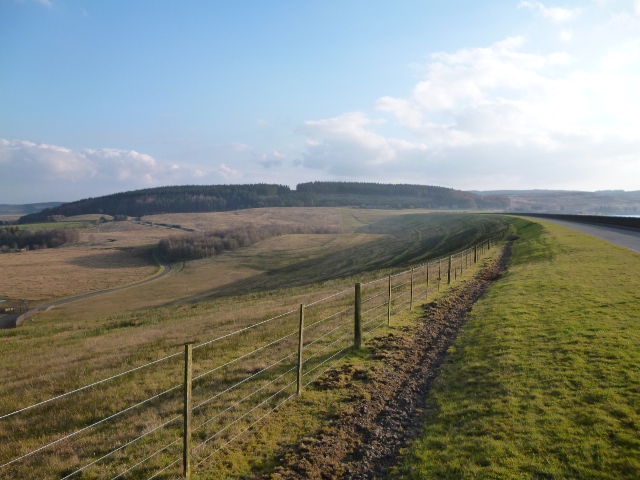
A few facts to start with. Kielder Water is Britain’s largest man-made lake set in England’s largest man-made forest. The reservoir supplies water to Newcastle and the North East. The project which involved flooding a large part of the North Tyne valley started in the early 1970’s and was finally completed in 1982. The dam itself is surprisingly unobtrusive.
Kielder Dam
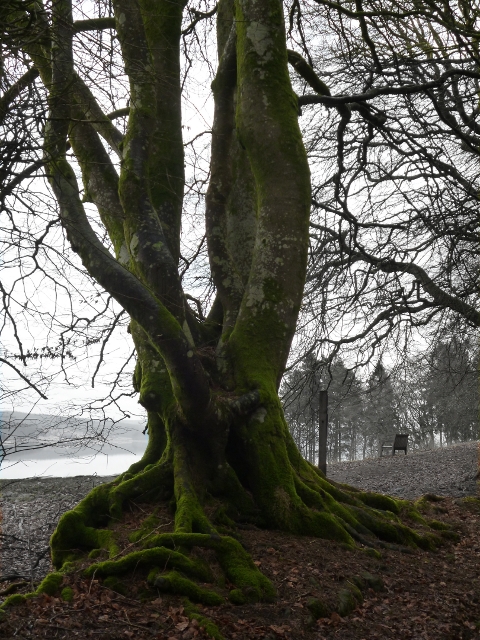
Today we went for a walk around a small part of the lake. This tree is a bit of an oddity in Kielder Forest, almost all the trees are conifers, but I liked it.
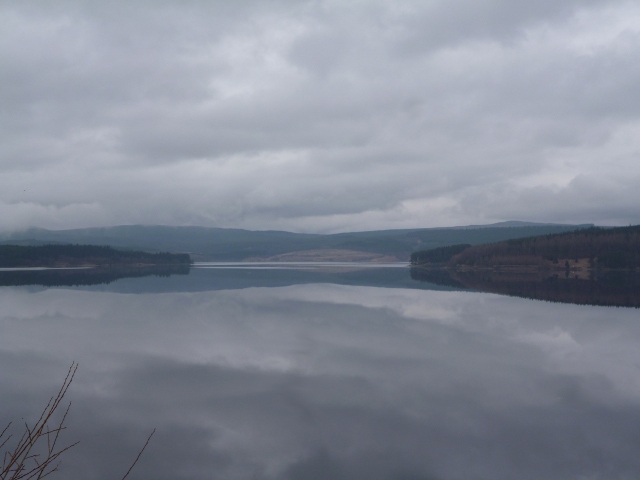
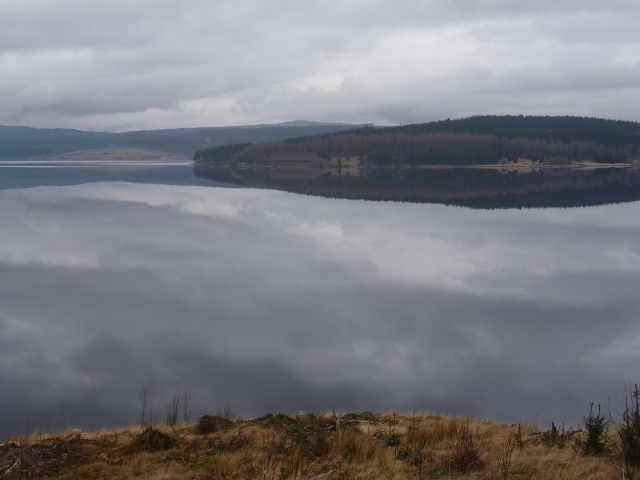
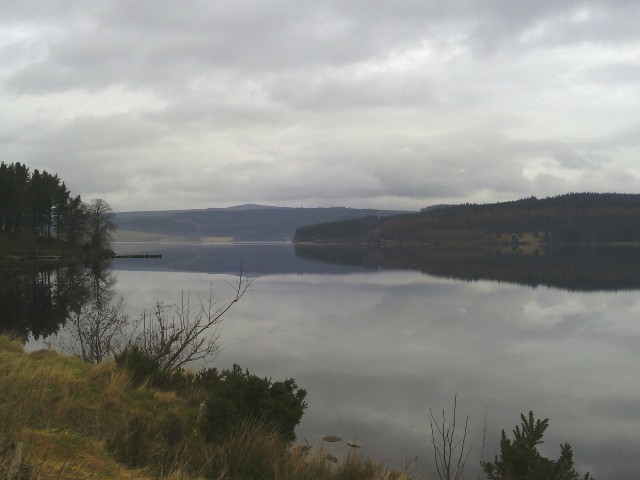
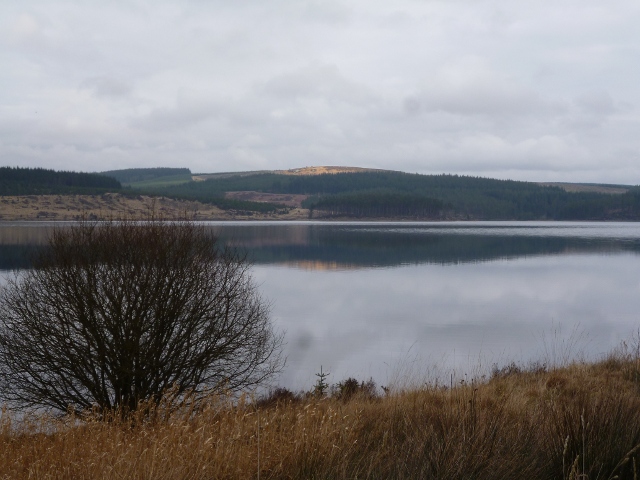
When we started out the lake was incredibly calm with reflections that were almost surreal.
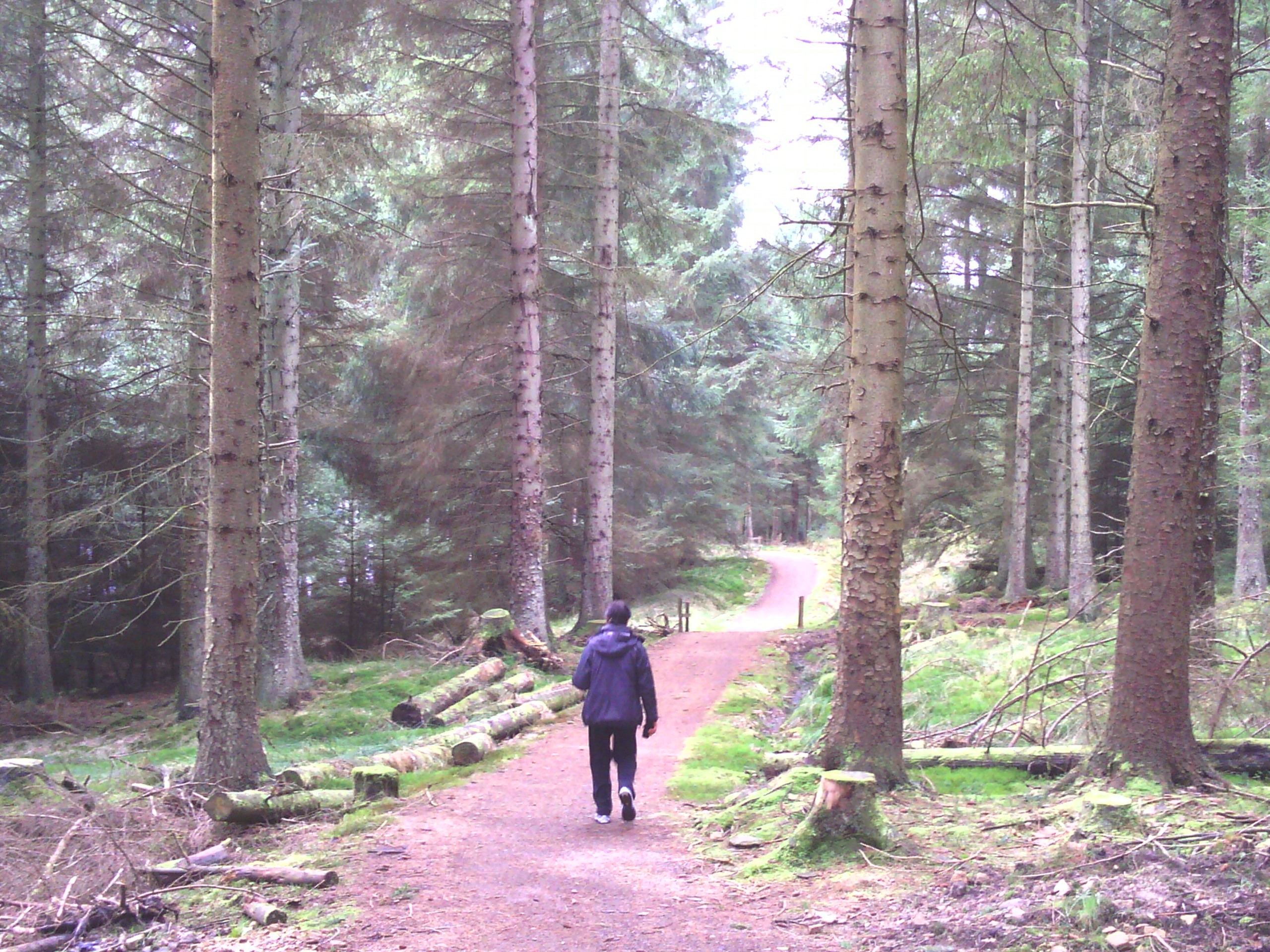
The walk we did was about six miles in length. It was well marked and easy to follow without map. The packed shingle surface was easy to walk on. Surprisingly for a route chosen by mrsjohnm55 there was very little mud. Despite the lack of mud Mrsjohnm55 ploughs bravely on.
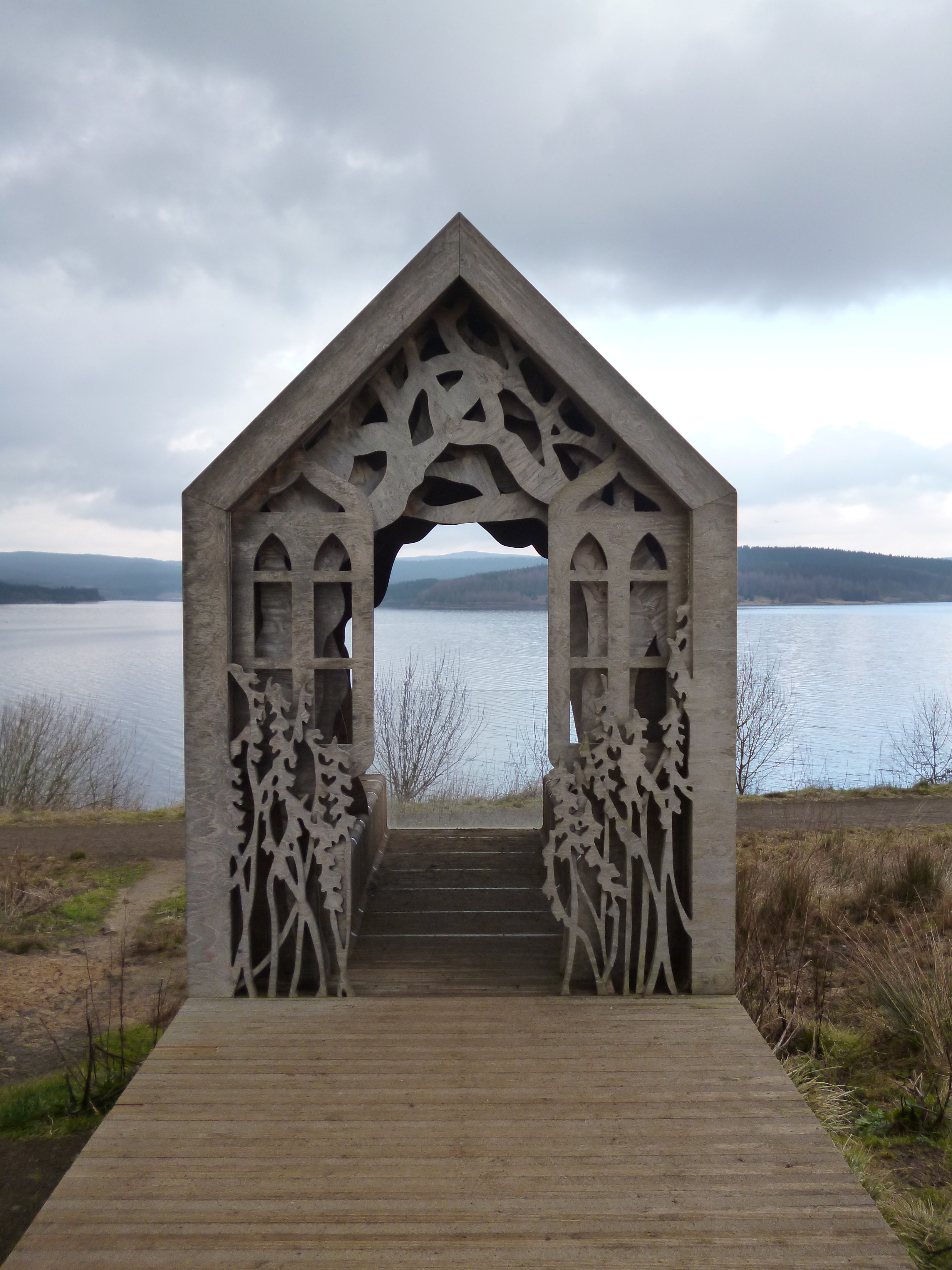
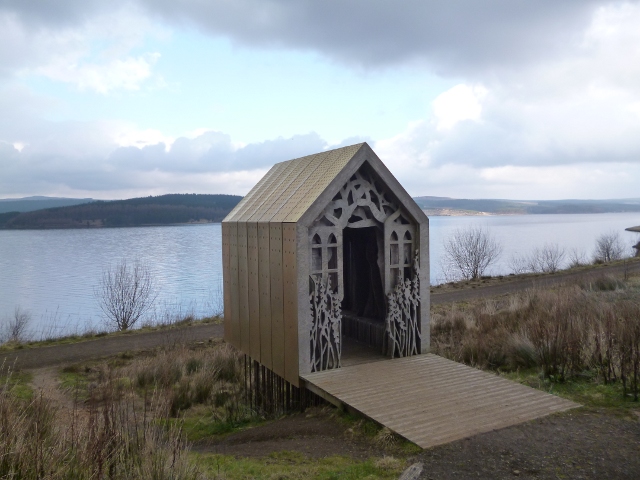
Other interesting features of the walk were what I can only describe as modern follies. The most interesting of which was “Freyas Cabin”
A company (art collective?) called Studio Weave designed and built “Freyas Cabin” and its companion “Robin’s Hut” which can be seen on the opposite shore.. The full story can be found on their website They made up a story about Freya and Robin and how they met which I quote below.
Freya and Robin
Not so long ago, not so very far from here, there lived a beautiful lady named Freya. Freya loved flowers. She loved the Wood Aven with its little strawberry flowers that smell like Christmas and protect against evil. She loved the Red Campion with their hoof-like petals stretching from the tips of magenta pods, decorated with tiny white curls. But most of all, she loved Foxgloves, tall figures dressed in soft bells, some in pink, some in white, and some spotted with the fingerprints of elves. Freya liked to think of the foxes ringing the bells to warn each other of danger and insects sheltering from the rain under their gentle parasols.
You could find Freya wandering across the moors wearing long dresses with big soft pockets full of flowers she’d collected. She carefully took her pickings home, and pressed them for keeping and to decorate everything around her.
Not so very far away from her, lived Robin. Robin lived in a wooden hut in the woodlands over the water from Freya. He spent his days walking through the woods, looking after the trees and the animals that lived in them. He liked climbing trees and building little wooden houses for the birds to lay their eggs in. He dashed about the forest playing swift and intelligent games with the deer and scrambled about helping the squirrels find their buried nuts.
Freya could see Robin across the water. She could see he was kind and careful with the trees and the animals and that he loved them as much as she loved the flowers. Mostly, he skipped about playing, but sometimes, Freya saw him standing, perhaps sadly, she thought, looking out over the water. She longed to be able to talk to him, to ask him if he was all right or what it was he was dreaming of. So one day, Freya decided to make Robin a gift of a wonderful cabin. She hoped that he would see the cabin from his wooden hut and then maybe he would make a raft or a boat and come to see it.
Over the next few weeks, Freya worked very hard to collect flowers and plants and small branches. She made a big flower press and carefully laid out her collection in the shape of a woodland, just like she imagined the one Robin lived in. For the walls, she arranged the strongest branches from thick to thin. And for the roof she made an enchanted forest ceiling with twisted branches tickling each other. She decorated the entrance with precious Foxgloves to invite the fairies in. Then she pressed everything tight together so they would be strong and crisp and last forever.
While she was making the cabin, she noticed that Robin spent more and more time dreamily looking across the water. She was thrilled for she thought he must be looking to see what she was up to. She was so excited that she went and collected as many tall, straight flowers as she could find and proudly balanced the cabin up on a thousand of the tallest straightest stems to be sure that Robin could see it properly. But Robin couldn’t see it properly; he couldn’t see it at all.
Freya lived on the South side of the lake, which meant that the sun’s rays lit up the landscape in front of her and she could see for miles. But Robin lived on the North of the lake, so when he looked towards the South the sun got in his eyes and all he could see was a golden blur above the lapping blue lake.
Actually, Robin was very fond of the golden blur and often stood admiring the hot fuzzy oranges and purples shimmer. It reminded him of an amazing place he had been told about when he was a little boy. He had heard the stories many times, that in the far North there is a magical place called Glimmerfell, where there are huge mountains pointing out above the clouds, covered with flowers growing from the rocks and the ice. Apparently, the flowers glow orange and purple because in Glimmerfell, it is always sunset. He found himself thinking of this place more and more, until eventually, one day, he decided to build a boat and set off to try to find it.
Of course, when Freya saw Robin collecting wood and beginning to build a boat, she was thrilled that he had seen that she had almost finished the cabin and was planning to row across the lake to see her. Over the next few days, Freya put the finishing touches onto the cabin and Robin built his boat and packed it with food for a long journey.
Then one morning, he untied the boat from its mooring, and set off. Freya watched expectantly as Robin rowed towards her. She felt she had never been so happy and excited in all her life. But after a short while, he seemed to be drifting away to the west and soon Freya realised that he wasn’t coming her way at all, but instead, was going in completely the opposite direction.
Freya couldn’t understand what she could have done so wrong. Not only did Robin not want to come and see the cabin she had made for him, he wanted to leave the lake completely. She sat down in the middle of the garden she’d planted by the cabin and began to cry. As Robin rowed further and further away, she became so upset, her tears turned into gold. She picked herself up and wrapped the cabin in the gold tears streaming from her eyes.
Meanwhile, as Robin was rowing away, he turned his head to look back at the lake he loved. He hoped everyone would be all right while he was gone. As he watched the familiar woodland slipping further and further away, knowing that he might not see his home for a long time, he noticed something glinting in the distance. He thought it must just be the sun in his eyes, but as he took one last glance, he saw it again, even brighter. He was so curious that he decided to row back and find out what it was. After all, he hadn’t gone too far yet.
As Robin approached the glimmering, it grew brighter and brighter and he rowed with all his might
As Robin approached the glimmering, it grew brighter and brighter and he rowed with all his might
As he approached the glimmering, it grew brighter and brighter and he rowed with all his might. Once he was quite near the shore he could see an unusual golden cabin that looked like it had a forest inside it. Then once he was very close, he could see that next to the cabin, someone was sitting and crying with her face buried in her dress. Robin quickly tied up his boat, rushed over, and gently swept the foxgloves so they sang soothingly. Freya lifted her head at the sound and saw Robin standing there with a concerned look on his face. A little embarrassed, she brushed the tears from her eyes and they fell like gold dew onto the surrounding grass. Robin offered his hand and she unruffled herself as he pulled her up. Seeing she was all right, Robin turned to the golden cabin. He was quite enchanted by it. Freya explained that she’d made it for him. Luckily, he had climbed inside for a better look just before she said this, so she didn’t see him blush!
Freya and Robin sat in the cabin all afternoon, talking about the trees and the flowers. Robin almost forgot he was planning to go to find Glimmerfell. He described to Freya, the cloud-collared mountains and the glowing ice-flowers. Freya was fascinated and asked him lots of questions he didn’t know the answers to because he hadn’t been there yet. Freya offered to lend Robin her flower press so he could collect some flowers to bring home. Robin said he wouldn’t know how to press the flowers properly and asked whether Freya would perhaps, like to go with him. Freya said she would love to.
So at sunset, having loaded Robin’s boat with some more food and Freya’s flower press, they set off on their adventure.
They didn’t leave very long ago, so they are still away adventuring, but if you can find them, you can see Robin’s wooden hut and the golden cabin that Freya made for him, facing each other across the lake, awaiting their return.
It is lovely area of the country and well worth a visit.
Update Sunday 04 March 2012
I have updated and modified this post, which was originally from my Android phone. For some reason it didn’t upload the images that I included. I have now added some images and added the story of Freya and Robin.
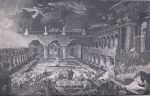
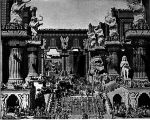
In the very early years of cinema DW Griffith more or less invented the Blockbuster Action movie with his films “Birth of a Nation” and “Intolerance”. The set designs for “Intolerance” clearly show John Martin’s influence. Compare the print of Martin’s painting “Belshazzar’s Feast with Griffith’s set design for a Babylonian scene in Intolerance.
(As always click on an illustration to see a larger version)
I remember reading somewhere that Griffith owned a good selection of Martin’s prints and did use them as source material for some of his sets. Unfortunately even in the age of Google I can’t find a reference.
Moving on to more recent events in the history of the cinema:
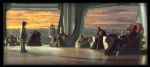
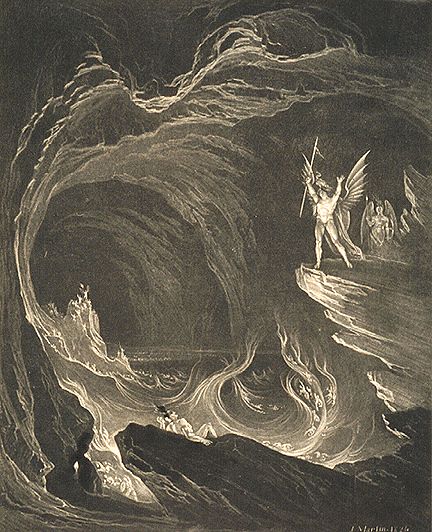
The scene in Star Wars I “The Phantom Menace” * where Anakin Skywalker is before the Jedi Council has clear echoes of John Martins “Paradise Lost” print entitled “Satan in Council.
There are many other examples that I could have chosen, but these two do as well as any to illustrate the hypothesis. Anyone who has seen Peter Jackson’s Lord of the Rings trilogy can see how Martins work influenced him.
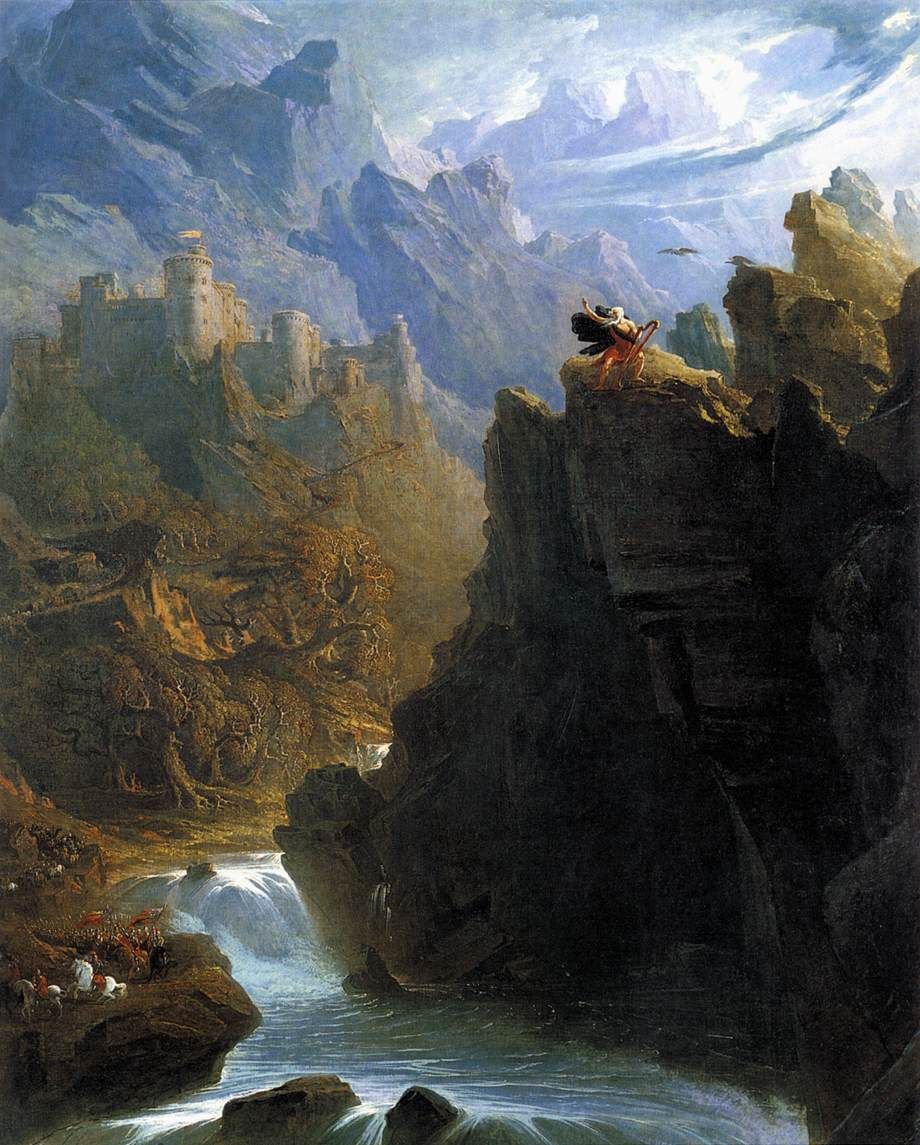
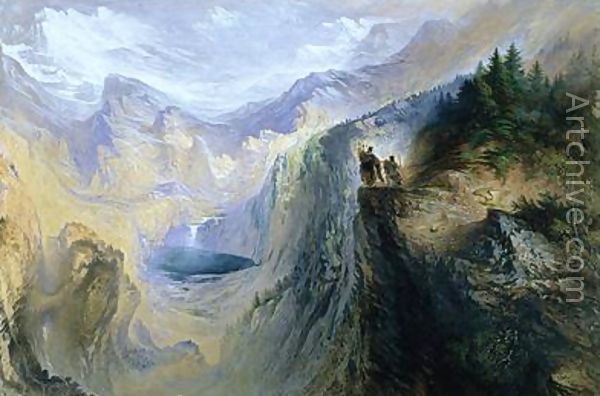
Two of Martin’s paintings “The Bard” and “Manfred on the Jungfrau” seem, to me at least, to have strongly influenced Jackson’s vision of Rivendell.
The Bard
Manfred on the Jungfrau
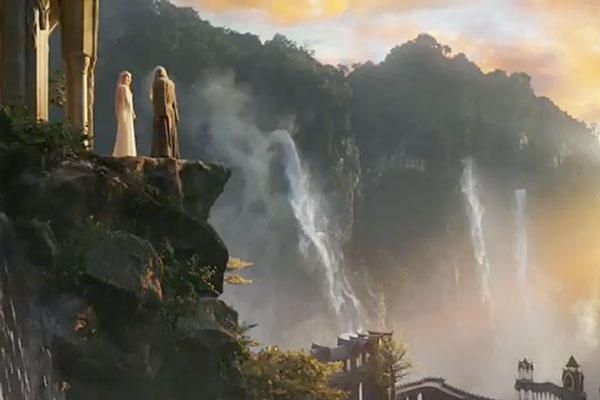
Now compare these with a still taken from the trailer of “The Hobbit”.
Rivendell (Still from the Hobbit)
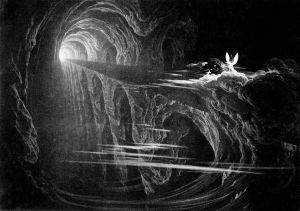
Also recall the scene inside Mount Doom shortly after Gollum fell to his death, taking the ring with him and Frodo and Sam made their escape across the rapidly collapsing bridge.
The influence of another “Paradise Lost” print “Bridge over Chaos” is obvious – to me at least.
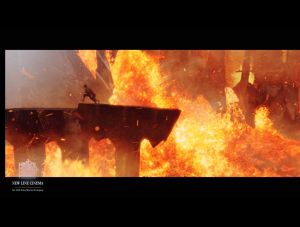
Almost every disaster movie ever made borrows its images to a greater or lesser extent from “The Great Day of His Wrath” with its vision of whole cities being cast into the flaming abyss. Take this still/advertising poster for “2012”.
Just to back up my reasoning The Tate made a short Sci-Fi/Disaster Movie influenced video to promote the show.
Disclaimer: I am not endorsing a film that stole £8.50 of my money and about two hours of my life under the false pretences that it had something to do with “The Empire Strikes Back”
Another review of an art exhibition just before it is due to close. I must try to get my act together next time.
The current exhibition at Tate Britain features the Cecil B de Mille of the early c19th Art World John Martin.
Portrait of John Martin by Henry Warren, 1839
John Martin was born on 19 July 1789 in Haydon Bridge near Newcastle. His family appears to have been fairly poor. He did not have much in the way of formal training in fine art. He was originally apprenticed to a coach painter. After the coach painter broke the terms of the indentures by failing in increase John Martin’s wages, he went to work for Boniface Musso, an Italian artist who had based himself in Newcastle. In 1806 he left Newcastle for London where he intended to establish himself as an artist. Initially he supported himself by working as a ceramic painter. (The only known ceramic by him is on display in Room 1)
Martin became known as a painter of the “Sublime” in other words as a painter of awe-inspiring and terrible scenes. He deliberately designed his paintings to stand out from the crowd in shows such as the Royal Academy and as such they took on what we would now see as a cinematic quality. Indeed his work can be likened to a block-buster action film, full of drama and possibly too many special effects. I’ll come back to this aspect in another post, because it is an area that I would like to explore in more depth.
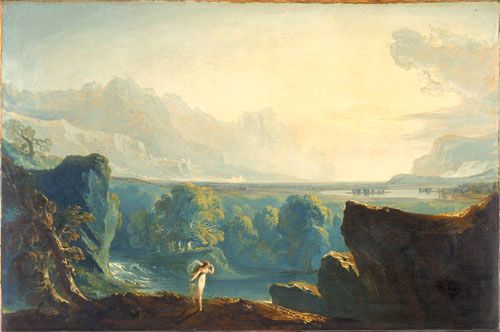
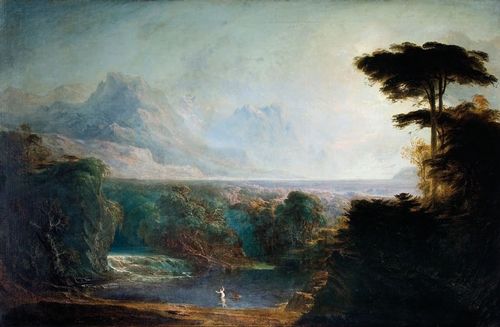
I have liked John Martin’s work for a long time, in fact since the first time I saw his Last Judgement Triptych. His best paintings have a grandeur and a touch of madness about them that I love. However during his lifetime (and since) the criticism that his work is repetitive and displays good craftsmanship but not true artistic merit is often made. The charge of repetition especially, does have a basis. He painted a series based on Ovid’s Metamorphoses, and while I wouldn’t say the every painting is the same, there is more than a theme running through them. In addition the mountains in almost every painting that features mountains, from “Clytie” in 1814 through to “The Plains of Heaven” in 1854, are essentially the same, albeit very dramatic, mountains.
Notice any similarities between the paintings?
I can forgive him, he was a man from a poor background making his living by selling his paintings. He found a formula that sold and stuck to it. Like Albrecht Durer (1471 – 1528), another artist who relied on what he sold to keep body and soul together, he moved into printmaking. And although ultimately it was only marginally profitable and a major drain of resources, like Durer, he produced some of his finest work in this medium.
He was initially commissioned by Samuel Prowett to create a series of prints to illustrate John Milton‘s Paradise Lost. Later, inspired by Prowett’s venture, between 1831 and 1835 Martin published his own illustrations to the Old Testament.
His illustrations for Paradise Lost are quite stunning, I have included two below, but to see more follow the links.
Part of the reason for John Martin’s decline in fame, and possibly where some of the idea that he was a craftsman and not a painter came from, was that for the best part of a decade from the late 1820’s he devoted most of his time to trying to produce a solution to London’s sewage disposal problems. The exhibition includes some of his plans and proposals for the sewage system. They are beautifully drawn and to this (mechanical) engineer’s eye seem to be workable solutions. They were never executed in his lifetime. The authorities rejected his plans, deeming them to be too expensive. Although whether they would have been more expensive in the long-term than doing nothing is less clear. However when Joseph Bazalgette designed and built the London wide sewage system in the 1860’s (a system that is still largely in use today) He adopted and incorporated many of John Martin’s ideas.
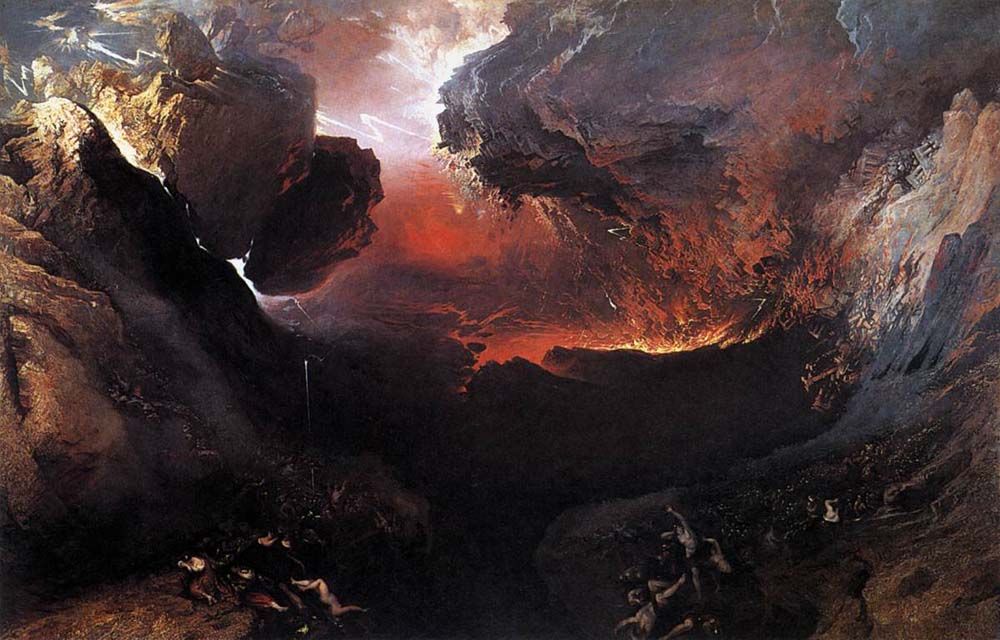
The main focus of the exhibition are what are known as “The Three Great Paintings” or “The Last Judgement Triptych”. John Martin painted them in the period shortly before his death. He completed them in 1853 shortly before a stroke paralysed his right side. He never recovered and died on February 17, 1854.
The Great Day of His Wrath (1851-53)
“The Great Day of His Wrath” based on the passage from The Book of Revelation Chapter 6 vs12-17 shows Marin at his apocalyptic apogee. We see people, buildings, whole cities, and mountains being hurled to their destruction in a chasm of fire. Martin is stating his belief that nothing can escape the wrath of God and indeed it is futile to even try.
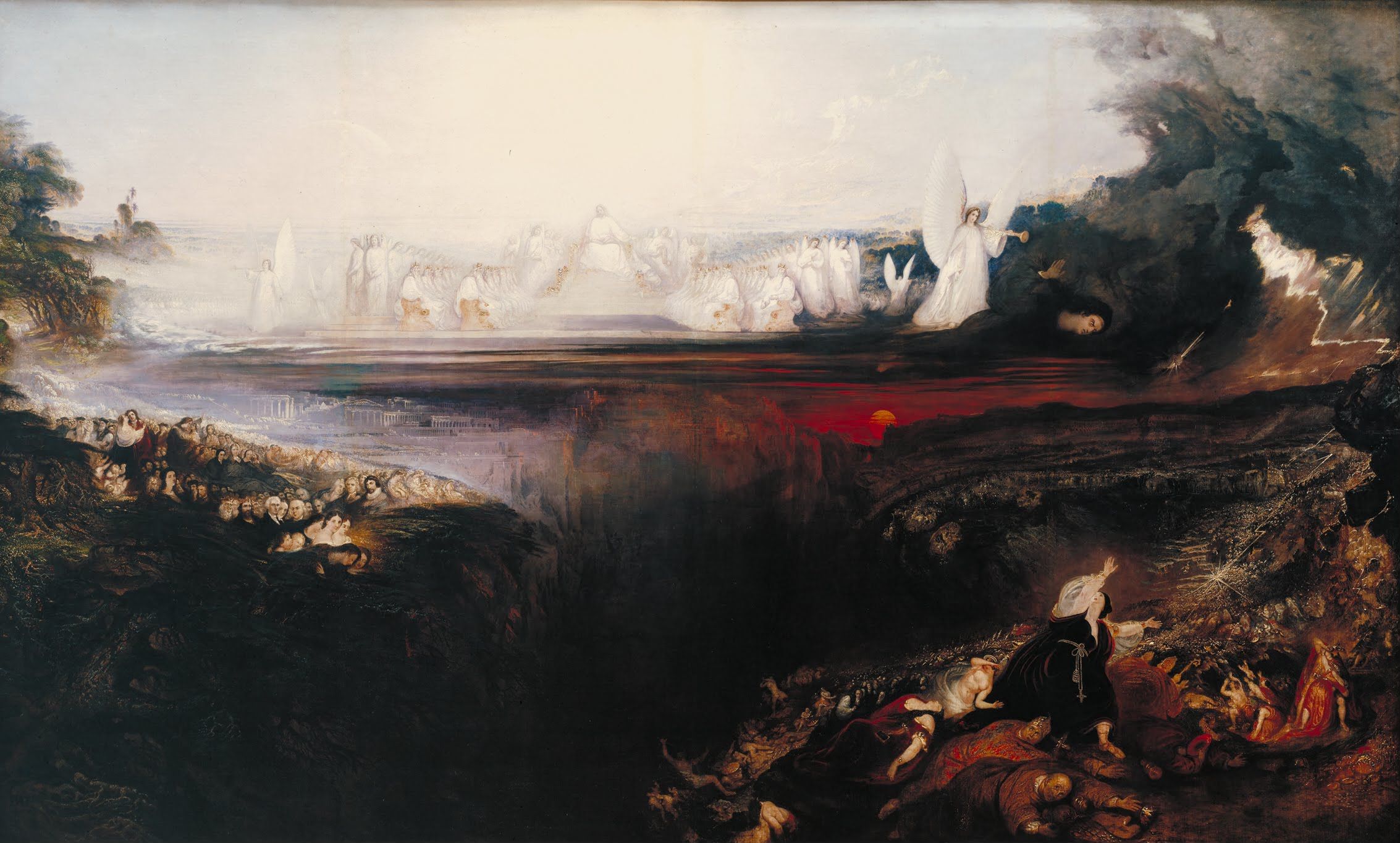
The Last Judgement 1853
Again based on passages in the Book of Revelation, Martin allows himself to play at being the Last Judge, on the right hand of Christ (left hand side of the painting) are the elect, the chosen, who will live for ever, with God in the New Jerusalem. On the left hand, being thrown into the pit of fire, along with Satan and the Whore of Babylon are the damned. Among the chosen are the likes of Shakespeare, Milton, Isaac Newton and a few Kings that Martin approved of. Among the damned are Popes, and priests, a couple of Kings he disapproved of, and I think Oliver Cromwell. Originally there was an index to the painting naming both the damned and the chosen.
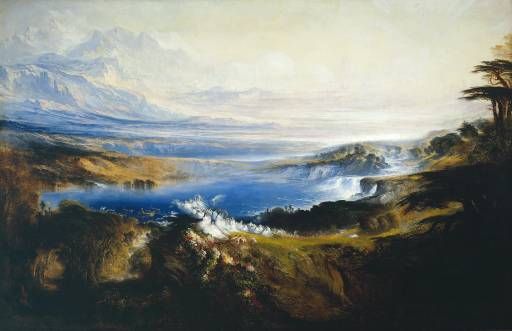
The Plains of Heaven 1851-53
This is the most serene and peaceful of the three paintings.It contrasts dramatically with “The Great Day of His Wrath” hanging on the other side of the central panel of “The Last Judgement”. Again a passage from the Book of Revelation is the inspiration, this time Chapter 21.
Then I saw “a new heaven and a new earth,” for the first heaven and the first earth had passed away, and there was no longer any sea. I saw the Holy City, the new Jerusalem, coming down out of heaven from God, prepared as a bride beautifully dressed for her husband. And I heard a loud voice from the throne saying, “Look! God’s dwelling place is now among the people, and he will dwell with them. They will be his people, and God himself will be with them and be their God. “He will wipe every tear from their eyes. There will be no more death or mourning or crying or pain, for the old order of things has passed away.”
Martin has produced his vision of paradise. In the foreground wearing white we see the chosen. Behind them is a deep blue heavenly lake, filled by the waters of rushing rivers and waterfalls. Majestic snow-capped mountains surround the scene, and in the background a faint, almost ghostly New Jerusalem descends to Earth.
The three paintings became famous in the years after John Martin’s death. The paintings toured widely both in Britain and the United States. They were described as “the most sublime and extraordinary paintings in the world” and valued at over 8000 guineas. Typically the exhibition would include a diorama and narration. The Tate puts on a modern take on this, projecting computer graphics onto the paintings. This makes the paintings seem as if they are backlit. The computer graphics are obviously capable of effects that the Victorians using gas lamps couldn’t manage, but the narration seemed authentically contemporary and suitably over the top.
Although prints of the paintings sold in large numbers, John Martin’s style of vast and dramatic paintings now seemed outmoded to the mid and late Victorians. The paintings themselves never found a buyer and by the 20th century his work had fallen into complete obscurity. When his painting of “The Destruction of Pompeii” was badly damaged in a flood in 1928, it was not considered to be worth restoring. The Last Judgement paintings were sold in 1935 for seven guineas.
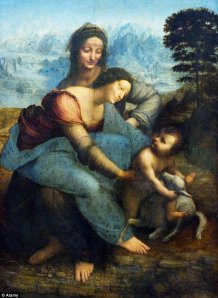
There is a bit of an argument going on in the art world about how to clean a painting and how much to clean it. It came to a head recently over the cleaning and restoration of the Louvre‘s “The Virgin and Child with Saint Anne” painted by Leonardo da Vinci.
Two French art experts have quit The Louvre’s advisory committee in a row over the restoration of a Leonardo da Vinci painting, according to reports.
Segolene Bergeon Langle and Jean-Pierre Cuzin resigned in protest over the cleaning of The Virgin and Child with Saint Anne, The Guardian said. The pair claim the Paris gallery has over cleaned the 500-year-old masterpiece. They argue it has left the work with a brightness the artist never intended.
There are a couple of points that make me wonder if they have actually thought about what they are saying. I am not disputing the fact that you need to be very careful when restoring a five hundred year old masterpiece. My arguments against them are these. Firstly, cleaning is not going to create new colours, it is only going to expose the colours that Leonardo (or his assistants) put on the wood panel in the first place. Secondly, they presume to know how Leonardo intended the painting to look. Did he leave a set of notes saying that on no account should five centuries worth of candle soot and darkening varnish ever be removed from the surface of the painting? Or are they really saying, “We actually preferred it the way it was before cleaning.”? If they had said that I could have accepted it as their judgement, because that is what it is, an aesthetic judgement. Trying to invoke the ghost of Leonardo to back up your taste is not really on.
Make your own mind up, the un-cleaned painting is on the left, and the cleaned painting is on the right.(Click on the picture to see it in a larger size.)
If you want to see an even better example of the restoration of a painting take a look at this article from the Guardian about Dulwich Picture Gallery‘s restoration of a painting of St Cecilia.
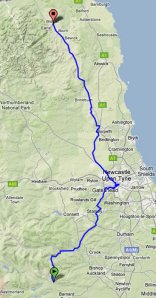
Day 5 – 08/05/2003 (Thursday) Egglestone to Wooler
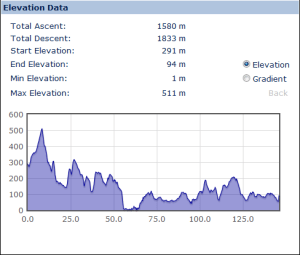
The Moorcock Inn does a very good breakfast, but it also lies about its location. If you click-through to their website you will see its address given as Hilltop, Egglestone. This is a lie, it is nowhere near the top of the hill. Well, I suppose the road does go down slightly for the first half mile or so, but then it goes up and keeps going up, sometimes alarmingly steeply for a long, long time.
On top of that my nemesis of a couple of days ago, the wind, was back with a vengeance. The first ten miles from “Hilltop” over the real top of the hill and down to Stanhope took well over an hour. It was so windy I was having to pedal going down a 10% slope to keep my speed up. The scenery was spectacular, and I had plenty of time to appreciate it, especially on the way up.
I made an executive decision in Stanhope and abandoned my original route over the hills via Hexham and Rothbury and took the wind and incline assisted route down the Wear valley which would eventually take me to Newcastle. It helped for a while. Going down the valley with the wind behind me I probably averaged over 30 km/hour for the first half-hour or so, but eventually I had to get out of the Wear Valley and into the Tyne. That meant more hills, though not as long and steep and more wind in my face, though not as strong.
My route now took me into Newcastle. The last time I had been to Newcastle was back in my days as an Engineer Cadet at South Shields Marine and Technical College. That was about thirty years ago. I would probably have saved myself about five or six miles if I had crossed the Tyne at one of the up river bridges. I decided that having made this detour through Newcastle that I might as well make a further detour and cross the Tyne on the Millennium Cycle Bridge.
Newcastle has changed a bit since my student days. The Quayside area which was derelict coal staithes and warehouses is now all smarted up and trendy. The roads also seem to have altered. It took me a while to find a way out that didn’t involve an urban motorway, but I eventually made it onto the back roads from Ponteland to Morpeth.
At this point my intention was still to make it to Duns today, but time was getting on and I still had over fifty miles to go. I decided that going straight up the main road from Morpeth to Coldstream would be quicker than the back roads. The A697 isn’t usually too busy because most of the north bound traffic goes up the A1.
There was one memorable point on the journey. I was descending in to a valley,I think it was the Coquet, and I looked across and thought to my self, the climb out the other side can’t be as steep as it looks, it must be foreshortening. The I looked down at my computer and saw it reading 85km/h and thought maybe it is as steep as it looks.
By the time I was getting up to Wooler it was around seven in the evening. There were still at least two hours in the saddle to get to Duns. I decided to stay the night at the Wooler Youth Hostel. I called my mum to say that I wouldn’t make it that night, but she could have my lunch ready for me the next day if she wanted. My sister offered to come and collect me and the bike, but the idea was to cycle up to Duns not just to get there, so I said thanks, but no thanks and had a night on the town in Wooler.
At least the wind died down today, or if there was any it was helpful, but we did find some hills. After two days in the flat-lands it was quite pleasant to be somewhere with contours.
Actually the first two-thirds of the trip was reasonably flat. I was climbing steadily and there were hills to my left and right but the roads were quiet (excluding the first few km up the A19) and it was pleasant cycling. It was only after Richmond, going on into Co. Durham that it became necessary to shift into the Granny Ring now and then. Continue reading Bike ride to Scotland: Part 4 York to Eggleston→












 A Scotsman in Suburbia