All posts by A Scotsman in Suburbia

I am not a Grumpy Old Man I am a middle aged man who occasionally gets slightly hacked off with things. My politics are greenish and to the left of centre. I am married again, following being widowed. I own two bikes, one car, one campervan and half a cat. I love cycling (hence the bikes) and cycle sport especially road racing. During the winter I enjoy watching football (soccer if you are North American). I sometimes paint and enjoy cooking and eating.

John Martin – Apocalypse

Another review of an art exhibition just before it is due to close. I must try to get my act together next time.

The current exhibition at Tate Britain features the Cecil B de Mille of the early c19th Art World John Martin.

John Martin
Portrait of John Martin by Henry Warren, 1839

John Martin was born on 19 July 1789 in Haydon Bridge near Newcastle. His family appears to have been fairly poor. He did not have much in the way of formal training in fine art. He was originally apprenticed to a coach painter. After the coach painter broke the terms of the indentures by failing in increase John Martin’s wages, he went to work for Boniface Musso, an Italian artist who had based himself in Newcastle. In 1806 he left Newcastle for London where he intended to establish himself as an artist. Initially he supported himself by working as a ceramic painter. (The only known ceramic by him is on display in Room 1)

Martin became known as a painter of the “Sublime” in other words as a painter of awe-inspiring and terrible scenes. He deliberately designed his paintings to stand out from the crowd in shows such as the Royal Academy and as such they took on what we would now see as a cinematic quality. Indeed his work can be likened to a block-buster action film, full of drama and possibly too many special effects. I’ll come back to this aspect in another post, because it is an area that I would like to explore in more depth.

I have liked John Martin’s work for a long time, in fact since the first time I saw his Last Judgement Triptych. His best paintings have a grandeur and a touch of madness about them that I love. However during his lifetime (and since) the criticism that his work is repetitive and displays good craftsmanship but not true artistic merit is often made. The charge of repetition especially, does have a basis. He painted a series based on Ovid’s Metamorphoses, and while I wouldn’t say the every painting is the same, there is more than a theme running through them. In addition the mountains in almost every painting that features mountains, from “Clytie” in 1814 through to “The Plains of Heaven” in 1854, are essentially the same, albeit very dramatic, mountains.
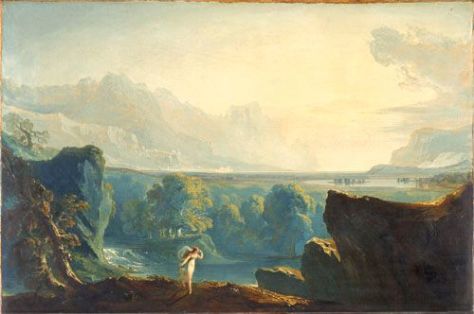

Notice any similarities between the paintings?

I can forgive him, he was a man from a poor background making his living by selling his paintings. He found a formula that sold and stuck to it. Like Albrecht Durer (1471 – 1528), another artist who relied on what he sold to keep body and soul together, he moved into printmaking. And although ultimately it was only marginally profitable and a major drain of resources, like Durer, he produced some of his finest work in this medium.

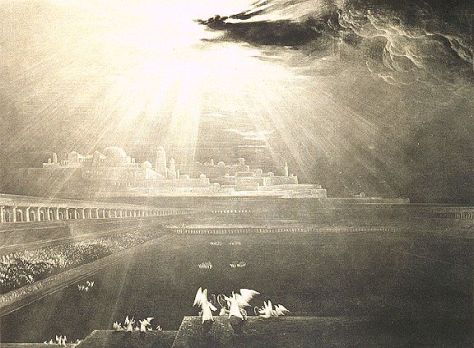
He was initially commissioned by Samuel Prowett to create a series of prints to illustrate John Milton‘s Paradise Lost. Later, inspired by Prowett’s venture, between 1831 and 1835 Martin published his own illustrations to the Old Testament.
His illustrations for Paradise Lost are quite stunning, I have included two below, but to see more follow the links.
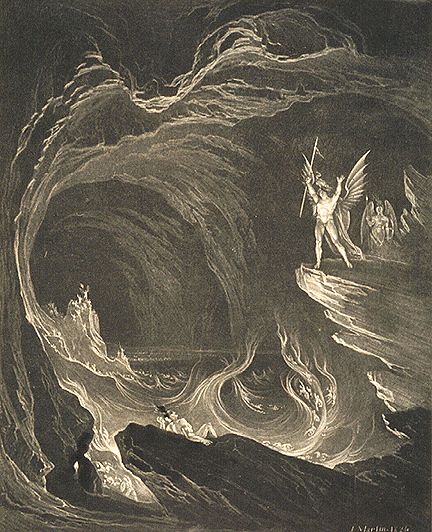

Part of the reason for John Martin’s decline in fame, and possibly where some of the idea that he was a craftsman and not a painter came from, was that for the best part of a decade from the late 1820’s he devoted most of his time to trying to produce a solution to London’s sewage disposal problems. The exhibition includes some of his plans and proposals for the sewage system. They are beautifully drawn and to this (mechanical) engineer’s eye seem to be workable solutions. They were never executed in his lifetime. The authorities rejected his plans, deeming them to be too expensive. Although whether they would have been more expensive in the long-term than doing nothing is less clear. However when Joseph Bazalgette designed and built the London wide sewage system in the 1860’s (a system that is still largely in use today) He adopted and incorporated many of John Martin’s ideas.

The main focus of the exhibition are what are known as “The Three Great Paintings” or “The Last Judgement Triptych”. John Martin painted them in the period shortly before his death. He completed them in 1853 shortly before a stroke paralysed his right side. He never recovered and died on February 17, 1854.
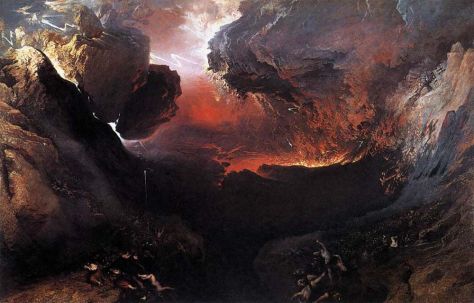
The Great Day of His Wrath (1851-53)

“The Great Day of His Wrath” based on the passage from The Book of Revelation Chapter 6 vs12-17 shows Marin at his apocalyptic apogee. We see people, buildings, whole cities, and mountains being hurled to their destruction in a chasm of fire. Martin is stating his belief that nothing can escape the wrath of God and indeed it is futile to even try.
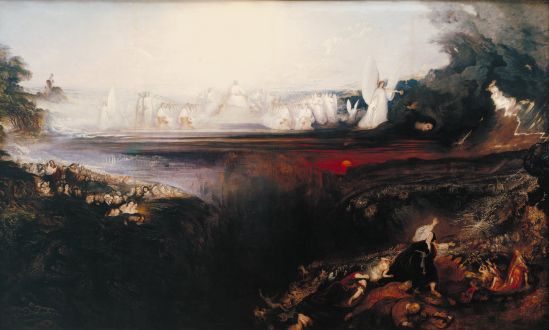
The Last Judgement 1853

Again based on passages in the Book of Revelation, Martin allows himself to play at being the Last Judge, on the right hand of Christ (left hand side of the painting) are the elect, the chosen, who will live for ever, with God in the New Jerusalem. On the left hand, being thrown into the pit of fire, along with Satan and the Whore of Babylon are the damned. Among the chosen are the likes of Shakespeare, Milton, Isaac Newton and a few Kings that Martin approved of. Among the damned are Popes, and priests, a couple of Kings he disapproved of, and I think Oliver Cromwell. Originally there was an index to the painting naming both the damned and the chosen.
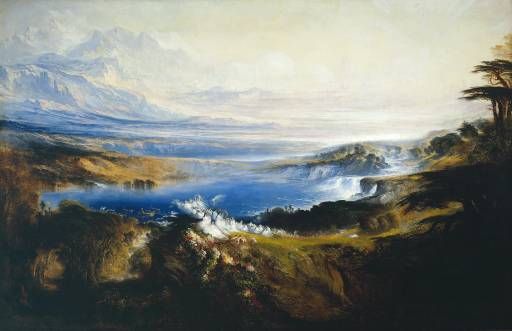
The Plains of Heaven 1851-53

This is the most serene and peaceful of the three paintings.It contrasts dramatically with “The Great Day of His Wrath” hanging on the other side of the central panel of “The Last Judgement”. Again a passage from the Book of Revelation is the inspiration, this time Chapter 21.

Then I saw “a new heaven and a new earth,” for the first heaven and the first earth had passed away, and there was no longer any sea. I saw the Holy City, the new Jerusalem, coming down out of heaven from God, prepared as a bride beautifully dressed for her husband. And I heard a loud voice from the throne saying, “Look! God’s dwelling place is now among the people, and he will dwell with them. They will be his people, and God himself will be with them and be their God. “He will wipe every tear from their eyes. There will be no more death or mourning or crying or pain, for the old order of things has passed away.”

Martin has produced his vision of paradise. In the foreground wearing white we see the chosen. Behind them is a deep blue heavenly lake, filled by the waters of rushing rivers and waterfalls. Majestic snow-capped mountains surround the scene, and in the background a faint, almost ghostly New Jerusalem descends to Earth.

The three paintings became famous in the years after John Martin’s death. The paintings toured widely both in Britain and the United States. They were described as “the most sublime and extraordinary paintings in the world” and valued at over 8000 guineas. Typically the exhibition would include a diorama and narration. The Tate puts on a modern take on this, projecting computer graphics onto the paintings. This makes the paintings seem as if they are backlit. The computer graphics are obviously capable of effects that the Victorians using gas lamps couldn’t manage, but the narration seemed authentically contemporary and suitably over the top.

Although prints of the paintings sold in large numbers, John Martin’s style of vast and dramatic paintings now seemed outmoded to the mid and late Victorians. The paintings themselves never found a buyer and by the 20th century his work had fallen into complete obscurity. When his painting of “The Destruction of Pompeii” was badly damaged in a flood in 1928, it was not considered to be worth restoring. The Last Judgement paintings were sold in 1935 for seven guineas.

It is only comparatively recently that John Martin’s true worth as an artist has been recognised again and “The Destruction of Pompeii” was successfully restored for the exhibition.

2011 in review

This is a summary of what I have done on the blog in 2001 and what you have read.

The WordPress.com stats helper monkeys prepared a 2011 annual report for this blog.

Here’s an excerpt:

A New York City subway train holds 1,200 people. This blog was viewed about 3,900 times in 2011. If it were a NYC subway train, it would take about 3 trips to carry that many people.

Click here to see the complete report.

A new blog

I have started a new blog, which is really a sub-blog of this one. I wanted to have a somewhere where I could keep all my recipes together, so I decided to set up another blog, imaginatively titled My Recipes. All the recipes on there at the moment have already featured on the main blog.

If you click on the My Recipes tab at the top of the page it will take you to the blog as will clicking on My Recipes in the blogroll. It was mainly done for my convenience, but everyone is welcome to use it.

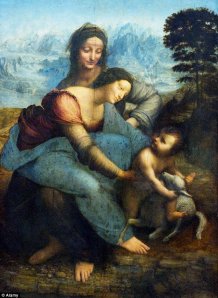
Was the Leonardo overcleaned?

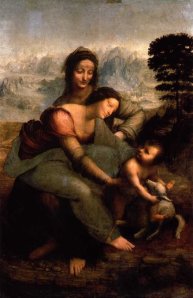
There is a bit of an argument going on in the art world about how to clean a painting and how much to clean it. It came to a head recently over the cleaning and restoration of the Louvre‘s “The Virgin and Child with Saint Anne” painted by Leonardo da Vinci.

Two French art experts have quit The Louvre’s advisory committee in a row over the restoration of a Leonardo da Vinci painting, according to reports.
Segolene Bergeon Langle and Jean-Pierre Cuzin resigned in protest over the cleaning of The Virgin and Child with Saint Anne, The Guardian said. The pair claim the Paris gallery has over cleaned the 500-year-old masterpiece. They argue it has left the work with a brightness the artist never intended.

via BBC News – Louvre experts ‘quit over Leonardo da Vinci work’.

There are a couple of points that make me wonder if they have actually thought about what they are saying. I am not disputing the fact that you need to be very careful when restoring a five hundred year old masterpiece. My arguments against them are these. Firstly, cleaning is not going to create new colours, it is only going to expose the colours that Leonardo (or his assistants) put on the wood panel in the first place. Secondly, they presume to know how Leonardo intended the painting to look. Did he leave a set of notes saying that on no account should five centuries worth of candle soot and darkening varnish ever be removed from the surface of the painting? Or are they really saying, “We actually preferred it the way it was before cleaning.”? If they had said that I could have accepted it as their judgement, because that is what it is, an aesthetic judgement. Trying to invoke the ghost of Leonardo to back up your taste is not really on.

Make your own mind up, the un-cleaned painting is on the left, and the cleaned painting is on the right.(Click on the picture to see it in a larger size.)

If you want to see an even better example of the restoration of a painting take a look at this article from the Guardian about Dulwich Picture Gallery‘s restoration of a painting of St Cecilia.

An impressive portfolio

The list of people and corporations who have consulted the Tarot card reader on Brighton Pier impressed me no end.

Still I suppose it’s cheaper than getting management consultants in, and the accuracy of the forecasts are probably about on par.

Happy Christmas

There has been a lack of activity on my blog recently but I hope to get back up to speed in the near future.
In the meantime Happy Christmas and enjoy the only Christmas No.1 worth listening to.

Can we have our ball back? … please

This strikes me as perhaps just a touch cheeky and optimistic.

President Barack Obama has said the US government has requested that Tehran return the surveillance drone captured by Iran’s military earlier this month.

BBC News – US asks Iran to return captured drone.

Now I can appreciate why the United States would like their spy plane back, what with all the top-secret anti-radar coatings and engines and the like. Not to mention whatever data it had picked up about Iranian nuclear installations and other interesting factoids. But do you think there is much chance? I suppose the Iranians could be a bit like the janitor when I was at primary school, and hold onto it for a day or two just to make a point then give it back.

No probably not.

Bike ride to Scotland: Part 7 Duns to Wallington (the easy way)

Day 7 – 10/05/2003 (Saturday) Duns to Wallington

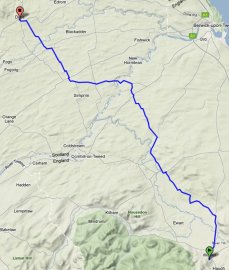
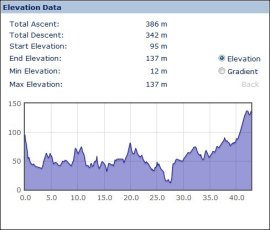
There are no maps or elevation profiles for today’s journey. There was also very little cycling involved.

I needed to be at Heathrow by 11 o’clock on Sunday the 11th to collect Mrs johnm55 after her trip to Canada. (I also needed to be back at work at 8 o’clock on Monday the 12th). Cycling back home to Wallington unfortunately wasn’t an option. I could have probably thought up an excuse for not being back at work, but not picking Mrs johnm55 up at the airport…. I don’t like to think of the possible consequences.

As I had stayed the night with my sister and her husband, we loaded the bike back into the pick-up for the trip back to Duns to say cheerio to mum. My sister then took me down to Berwick to catch the train back to London. I put the bike in the guard’s van and settled down to make the return journey in fewer hours than it had taken me days to cycle up.

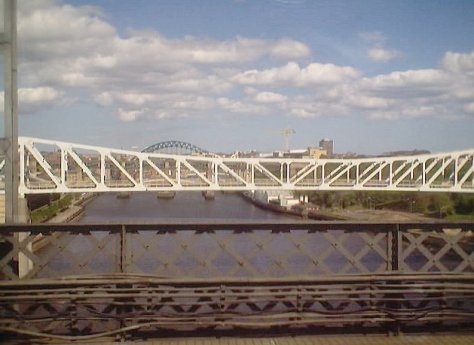
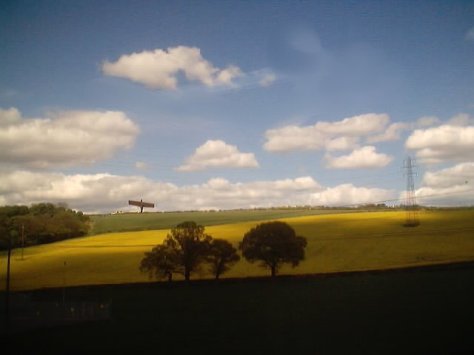
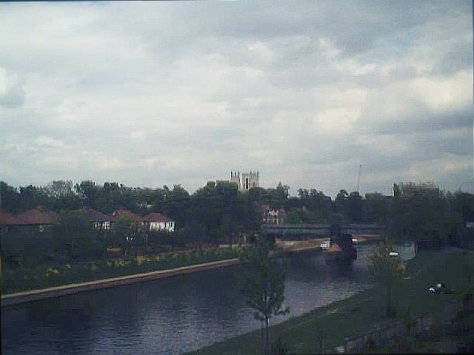
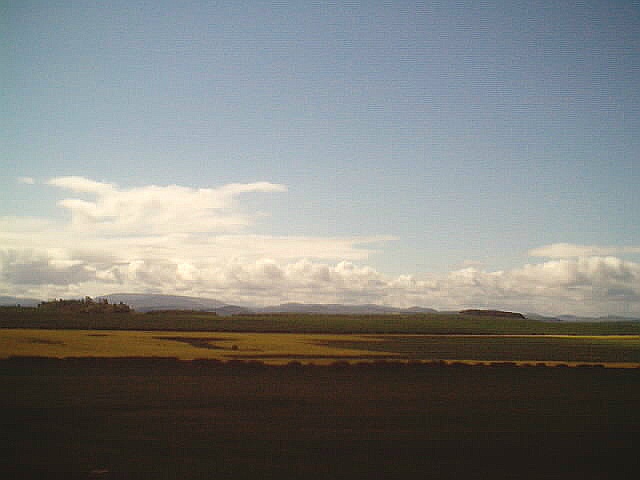
The East Coast Mainline follows roughly the same route as my bike trip, so as we flashed past various places I had been on the bike I took some photos through the window of the train.

The Tyne Bridges

The Angel of the North

York Minster – it is there honest

Having ate, drank and dozed my way back to London, I wheeled the bike out of King’s Cross Station onto the Euston Road ready to ride back home to Wallington. But… after a week of cycling on quiet back roads with about three cars per hour passing me, I decided that dicing with death and London traffic could wait for another day. So I wheeled the bike back to the station and onto the Thameslink train to East Croydon

The Galaxy on the train

I did have to cycle back from East Croydon, but I was up to that by the time I arrived.

The next morning I was up bright and early to make sure that I was at Heathrow in time to pick up a jet-lagged wife back from Toronto. We both had a good week.

Bike ride to Scotland: Part 6 Wooler to Duns

Day 6 – 09/05/2003 (Friday) Wooler to Duns

Friday morning dawned bright and clear over Wooler. After a breakfast of porridge and toast I set off on the last leg of the trek to Duns (and what should have been last night’s evening meal). I was now back in the part of the world that I grew up in, on roads that I cycled long ago.

It was an easy day, just under thirty miles to ride and while it wasn’t flat there were no serious hills or wind to contend with. I decided to take the back road via Ford and Etal crossing the Tweed into Scotland at Norham. For the first part of the journey (as far as Norham) I followed National Cycle Route 68 although I ignored the off-road bits. Once you climb out of the valley of the River Till there are spectacular views across to the Cheviot Hills. Just over half way I crossed the Tweed into Scotland.

Writing about the Tweed and the Till reminded me of a dark little poem that I learned at school. The Battle of Flodden was fought near here and I think that the poem has its origin in the aftermath of battle.

Says Tweed tae Till,
“Why dae ye rin sae still?”
Says Till tae Tweed,
“Though ye rin wi’ speed,
whaer ye droon ae man
A droon twa”.

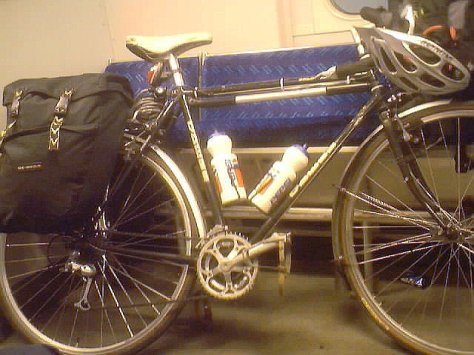
I was now in Scotland and took a photo of my bike to prove it

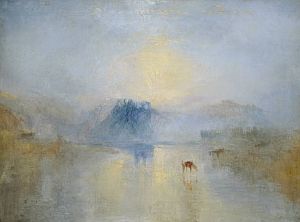
I forgot to take a picture of Norham Castle, so you will have to make do with Turner’s take on the scene.

After just over an hour’s ride through the rolling Berwickshire countryside I had reached my destination

By the time I had finished my shower and changed out of my cycling gear, Mum had lunch ready for me. It was a satisfying feeling to sit down to lunch knowing that I had cycled all the way from London to eat it. Later on my sister turned up with the pick-up to take Mum and I down to her house for dinner. I could have cycled there, it’s not much more than fifteen miles, but I was back wearing my normal clothes and I had done what I set out to do, so I put the bike in the back of the pick-up. Later on my brother and his wife turned up and we had a bit of a family reunion over my sister’s excellent food and probably a wee bit too much wine.

Cameron’s Tories are the wrong kind of right.

Tim Mongomerie editor of the Conservative Home* blog had a piece in yesterday’s Guardian in which he argues that David Cameron is not pursuing the right kind of right-wing policies.

I believe that Britain wants a party with rightwing policies but it wants a rightwing party that demonstrates a deep concern for the ordinary voter. In other words, we are talking about a party that occupies the common ground rather than some milk-and-water centre ground. A party of the common ground takes a tough approach to immigration, crime and welfare, but also wants to protect the NHS and look after the poor. Cameron should have aimed to turn the Conservatives into a rightwing party with a heart; instead he turned it into a leftwing party with cuts.

So a bit more like the UKIP or the BNP and a bit less like the LibDems then Tim?

*Excessive reading of this blog may cause an uncontrollable increase in blood pressure and a reduction in IQ