Fred Goodwin (aka Fred the Shred) is no longer Sir Fred Goodwin, but has become one of us again, albeit one of us with a £350,000 per year pension. The Queen has stripped him of his knighthood.
The Guardian reports:
Fred Goodwin, the former chief executive of the Royal Bank of Scotland, has been stripped of his knighthood by the Queen on the advice of the forfeiture committee.
It was awarded by the previous Labour government in 2004 for services to banking .
The London Gazette announced that he had brought the honours system into disrepute.
Goodwin has no right of appeal, and in accordance with custom was given no right to make representations to the forfeiture committee, a group of four permanent secretaries. The authority to rescind an honour rests with the Queen alone.
David Cameron said: “I welcome the forfeiture committee’s decision on Fred Goodwin’s knighthood. The FSA [Financial Services Authority] report into what went wrong at RBS made clear where the failures lay and who was responsible. The proper process has been followed and I think we’ve ended up with the right decision.”
I am not against him losing his knighthood, but I feel that it is just a token gesture. I agree with the sentiments expressed by a Unite spokesperson:
David Fleming, Unite’s national officer, said: “It is a token gesture to strip Fred Goodwin of his knighthood, but one which will be well received by the thousands of workers who lost their jobs during his rule.
What I am more bothered about is that Fred Goodwin is now the scapegoat for the banking industry. All the sins of the industry are now heaped onto his shoulders, and he has been loose in the desert. The banking system can the carry on as before, its sins suitably atoned for.
As I was driving home, listening to the news on the radio, another thought occurred to me as the pundits weighed in with their thoughts. Mr Fred Goodwin has not even been charged with a criminal offence, let alone convicted of anything.
This man was found guilty of perjury and perverting the course of justice and sentenced to four years in prison (of which he served two). He is still allowed to call himself Lord Archer of Weston-super-Mare, and (if he has the brass neck, which he probably has) can attach the words “The Right Honourable” to the front of the title.
So I am looking forward to hearing Eddie Mair open the PM programme with the announcement that “Jeffrey Archer has been relieved of his Lordship and is now to be known only as Mr Jeff Archer.”
This is the last Sunday in January, and I know that, in London at least, the temperature will probably drop below zero for the first time since about this time last year. The signs that spring is on the way are unmistakable though.
The Belgian sorry, World Cyclo-cross Championships have just taken place. In the cycling world this means that winter is almost past.
More to the point though, to-day was also the day that Le Grand Prix Cycliste La Marseillaise (L’Ouverture) took place. (The report and results link is in French.) For me, this marks the start of the cycling season and therefore the beginning of Spring.
Soon it will be Paris-Nice, Milan-San Remo, De Ronde Van Vlaanderen, Le Tour de France, all leading up to the Olympic Road Race in my back yard, on the roads that I ride week in, week out. Can’t wait.
Note: The domination by the Belgians (that’s a phrase that isn’t used too often) who took the first seven places, was only in the men’s championships. The women shared the honours around a bit more evenly, but even then, first and second were Dutch.
Further update 30/12/2011 16:30
GP d’Ouverture La Marseillaise 2012 – Highlights from France3
It is not going to be a theme of the blog, but I am diabetic and have been for about 25 years. Still as some one, probably my sister, once said to me; “John, diabetes doesn’t have to be a pain in the arse, there are lots of other places you can inject your insulin.”
All this is partly to explain why I found this video clip funny.
Still at least diabetics in the UK don’t have to spend half their lives arguing with Health Insurance companies. Well, for the time being at least.
A guy named Marcus Grimm made it. He blogs at Sweet Victory. His main theme is running marathons,
I’ll stick to cycling.
If someone can do a mash-up of the two of them it would make a perfect theme video for Team Type-1
Leonard Cohen has a new album out. The Guardian has it available as an album stream if you want a preview.
I have listened to it and can only say the man just gets better with age.
Leonard Cohen has an undeserved reputation as an artist who will cause you to slit your wrists. I find that he has precisely the opposite effect on me. He calms me down and helps me reconnect with reality.
The album can be heard here. There is also a link on the page to an excellent interview from Saturday’s Guardian.
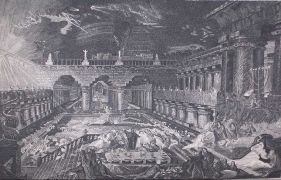
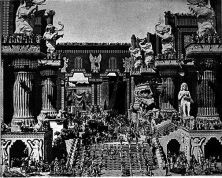
In the very early years of cinema DW Griffith more or less invented the Blockbuster Action movie with his films “Birth of a Nation” and “Intolerance”. The set designs for “Intolerance” clearly show John Martin’s influence. Compare the print of Martin’s painting “Belshazzar’s Feast with Griffith’s set design for a Babylonian scene in Intolerance.
(As always click on an illustration to see a larger version)
I remember reading somewhere that Griffith owned a good selection of Martin’s prints and did use them as source material for some of his sets. Unfortunately even in the age of Google I can’t find a reference.
Moving on to more recent events in the history of the cinema:
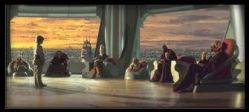
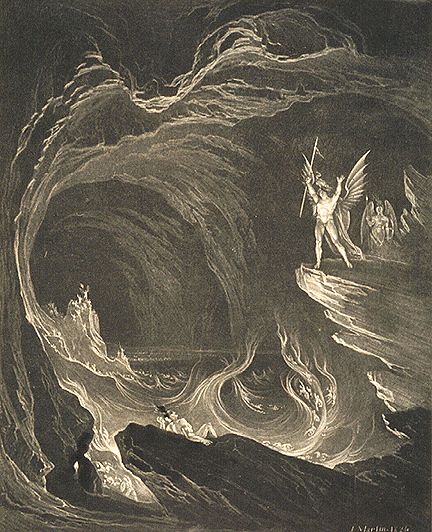
The scene in Star Wars I “The Phantom Menace” * where Anakin Skywalker is before the Jedi Council has clear echoes of John Martins “Paradise Lost” print entitled “Satan in Council.
There are many other examples that I could have chosen, but these two do as well as any to illustrate the hypothesis. Anyone who has seen Peter Jackson’s Lord of the Rings trilogy can see how Martins work influenced him.
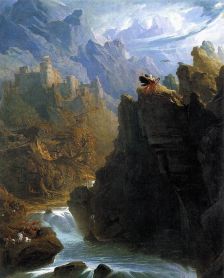
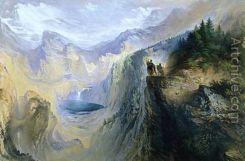
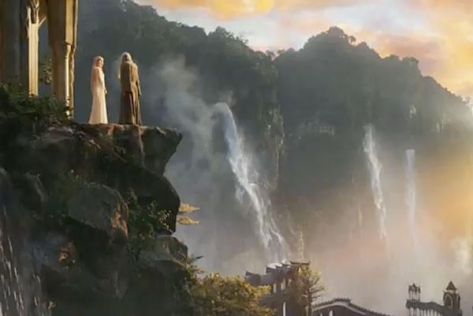
Two of Martin’s paintings “The Bard” and “Manfred on the Jungfrau” seem, to me at least, to have strongly influenced Jackson’s vision of Rivendell.
The BardManfred on the Jungfrau
Now compare these with a still taken from the trailer of “The Hobbit”.
Rivendell (Still from the Hobbit)
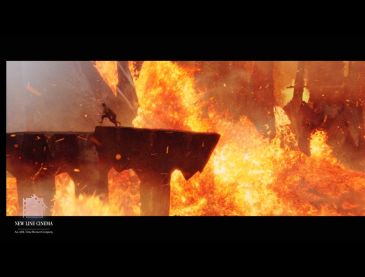
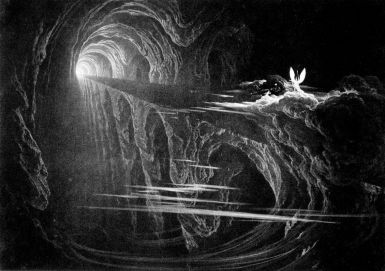
Also recall the scene inside Mount Doom shortly after Gollum fell to his death, taking the ring with him and Frodo and Sam made their escape across the rapidly collapsing bridge.
The influence of another “Paradise Lost” print “Bridge over Chaos” is obvious – to me at least.
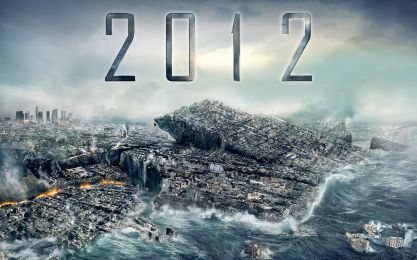
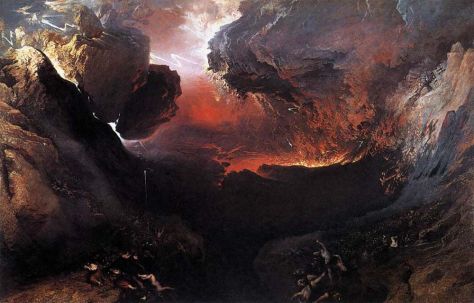
Almost every disaster movie ever made borrows its images to a greater or lesser extent from “The Great Day of His Wrath” with its vision of whole cities being cast into the flaming abyss. Take this still/advertising poster for “2012”.
Just to back up my reasoning The Tate made a short Sci-Fi/Disaster Movie influenced video to promote the show.
Disclaimer: I am not endorsing a film that stole £8.50 of my money and about two hours of my life under the false pretences that it had something to do with “The Empire Strikes Back”
I found this video on the Garmin Cycle Team’s website. I like the team’s ethos, especially the strong anti-doping stance. I like the way that are a team and not a bunch of riders who happen to wear the same jersey. I am also a great admirer of Jonathan Vaughters’ side burns.
Admittedly it is a bit of a puff piece, but I think it is worth watching.
Another review of an art exhibition just before it is due to close. I must try to get my act together next time.
The current exhibition at Tate Britain features the Cecil B de Mille of the early c19th Art World John Martin.
Portrait of John Martin by Henry Warren, 1839
John Martin was born on 19 July 1789 in Haydon Bridge near Newcastle. His family appears to have been fairly poor. He did not have much in the way of formal training in fine art. He was originally apprenticed to a coach painter. After the coach painter broke the terms of the indentures by failing in increase John Martin’s wages, he went to work for Boniface Musso, an Italian artist who had based himself in Newcastle. In 1806 he left Newcastle for London where he intended to establish himself as an artist. Initially he supported himself by working as a ceramic painter. (The only known ceramic by him is on display in Room 1)
Martin became known as a painter of the “Sublime” in other words as a painter of awe-inspiring and terrible scenes. He deliberately designed his paintings to stand out from the crowd in shows such as the Royal Academy and as such they took on what we would now see as a cinematic quality. Indeed his work can be likened to a block-buster action film, full of drama and possibly too many special effects. I’ll come back to this aspect in another post, because it is an area that I would like to explore in more depth.
I have liked John Martin’s work for a long time, in fact since the first time I saw his Last Judgement Triptych. His best paintings have a grandeur and a touch of madness about them that I love. However during his lifetime (and since) the criticism that his work is repetitive and displays good craftsmanship but not true artistic merit is often made. The charge of repetition especially, does have a basis. He painted a series based on Ovid’s Metamorphoses, and while I wouldn’t say the every painting is the same, there is more than a theme running through them. In addition the mountains in almost every painting that features mountains, from “Clytie” in 1814 through to “The Plains of Heaven” in 1854, are essentially the same, albeit very dramatic, mountains.
Notice any similarities between the paintings?
I can forgive him, he was a man from a poor background making his living by selling his paintings. He found a formula that sold and stuck to it. Like Albrecht Durer (1471 – 1528), another artist who relied on what he sold to keep body and soul together, he moved into printmaking. And although ultimately it was only marginally profitable and a major drain of resources, like Durer, he produced some of his finest work in this medium.
He was initially commissioned by Samuel Prowett to create a series of prints to illustrate John Milton‘s Paradise Lost. Later, inspired by Prowett’s venture, between 1831 and 1835 Martin published his own illustrations to the Old Testament.
His illustrations for Paradise Lost are quite stunning, I have included two below, but to see more follow the links.
Part of the reason for John Martin’s decline in fame, and possibly where some of the idea that he was a craftsman and not a painter came from, was that for the best part of a decade from the late 1820’s he devoted most of his time to trying to produce a solution to London’s sewage disposal problems. The exhibition includes some of his plans and proposals for the sewage system. They are beautifully drawn and to this (mechanical) engineer’s eye seem to be workable solutions. They were never executed in his lifetime. The authorities rejected his plans, deeming them to be too expensive. Although whether they would have been more expensive in the long-term than doing nothing is less clear. However when Joseph Bazalgette designed and built the London wide sewage system in the 1860’s (a system that is still largely in use today) He adopted and incorporated many of John Martin’s ideas.
The main focus of the exhibition are what are known as “The Three Great Paintings” or “The Last Judgement Triptych”. John Martin painted them in the period shortly before his death. He completed them in 1853 shortly before a stroke paralysed his right side. He never recovered and died on February 17, 1854.
The Great Day of His Wrath (1851-53)
“The Great Day of His Wrath” based on the passage from The Book of Revelation Chapter 6 vs12-17 shows Marin at his apocalyptic apogee. We see people, buildings, whole cities, and mountains being hurled to their destruction in a chasm of fire. Martin is stating his belief that nothing can escape the wrath of God and indeed it is futile to even try.
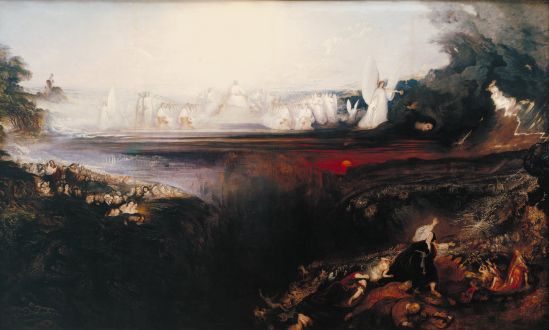
The Last Judgement 1853
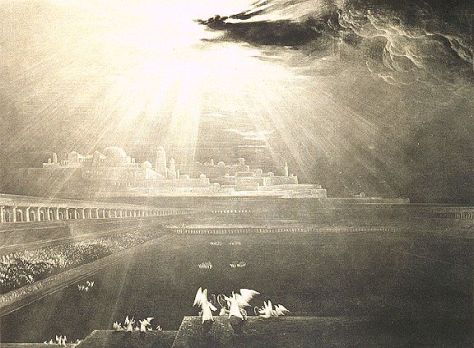
Again based on passages in the Book of Revelation, Martin allows himself to play at being the Last Judge, on the right hand of Christ (left hand side of the painting) are the elect, the chosen, who will live for ever, with God in the New Jerusalem. On the left hand, being thrown into the pit of fire, along with Satan and the Whore of Babylon are the damned. Among the chosen are the likes of Shakespeare, Milton, Isaac Newton and a few Kings that Martin approved of. Among the damned are Popes, and priests, a couple of Kings he disapproved of, and I think Oliver Cromwell. Originally there was an index to the painting naming both the damned and the chosen.
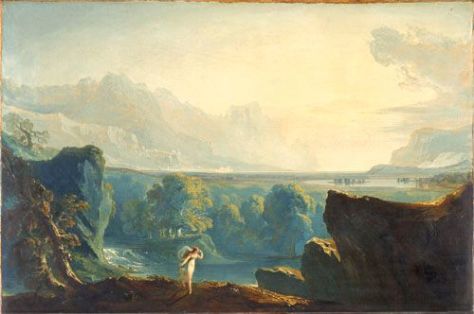
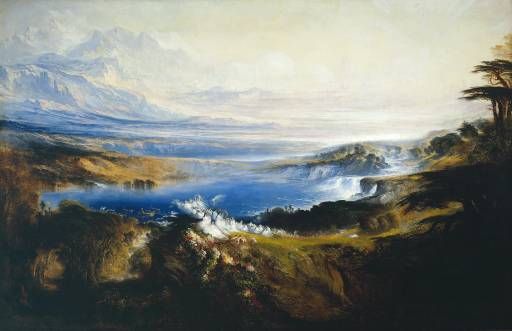
The Plains of Heaven 1851-53
This is the most serene and peaceful of the three paintings.It contrasts dramatically with “The Great Day of His Wrath” hanging on the other side of the central panel of “The Last Judgement”. Again a passage from the Book of Revelation is the inspiration, this time Chapter 21.
Then I saw “a new heaven and a new earth,” for the first heaven and the first earth had passed away, and there was no longer any sea. I saw the Holy City, the new Jerusalem, coming down out of heaven from God, prepared as a bride beautifully dressed for her husband. And I heard a loud voice from the throne saying, “Look! God’s dwelling place is now among the people, and he will dwell with them. They will be his people, and God himself will be with them and be their God. “He will wipe every tear from their eyes. There will be no more death or mourning or crying or pain, for the old order of things has passed away.”
Martin has produced his vision of paradise. In the foreground wearing white we see the chosen. Behind them is a deep blue heavenly lake, filled by the waters of rushing rivers and waterfalls. Majestic snow-capped mountains surround the scene, and in the background a faint, almost ghostly New Jerusalem descends to Earth.
The three paintings became famous in the years after John Martin’s death. The paintings toured widely both in Britain and the United States. They were described as “the most sublime and extraordinary paintings in the world” and valued at over 8000 guineas. Typically the exhibition would include a diorama and narration. The Tate puts on a modern take on this, projecting computer graphics onto the paintings. This makes the paintings seem as if they are backlit. The computer graphics are obviously capable of effects that the Victorians using gas lamps couldn’t manage, but the narration seemed authentically contemporary and suitably over the top.
Although prints of the paintings sold in large numbers, John Martin’s style of vast and dramatic paintings now seemed outmoded to the mid and late Victorians. The paintings themselves never found a buyer and by the 20th century his work had fallen into complete obscurity. When his painting of “The Destruction of Pompeii” was badly damaged in a flood in 1928, it was not considered to be worth restoring. The Last Judgement paintings were sold in 1935 for seven guineas.
This is a summary of what I have done on the blog in 2001 and what you have read.
The WordPress.com stats helper monkeys prepared a 2011 annual report for this blog.
Here’s an excerpt:
A New York City subway train holds 1,200 people. This blog was viewed about 3,900 times in 2011. If it were a NYC subway train, it would take about 3 trips to carry that many people.









 A Scotsman in Suburbia