Tour de France 2011 – Part 2: Rest Day Reflections

Tour de France Logo

My original intention was to post my thoughts on the Tour daily, but life got in the way. So these are my thoughts on the first nine days

Stage 3

Stage three from Olonne-sur-Mer to Redon was the first of this years tour that offered an opportunity to the pure, as opposed to uphill sprinters. It followed a fairly predictable pattern, an early break by a few riders from French teams and/or Vaconsoliel, steadily reeled in by Garmin and HTC, with some help from other teams. I suppose that it was also fairly predictable, that being his first opportunity at a stage win, things didn’t go quite right for Mark Cavendish aka “The Fastest Man in the World”©. I’m not sure if Garmin successfully disrupted his lead-out train, or whether HTC just messed it up, but either way they failed to deliver him at the 200m to go sign the way they normally do. Garmin have clearly worked out who is going for what sprint and the Maillot Jaune Thor Hushvod, who no longer has the absolute top end speed of a flat-land sprinter, gave Tyler Farrar a perfect lead out to take his first ever individual stage win in the Tour de France.
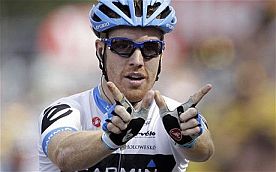
Tyler Farrar wins Stage 3

About six weeks ago Tyler Farrar’s friend and training partner Wouter Weyland was killed in a horrific crash at the Giro d’Italia. Tyler dedicated the stage win to his memory.

“Cav” also ran into an almost inevitable conflict with the Race Referees. At the intermediate sprint, both he and Thor Hushvod were trying to get the same wheel, with the inevitable bit of pushing and shoving. Neither of the riders thought much about it, and it looked fairly innocuous to me, but the referees thought otherwise and disqualified them both from the sprint and fined them 200 SFr.

Stage 4

Stage 4 finished on the Mur de Bretange which is a beast of a hill in the middle of Brittany. It is about 2km long and ramps up at around 8 to 10%. So http://www.slipstreamsports.com/garmin-slipstream-pro-team/pro-men/thor-hushovd was widely tipped (including by himself) to lose the maillot jaune. It was a stage made for the type of rider who excels in the Ardennes classics. I other words Philippe Gilbert. It didn’t work out as expected though.

The peleton caught the inevitable breakaway a bit before the serious bit of the race. When it cane to the Mur a few riders had a dig including Gilbert and Contador but the guy who hung on to win by about a tyres width was Cadel Evans. Considering the length and the quality of his career I was slightly surprised to find that this was the first ever stage win in the Tour de France. Climbing out of his skin and into sixth place, in the same time as the winner was the MIghty Thor, holding on to his yellow jersey for another day.

Stage 5
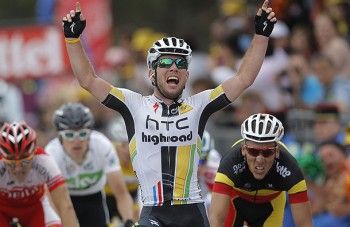
Stage 5 took us from Carhaix to Cap Fréhel we were still in Brittany, narrow winding roads cross winds and lots of opportunities to crash. The stage was sort of sprinters stage, but the finish was again uphill, not as long and steep as yesterday, but steep enough to make it difficult for the flat-earth sprinters. Mark Cavendish decided to prove the organisers wrong. I’m not sure where he popped up from, but in the midst of a bunch of uphill sprinters like Phillipe Gilbert and Edvald Boassen-Hagen “Cav” popped up to take the stage.

Stage 6

Stage 6 took us from Dinan (in Brittany) – Lisieux (in Normandy). It was another uphill finish. Mark Cavendish and Tyler Farrar must be wondering exactly what they have done to upset the organisers of the Tour de France.

The stage was notable because it was the first stage won by a British team for 43 years, not as long as the wait to win Wimbledon or the World Cup, but up their with them. A slight pity then that the winner was a Norwegian riding for Team Sky. Edvald Boassen-Hagen was perfectly set up for the stage by Geraint Thomas and took the win well. Oh the other Norwegian on the tour took third on the stage and kept the maillot jaune for another day.

Stage 7

Stage 7 ran from Le Mans to Châteauroux . Chateauroux was the scene of Mark Cavendish’s first ever stage win in the Tour de France, so would anyone like to guess what happened. Correct, HTC with all nine riders on the front gave Cavendish the perfect lead out, dropping him off with about 200m to go and he finished the job. It was probably made slightly easier because a crash delayed Tyler Farrar, the only other sprinter in the same league as “Cav”, wasn’t around to contest the sprint.

Thor Hushvod finished 7th and kept the lead for yet another day

Other news from a British perspective was  that Bradley Wiggins had to abandon, following a chute which left him with a broken collar-bone. This was a big disappointment as was in excellent form. I don’t think he would have won the race, but he would have challenged for a place on the final podium.

Stage 8

Stage 8 from Aigurande to Super-Besse Sancy was supposed to be the stage when the favourites showed their hand for the first time, and it was definitely the stage that would finally see Thor Hushvod relieved of the Maillot Jaune. The Moyen Montagne of the Massif Centrale was supposed to be too much for him, the first Category 2 climb of the tour and then the climb up to Super Besse should surely see him out the back.
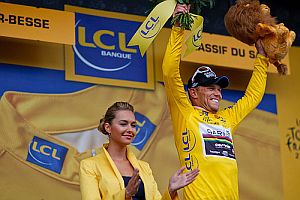
Thor Hushvod Yellow @Super Besse

Yet again this didn’t happen. The favourites were understandably a bit reluctant to blow their brains out for gains that would be insignificant when the real mountains arrive in the middle of the week. and Hushvod well supported by his team, finished comfortably with the leaders yet again.

Stage 9

A crash strewn Stage 9 from Issoire to Saint-Flour was the day that Garmin-Cérvelo and The Mighty Thor ran out of luck. A massive pile up on the descent from the Puy Mary saw Alexandre Vinokourov, Jurgen Van den Broeck, his team-mate Fredrik Willems and Garmin-Cervélo’s Dave Zabriskie all forced to abandon. Later on to wards the end of the stage a piece of what at best could be described as thoughtless driving by a French television car took out two of the riders, Juan-Antonio Flecha and Johnny Hoogerland, in the winning break. Flecha seemed to get away comparatively minor with cuts and bruises, but Hoogerland was pitched into a barbed wire fence.

Garmin’s original tactics had been to put David Millar into the break which everyone knew would include Thomas Voekler. This would have had two effects. First it would have put the onus on the other teams to chase and secondly as Millar was only 8 seconds off the lead himself, it would have discouraged Voekler as Millar would have inherited the Yellow Jersey if the break had made it to the finish. Unfortunately Millar had a minor fall and was still being patched up behind the peleton when Luis Leon Sánchez (who won the stage), Voeckler, Sandy Casar, Hoogerland, and Flecha took off.

The crash on the Puy Mary caused the peleton to declare a temporary truce to allow the riders caucht behind the crash to get back on, and by the time the truce was declared over the break’s lead had gone out from a manageable three minutes to round about ten. In addition Thor’s man for pulling back the breaks, Dave Zabriskie, was in an ambulance with a broken wrist. So after a full week on Thor’s shoulders the Maillot Jaune passed to Thomas Voeckler. The last time he held the jersey was in 2004 he kept it for ten days. His dogged determination to keep it turned him into the most popular rider in France. I doubt he will hold it for that long this time, but he should keep hold of it until The Pyrenees.

Rest Day

The first nine days have already shaped the Tour quite a bit. Two riders(Bradley Wiggins and Jurgen Van den Broeck) who had legitimate aspirations of standing on the podium in Paris are out. Alexandre Vinokourov a rider who does shake things up with his attacks is also out. Other contenders such as Andreas Kloeden, and Alberto Contador have been involved in crashes, Contador more than once. The problem with this is that even though the damage is limited to a bit of road rash, every time you come off it takes a little more out of you. The Schlecks and Cadel Evans have both escaped so far.

In my opinion the two main stories so far have been Thor Hushvod’s defence of the Maillot Jaune and Phillipe Gilbert’s attempts to win the Green Jersey and stages. The Green Jersey competition looks like a three-way fight between him, Mark Cavendish and Jose Joaquin Rojas. Cavendish is the best sprinter, Gilbert can pick up points on more hilly stages, but probably not in the high mountains, Rojas can do a bit of both, but isn’t as good as Gilbert in the hills and isn’t as fast as Cav in the sprints. Thor Hushvod shouldn’t be ruled out either. If you asked me to place a bet my money would be on Cavendish, but I would want decent odds.

As regards the General Classification, from what I have seen so far, my judgement is that Contador is not at 100%, Andy Shleck hasn’t tried anything so far but has covered any moves without apparently breaking sweat. Cadel Evans looks close to his best form, has been aggressive, without wasting too much energy, and generally looks up for it.

My men for the podium in Paris (barring accidents or illness) are those three, but I wouldn’t be too surprised if someone like Nicholas Roche or Tom Danielson sneaks onto the bottom step.
Billy Bragg on Murdoch Phone Hacking and the rest

Billy Bragg makes some very pertinent musical points about the Murdoch Empire:

The background (if you don’t know the story already) to his chorus line “Scousers never buy the Sun” is the virtual city-wide boycott of the Sun that has held for over twenty years. Following the disaster at the Hillsborough Stadium in which 96 Liverpool fans were killed, the Sun published various disgusting and untrue allegations about the conduct of the Liverpool fans at the game. This article gives the background

Rupert Murdoch, Phone Hacking and Press Regulation

Will Cookson has an interesting post on media regulation, where he argues against our current media ownership rules. He says;.

We need to look at the ownership rules of the media for our country. They are not like other goods and services. They can strike at the root of our democracy. If someone like Rupert Murdoch can summon senior politicians at short notice to the other side of the world because of his power then that is bad for democracy.

The media should only be allowed to be owned by UK citizens resident in this country. Political parties are no longer allowed to receive gifts from overseas residents and the same should apply to the media ownership.

Not that much for me to disagree with there, though drafting legislation in such a way that it cannot be challenged (especially under EU competition law) will be difficult. Plus all our main political parties and the City do not think that nationality of ownership is anything that we should worry about. Convincing them otherwise without voting for a UKIP or a Socialist Workers Party government at the next election will be difficult.

Where I tend to disagree with Will  is on his proposals for regulation, which I think have implications around freedom of the press, and freedom of speech in general. He says;

We must have an external independent ombudsman for the media whatever the media throw at the politicians (and be prepared for some very nasty stories about politicians with innuendo and smears in the early autumn).

Newspapers have always been the tools and playthings of the rich and powerful. Owners in the past like Lord Beaverbrook and the Rothermeres  (owners of the Daily Mail) have always used their publications to persuade, bribe (by granting or withholding support) and if necessary bully governments into doing their bidding. Whether Rupert Murdoch has a larger and more insidious influence is a moot point

I am sure that journalists on the past bought information and were on far too friendly terms with various police officers. They didn’t hack mobile phones (they didn’t exist), but probably had ways of tapping landlines if they thought that the story would be worth the risk. But the sins of the past do not excuse the sins of the present day.

Even phone hacking gets a bit tricky. I don’t want my mobile hacked. I don’t want Milly Dowler’s parents’ phones hacked. Neither do I want the phones and emails of relatives of service personnel killed in Iraq and Afghanistan hacked. But, say a newspaper has very tenuous evidence that a senior politician is accepting bribes to influence the placing of government contracts , would I worry if the newspaper hacked his or her phone as part of their investigation?

The hard question is what to do about it. It is without doubt that what happened at the News of the World was beyond the competency of the Press Complaints Commission as it is presently set up. The PCC does valuable arbitration and conciliation work and it needs to carry on doing it, but without increased powers it should drop the pretence that it is a regulator.

A truly effective regulator has to have the powers to stop a story being published in the first place. Our ridiculous libel laws (“super-injunctions”) are often used by celebrities to just that end. The publishing of a story , or putting a celebrity adulterer’s name to a twitter #hashtag. puts the information into the public domain. Taking it back is impossible. The regulator can do nothing other than deal with the complaints.

The idea of a state appointed “independent” press regulator worries me. Would a state appointed regulator have allowed the Daily Telegraph break the story of the MP’s expenses scandal? MP’s, and probably not just the guilty parties, would have complained to the regulator and asked for the suspension of the story. The Telegraph bought the information. The information, was probably stolen. I think that an independent regulator would have prevented the Telegraph publishing the story.

How far will the press regulators powers go? Will every story in every newspaper need submitting to him or her before publication? If not, what will be criteria that triggers the need for submission? If a newspaper (or other outlet like say a blog) publishes an unsuitable story what powers will the regulator have to correct them? Will the regulators powers only apply to newspapers, or will they extend to include all publications? If the regulators powers cover all publications, will I have to send my blog posts, will they come back with the spelling and grammar corrected and will the regulator reading my blog posts show up in my statistics? Do we want to regulate unsuitable stories or just unsuitable methods of journalism?
We must have these, and probably more questions satisfactorily before we head down this path.

I think that keeping press regulation voluntary, with the PCC having increased powers to demand retractions and insist on the positioning of the retractions within the newspaper, and possibly even suspending a publication in the worst cases might work. If, as is currently the case with the Express group newspapers, they refuse to be bound by the PCC rulings then OFCOM will take over their regulation. OFCOM has the powers to insist that the owners of a non compliant company sell their stakes in it (at a loss if necessary).

Oh, and applying the law, not just to “rogue” reporters, but extending culpability to those who employ them.The possibility of the Rupert and James Murdoch, Andy Coulson and Rebekah Wade, spending some time behind bars would really get the attention of the owners and editors of newspapers. I understand that the instances of phone hacking have dropped to round about zero since Glenn Mulcaire and Clive Goodman were jailed.
I am also sure that it is against the law for police officers to pass confidential information to third parties, with or without money changing hands. If the law needs clarifying then clarify it, but again applying the law will be more effective.

The Space Race is Over

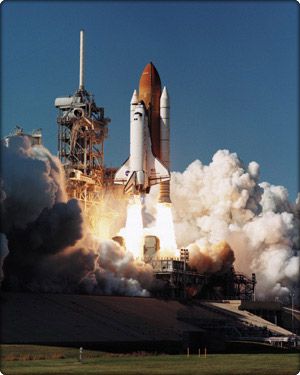
Today(8th July) at 15:26 (GMT), assuming that the weather holds, the Space Shuttle Atlantis will blast off on the last Space Shuttle mission ever.
Space Shuttle Launch
I grew up in the fifties and sixties when space exploration was on the cutting edge of technology (hence the term “rocket science”) and adventure. I remember the Earth rise photograph taken from Apollo 8. I remember crowds of people in front of a shop window watching Neil Armstrong take his first steps on the moon. I remember the drama of Apollo 13 and the relief when the astronauts landed safely.
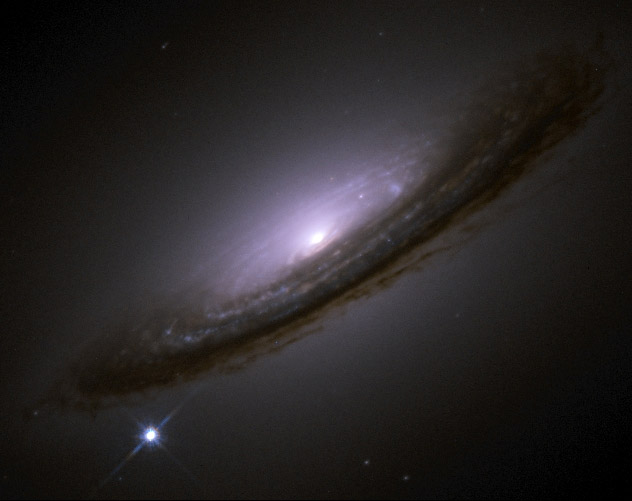
The Space Shuttle programme was never going to be as exciting, but in many ways it was probably more important. The tragedies of Columbia and Challenger should never be forgotten, but neither should we forget the advances in knowledge that we gained from the Space Shuttle programme. Above all it brought us the Hubble Space Telescope which as well as advancing our knowledge of the universe and its origins brought us some of the most beautiful photographs ever taken.
I think it is interesting to note that the laptop I am typing this on probably has more computing power than was available to the first shuttles.
I know that the Space Shuttles are probably more or less worn out and that trying to keep them in service and safe would probably bankrupt NASA, but this saddens me, probably because one more connection to the hopes and dreams that I had as a child has been severed.

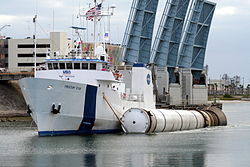
Freedom Star

I also have a tenuous connection with the Space Shuttle programme. Back in 1983, I was on a ship called the Petite Forte. We were laid up in Jacksonville. Berthed on the other side of the dock were the tugs that recovered the reuseable rocket boosters. During the four months that I was there I became quite friendly with the crew of the two ships the Freedom Star and the Liberty Star.

Billy Bragg sums all of my feelings up, better than I can in this song;

Tour de France 2011 – Part 1

Tour de France Logo

Prologue

Well there isn’t a prologue this year. So you will have to make do with my musings on what is going to happen.

The GC (General Classification or Yellow Jersey) is I think it is a straight fight between Alberto Contador (Spa) Saxo Bank Sungard (last years winner) and Andy Schleck (Lux) Leopard Trek (last years runner-up). Schleck probably is a slightly better climber than Contador and has a stronger and more experienced team, (you don’t get stronger than Fabian Cancellara or more experienced than Stuart O’Grady and Jens Voigt), but Contador proved in 2009 that he can win without a team, or indeed with a team gave that appeared to be actively working against him. Contador is by far the best individual time trialist. The Team Time Trial is fairly short so no team (except possibly Euskatel) should lose too much time.

Who is going to win? I don’t know, but I will be very surprised, barring accidents or an early intervention by CAS, if Contador and Andy Schleck are not on the top two steps. The third step could be occupied by any one of about ten riders, Bradley Wiggins, Jurgen Van Den Broeck (Bel) Omega Pharma-Lotto and Cadel Evans (Aus) BMC Racing Team among the candidates.

The Points Competition (Green Jersey) has a new format this year with only one intermediate sprint per stage and not the two or three that there were in the past.. The other big difference is that the intermediate sprint is now worth 20 points to the winner with points going down to the first fifteen riders across the line. This means that anyone who wants to win the competition will have to go for the points at the intermediate sprint, unlike in earlier years when the overall contenders could rely on a breakaway mopping up the intermediate points and only have to worry about the final sprint. On paper the favourite to win the green jersey is Mark Cavendish, but he has a habit of sitting up in a sprint when he knows that he has been beaten, thus dropping points by finishing tenth when he could have been second or third. Thor Hushvod has stated that the Green Jersey is not his aim this year, so I think that it could well end up on the shoulders of his team-mate Tyler Farrar.

The King of the Mountains Competition (Polka Dot Jersey)has in recent years become a completion fought out by French riders who got themselves into early breaks and hoovered up the points available before the GC contenders started racing properly in the latter stages of the race. Like the Points competition the scoring has been altered this year, with fewer points available on the lesser climbs. This is possibly to discourage the opportunist French breakaway riders and encourage some of the bigger names to make it a goal if they lose time in the GC. Having said that I would like to see David Moncoutie (Fra) Cofidis win.

Stage 1

Saturday’s stage, unusually wasn’t a prologue time trial, but a road stage with a reasonably steep uphill finish. Philippe Gilbert was such a short-priced favourite for the stage that one Belgian punter was heard to remark that it would probably cost him money even if Gilbert won. Surprisingly enough Philippe Gilbert did win it and in style. His team controlled the race well into the finalé, including an amusing to watch, although probably not to do, 100m turn on the front, uphill, by André Griepel. Fabian Cancellara attacked with about 500m to go, forcing Gilbert to go probably a bit earlier than he had planned, but if Spartacus goes, you have to go with him if you want to win. Gilbert caught him and sat on for a few seconds to see what was going to do, then went himself. Cadel Evans tried to bridge across but didn’t manage and came second, with Thor Hushvod coming third and setting himself up nicely for an attempt at the yellow jersey in the following days team time trial.

The other incident that shaped the day, and could yet shape the tour was a mass pile up with about 10k to go. A spectator got too close to the action and caused an Astana rider to crash , bringing half the peleton with him. Alberto Contador although not actually involved, was caught behind the crash and lost about a minute and a half to his rivals.

Stage 2

The second stage of this years Tour de France was the Team Time Trial. Jonathon Vaughters the owner/manager of Team Garmin-Cervélo has tried to win a stage of the Tour de France for the past three years. In addition he has a bit of an obsession with the Team Time Trial. This is probably due the fact that one of the highlights of his career as a cyclist was winning the Team Time Trial stage in 2001 when he was a member of Roger Legay’s Credit Agricole team.

It all worked out perfectly for him and the team. They won the stage by 4 seconds and moved Thor Hushvod out of his world champions rainbow strips into the Maillot Jaune, though today he was rather incongruously wearing the polka dot jersey of the leader of the King of the Mountains competition. If you want to know why I suggest that you read the minutiae of the Rules & Regulations of the Tour de France (in French).
This is link is David Millar’s reaction to the win

Below is Johnathan Vaughter’s reaction.