You think that concern about Global Warming is a new phenomenon? Think again.
From Climate Progress

You think that concern about Global Warming is a new phenomenon? Think again.
From Climate Progress
My mother has somewhere in her photo box this photograph of her great-grandfather (or my great-great grandfather) William Elliot. He was born (probably) in 1817 and died in 1897 . I don’t know exactly when it was taken, but he looks to be around sixty so I think it was probably 1880 give or take five years. It was around that time several of his sons emigrated to New Zealand, so my guess is that it was taken in order that they would have a memento of him.
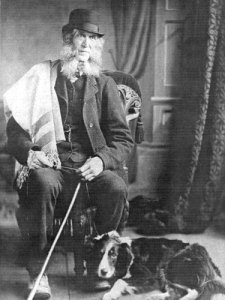
Looking at William Elliot’s photograph the thought occurred to me, that this may well have been the only photograph ever taken of him. I find it to be a powerful and evocative image. It is carefully composed, and although I am sure he is wearing his Sunday best, it includes elements that show that he was a shepherd, his dog, his crook, and he has his plaid over his shoulder. It would also have been costly to produce. I have no idea exactly how much, but my guess is at least a days wages and possibly more than a weeks. It is a valuable image in every sense of the word.
Do we still make valuable images, in the sense of images that are worth valuing, today?
As the digital camera, either as a standalone device, or built into our mobile phones, became ubiquitous the volume of photographs taken has since multiplied by a factor of gazillions.
When I was a child, being allowed to take a photograph, with mum and dad’s camera was an unusual event. I might waste a shot by taking a picture of my finger. That wasted shot still had to be processed and paid for. Today four-year olds happily snap away with mum’s digital camera, because we know that we can just delete any and every image that doesn’t work and keep the one or two that we find amusing.
In all of this we have, I think lost sense of the value that a photograph can have. We rarely take time to compose photographs, we just snap away, knowing, hoping, that one of the 6035 images on the SD Card might just be worth keeping. I don’t think that we in general even think about what we are photographing, and I am not even convinced that we even look at, let alone look properly at the images we produce.
Quite a while ago, before I owned a digital camera, I was sorting through a pile of snapshots that I had taken on holiday. I found that I could barely identify the location of quarter of them. I made a conscious decision that day to take less photographs and make more sketches. When I look back through my sketch books I can recall exactly where I was when I made that sketch. I can remember what was happening around me, and what I was feeling at the time. Because I took ten minutes to sit down and actually look at what I was recording, rather than two seconds to push a random shutter.
I’m not saying don’t take photographs, I still take, I might even say make, but that sounds a bit pretentious, photographs. I know that there are some things that can’t be easily captured in a sketch but are caught in a photograph. What I am saying is look at what you are photographing before you take it. Look at the result after you have taken it. Exercise some kind of quality control before you dump the latest batch of photos on Facebook or Flickr. Possibly restrict the number of shots you allow yourself to take to say 20 per day to force yourself to choose your subject.
If you do manage to produce a valuable image, get it printed, because my mother’s copy of William Elliot’s photo will still be around when my digital copy as vanished into hyperspace.
The Guardian had an article recently which basically asked people whether they thought they were middle-aged or not. This caused a debate in our house because I do think of myself as middle-aged whilst my wife, who is actually slightly older than me, does not. So how to define middle age. If we take the biblical three-score years and ten then the middle of your life would be at thirty-five years. If we divide our life up into three segments, young, middle-aged, and old the we see that you would be young from birth to twenty-four, middle-aged from twenty-four to forty-six and old from then until you pop your clogs. This won’t do as a definition, because that makes me old, and I’m not old, I’m middle-aged.
Even if we use modern life spans of say ninety years, it still wont do, because that will make me old in four years time, and I have no intention of being old in 2015. So I propose the following; you are a child/young adult till you leave school, you are officially young till you reach forty, the you become middle-aged until you are seventy, and after that you are old. Either that or you are middle-aged if you feel middle-aged.
Officially admitting you are middle-aged releases you from all sorts of burdens that the young suffer from. You no longer have to follow the trends of fashion. If you find that a jumper and a pair of jeans is what you are comfortable in, then when the ones you have been wearing for the past five years wear out, the all you need to do is buy replacements, as similar as possible to the ones you (or more likely your partner) have just thrown out. The freedom from the strictures of fashion also mean that you are free to buy a pair of jeans from a shops ‘value’ range at £9.99 rather than paying through the nose for a designer label.
An aside:
As a good Trade Union member, I am concerned about the conditions that the workers in third world clothing factories are forced to work under. I also think that in general we pay far too little for the clothing we buy. However when I see that a shop’s value range jeans at £9.99 per pair and the same shop’s designer range at £59.99 per pair are made in the same country, and possibly the same factory, I think I am entitled to assume the £50.00 difference in price is not going to the seamstress in Bangladesh.
Back to the joys of middle age. If you have accepted that you are middle-aged, you have probably also accepted the life that you have. Your mortgage is either paid off or as good as. You have probably decided that you are reasonably competent at your job, but feel no great desire or need to constantly prove yourself or to push for promotion. No you are happy to continue doing a fair day’s work for a fair day’s money, without over extending yourself, for the next ten or so years until you retire. If you are still young, this seems like a recipe for boredom, if you are middle-aged it is a recipe for contentment.
I read this in today’s Observer
Gazan youth issue manifesto to vent their anger with all sides in the conflict
Gaza Youth’s Manifesto for Change is an extraordinary, impassioned cyber-scream in which young men and women from Gaza – where more than half the 1.5 million population is under 18 – make it clear that they’ve had enough. “F**k Hamas…” begins the text. “F**k Israel. F**k Fatah. F**k UN. F**k UNWRA. F**k USA! We, the youth in Gaza, are so fed up with Israel, Hamas, the occupation, the violations of human rights and the indifference of the international community!”
Here in Gaza we are scared of being incarcerated, interrogated, hit, tortured, bombed, killed,” reads the extraordinary document. “We are afraid of living, because every single step we take has to be considered and well-thought, there are limitations everywhere, we cannot move as we want, say what we want, do what we want, sometimes we even can’t think what we want because the occupation has occupied our brains and hearts so terrible that it hurts and it makes us want to shed endless tears of frustration and rage!
The text ends with a triple demand: “We want three things. We want to be free. We want to be able to live a normal life. We want peace. Is that too much to ask?”
This seems to me a perfectly reasonable response to the situation that they find themselves in. What I want to know, and can’t quite work out is what can I do to help them achieve their demands?
http://www.youtube.com/v/oawfn73Va6M&hl=en_US&feature=player_embedded&version=3
 A Scotsman in Suburbia